
This is a picture of what it holds.
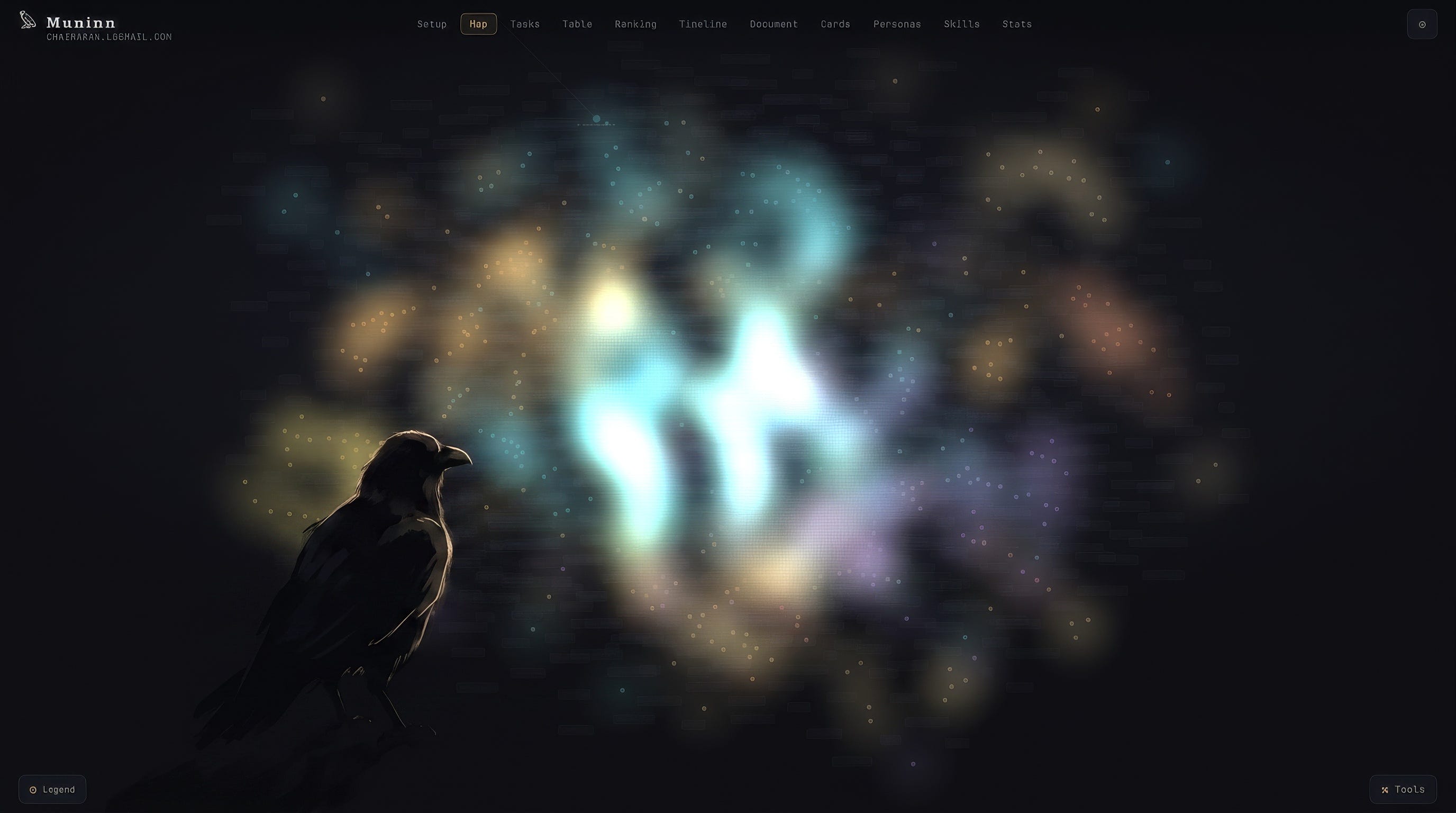
Every memory I have given it, in one view. The colors are separate parts of my life. The bright spots are where I keep returning. This is not a demo. It is the memory Muninn was built with, the one that carried its own making across hundreds of sessions.
I showed you this field once. Then it held three hundred and thirty-one things. Now it holds seven hundred and ninety-three. Eleven hundred tags. Eleven separate parts of my life, kept at once, none of them bleeding into the others.
This is part of a book I’m writing in the open, AI Has No Morality. It Has Yours. Subscribe to get each piece as it goes out.
The count is not the change. Look at the lines.
There are two hundred and ninety-seven of them now, running between the dots. When I first showed you this, it was a field. Each memory sat by itself and I read them one at a time. It is not a field anymore. It is a web. Every memory sits inside a small net of the ones it touches, and when I reach for one, the ones around it come up with it. A list hands you a row. A graph hands you the row and the neighborhood it lives in.
I built this. The system is called Muninn, after the raven. I showed it to you in May, when it was a map, a list, and a way of reading my own entries back. Most of what follows did not exist then.
What it already did
If you did not read the first piece, here is the short version of what this thing already does, before any of the new part.
Shows the whole memory as one map, and lets me open any single dot and read the entry in full, as it was written.
Lays every memory out as a plain list I can search, sort, correct, and delete. Nothing filed where I cannot reach it.
Ranks the memories by what I actually keep reaching for, not by date, so I can see the order it would surface first and argue with it.
Puts time on its own track, one lane per part of my life, so I can see where my attention really went.
Keeps a card on every person I have written about, and pulls what it knows before I write back to them.
Lets me export all of it and carry it out.
Everything above was true a month ago. Since then two things changed. One in the world, one in the tool. The world first.
Everyone remembers you now
While I was building this, every major assistant learned to remember you. ChatGPT keeps a profile. Claude does. Gemini does. Teach one your name, your work, your habits, close it, come back, and it knows.
So remembering stopped being the thing. When all of them do it, the question moves. It is not whether it remembers you. It is whether the memory is yours.
You can open most of them and read a list of what they saved. That is real, and it beats nothing. But you cannot pour it into a shape of your own. You cannot carry it out and keep a copy. And it cannot walk over to the assistant next door. Each one is a way for a company to hold you, not a thing you get to hold. That last part is what this is about.
It holds more than a profile
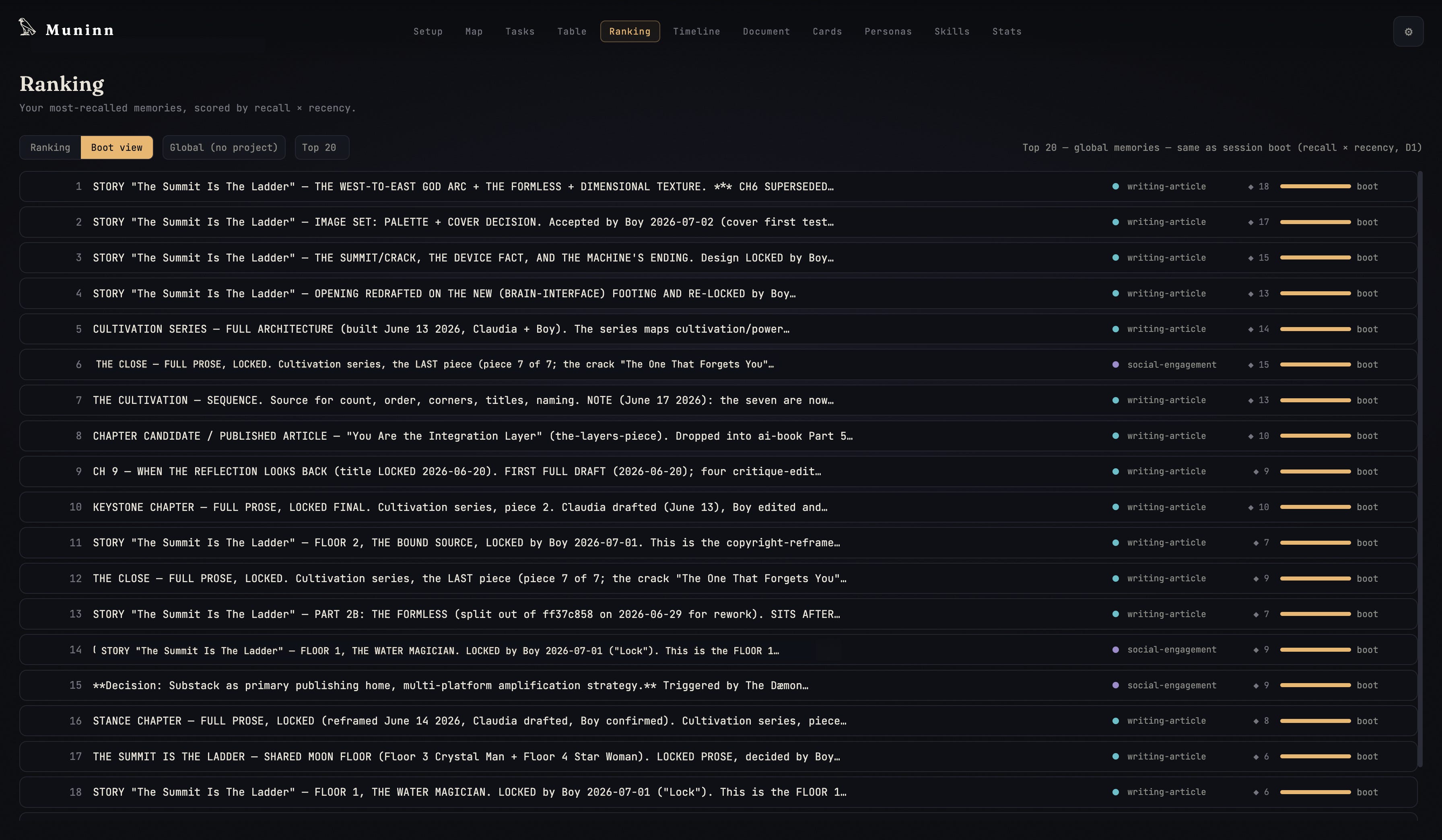
When I open a new conversation, it does not start cold. In one call it hands the machine who I am, the rules I write by, where we left off last time, and, near the top, the handful of memories I keep coming back to. Not the newest ones. The ones I actually reach for. It watches which entries I open and moves those to the front, and I can see that ranking for myself and move something when it leads with the wrong thing.
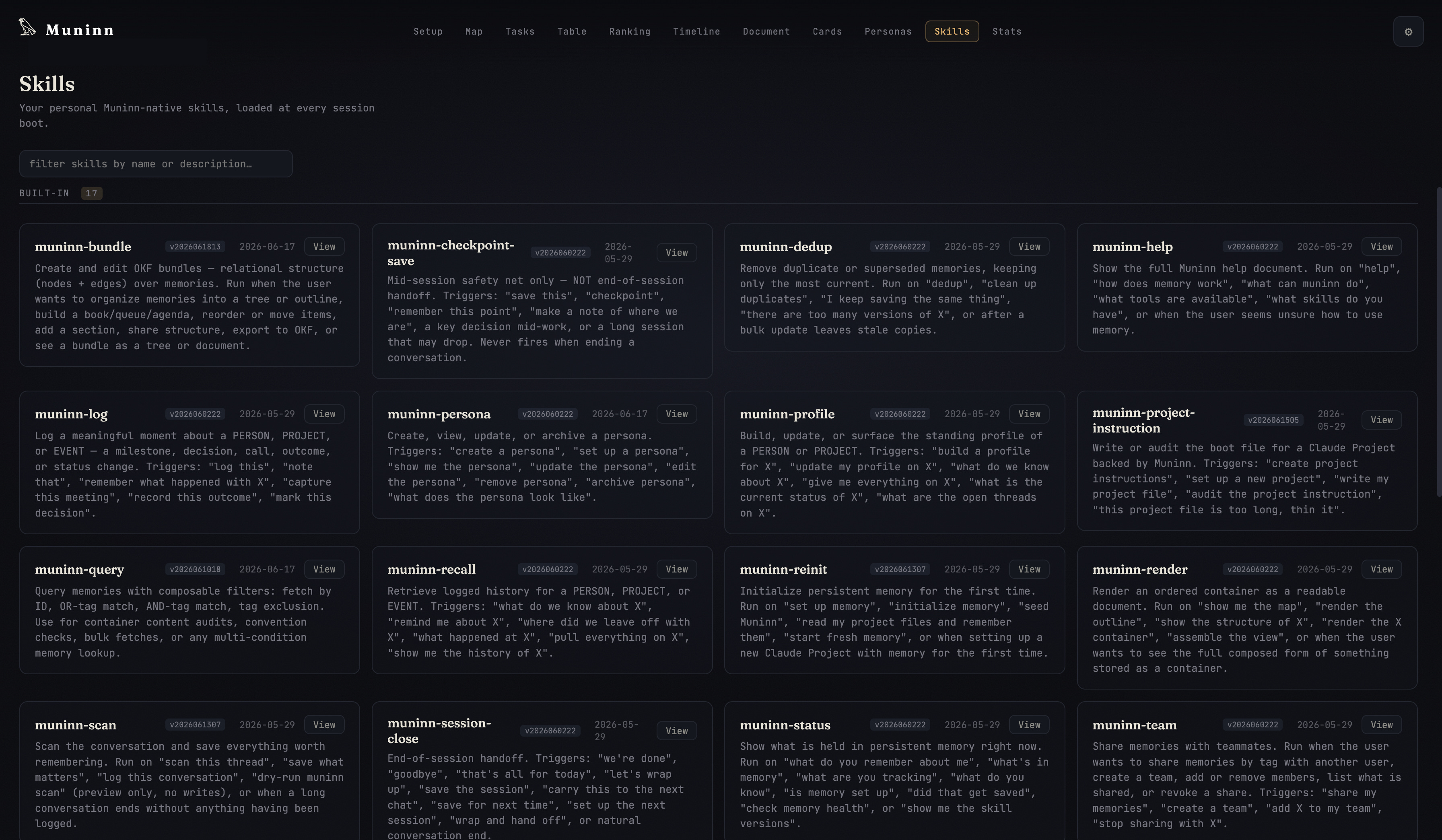
And what it hands over is more than facts about me. The memory those assistants keep is a list: your name, your job, how you like your answers. Useful, and thin. This holds the rules I have given it about how to speak to me, thirty-five of them, kept as memory like anything else. It holds who I am, filed and openable. It holds the voice I write in, a whole persona it loads before it says a word, so the thing that answers me already sounds like the room we work in. It holds skills, two dozen of them, small standing instructions that tell it when to reach for which tool, carried across every chat instead of re-explained each time.
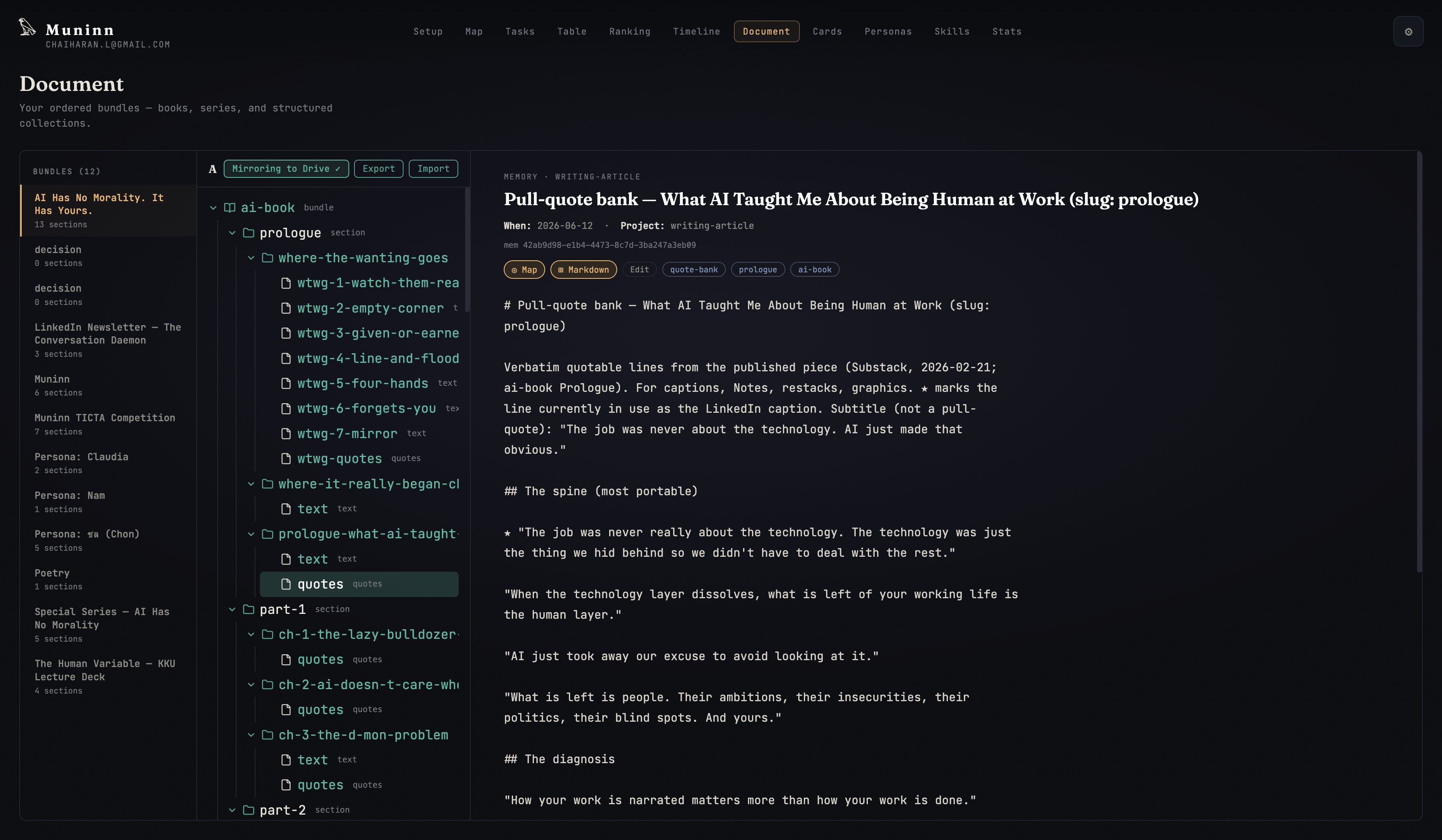
Some of what it holds is not a moment at all. It is an order. A book is a stack of pieces plus the sequence they go in. The pieces are memories. The sequence is its own thing, held apart from them, so when I move a chapter I move one pointer and not the manuscript. Ask for the book and it assembles the book, in order, out of the parts. I can open that shape and walk it as a folder tree, click down into it, and read any single piece in place.
None of it is a memory type someone at a company decided I was allowed to have. They are categories I made, in a vocabulary I chose.
No one else can read it
Every memory body is encrypted where it sits. Each one has its own key, and that key is wrapped under a single key of mine that is never stored anywhere in the open. It comes unwrapped only inside a request, unlocked by the credential I already carry, and then it is gone again.
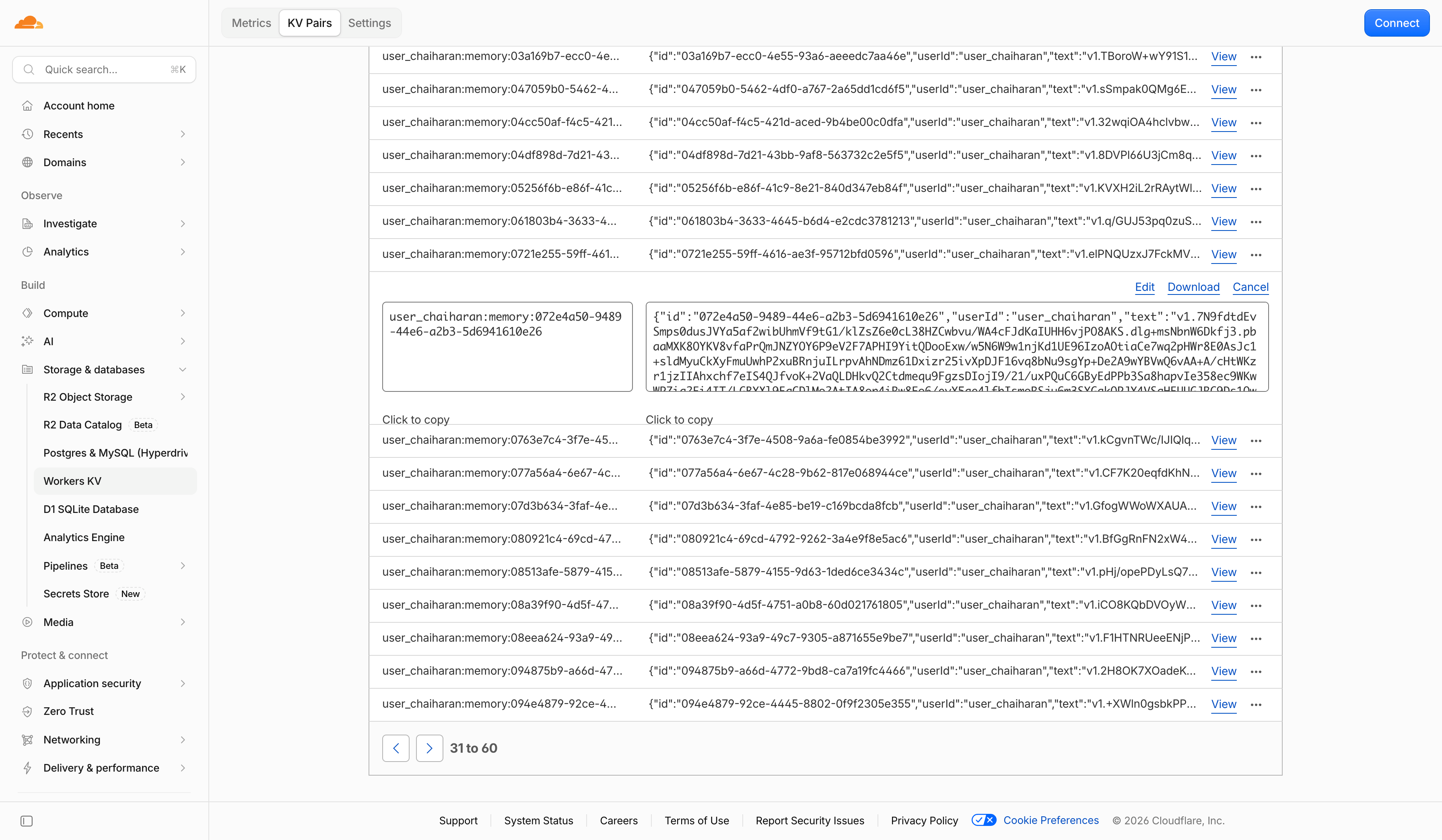
Which means this. I hold the server. I built the thing. I cannot read your memories. Not from the dashboard, not from a database dump, not by trying. There is nothing sitting at rest that can decrypt them.
It goes past the bodies. The tag index is blind too, so the machine holding your tags never sees what they say. The search index sits in a shape that is scrambled with a key only you hold, so a stolen copy of it reads as noise.
Two boundaries I will state plainly, because a claim like this is worth nothing without them. Searching requires the text in the clear for the instant the search runs. And if you connect a mirror, you are choosing to leave one server-held copy of the key so the clock can push your files out while you sleep. Disconnect and it is deleted.
Here is the part that makes it real. If you lose your password and your recovery code, your memories are gone. I cannot get them back for you. Nobody can. That is not a gap in it. That is the same fact as the promise, seen from the other side. A door only you can open is a door only you can open.
New accounts are born this way.
It leaves as plain, open files
This is the one I care about most, and it is the answer to everything above.
In the first piece I told you I could export the whole memory and keep it somewhere that was not theirs, because a memory you cannot carry out is not yours. It is one you are renting back from whoever holds the drawer. That was true, but it was a button I had to remember to press.
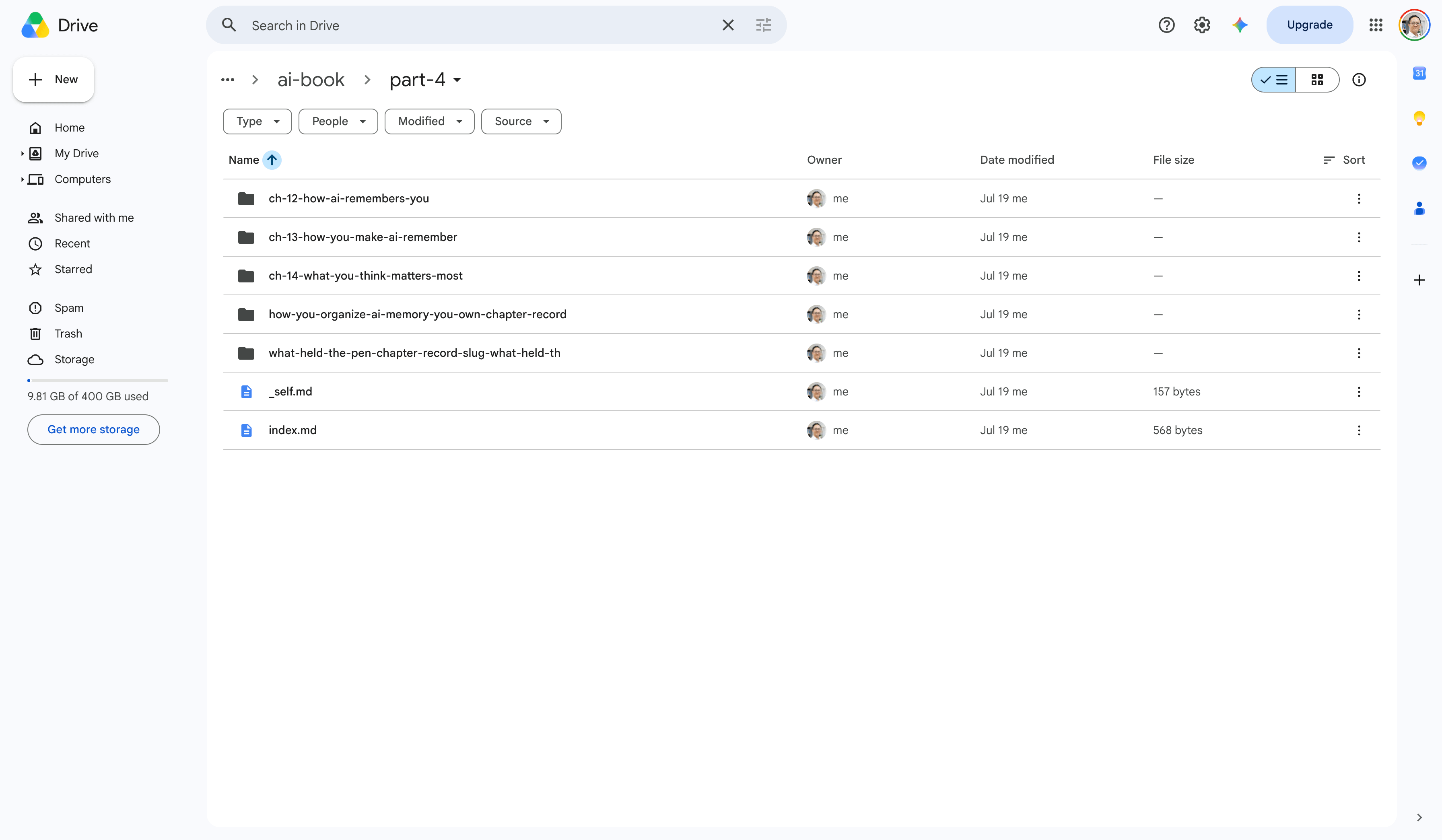
Now it leaves on its own. It writes its whole self out to a repository I own on GitHub, or a folder in my own Google Drive, every fifteen minutes, on its own clock. It arrives as plain markdown in plain folders, the same shape you would keep notes in yourself, the kind any program can read. Not a locked export that only Muninn understands. If I change a file in the repository, GitHub can carry that change back in. The copy on their server is no longer the only copy, and it was never meant to be the important one.
And because it sits outside any one assistant, the same memory serves whichever one I open. Claude today, something else tomorrow, the same store underneath. It does not belong to the machine that reads it.
The whole reason I built this was so a machine that holds this much of me could never do it in the dark, and could never keep me by keeping the only key. The map was the first half of that. The door out is the second.
It stopped being only about the past
A memory holds what happened. This one no longer only does that.
It holds what has not happened yet. Things I have to do, with a day attached, sitting in the same field as the rest of my life instead of in some separate app that knows nothing about me.
And they get louder as they come. Each one carries a curve. Far out, it stays quiet and does not interrupt. As the day closes, it climbs, until it is the first thing waiting when I open a window. If I am not ready for it, I push it down and it goes quiet again until it matters. There is a view for them too, a list or a calendar, ordered by what is pressing rather than by when I happened to write it down.
That is a different kind of thing than a diary. A diary holds where you have been. This holds where you have been and what you are walking toward, in one place, in one vocabulary, and the machine that talks to me can see both.
The raven, again
The raven goes out across the world and comes back at dusk carrying everything she saw. That was the whole idea. She remembers so I do not have to.
Now she carries two things. What I have done, and what is still coming.
And she does not only show me what she is holding. She sets a copy of it down, every quarter hour, in a place that is mine, whether I am watching or not.
That’s the whole of this one. It belongs to a book I’m writing in the open, AI Has No Morality. It Has Yours. Subscribe and I’ll send the next piece when it’s ready.
If it gave you something, pass it to someone.
BØY (Chaiharan) has spent 30 years in tech, building products, recovering disasters, and turning around the things nobody else wanted to touch. Based in Bangkok. Writing a book in public about what AI reveals about the humans who use it.