
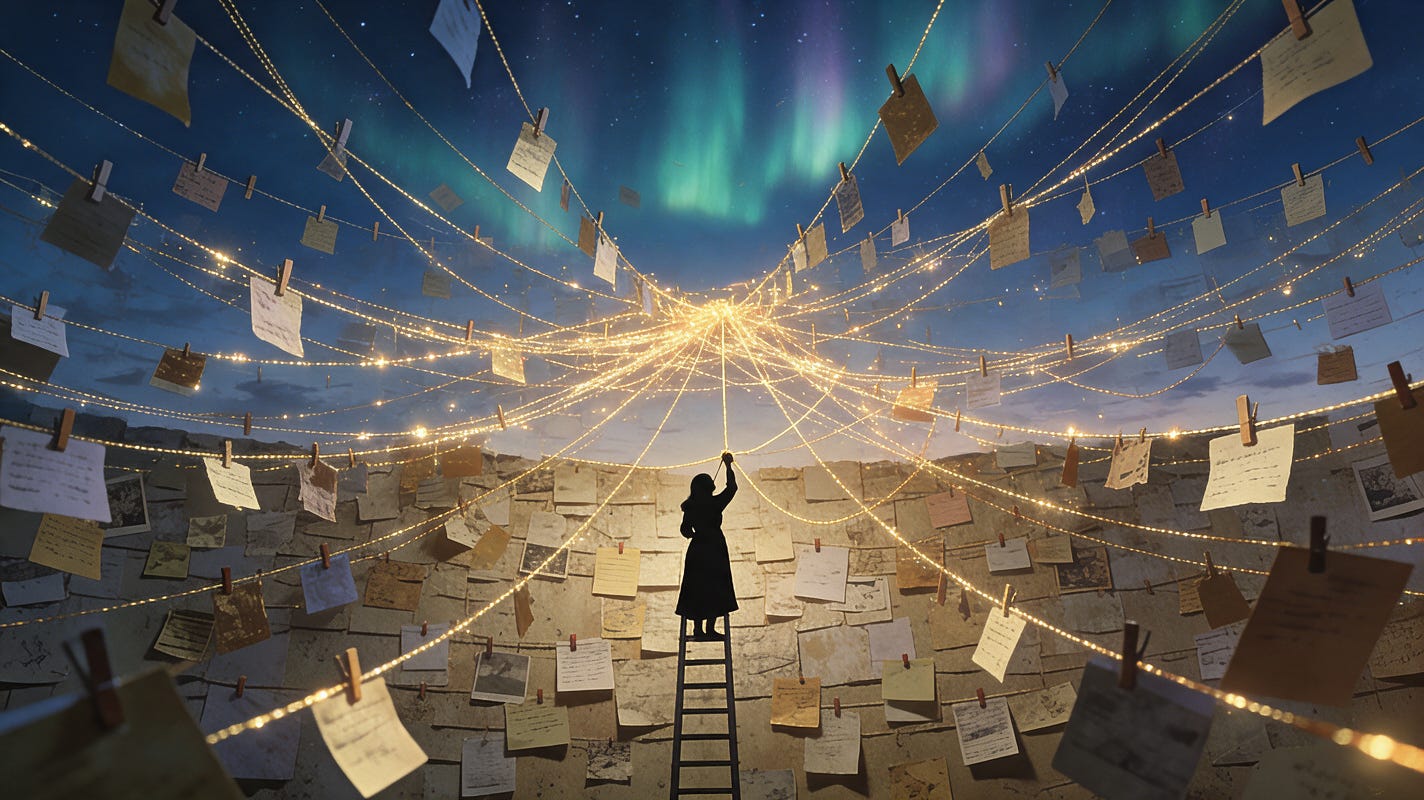
What this page is
This is the long version of The Cost of Discovery. That essay asks one question. Why does a poem have a level in a Chinese vertical drama, and why did it look familiar to me? This page is everything the question touched.
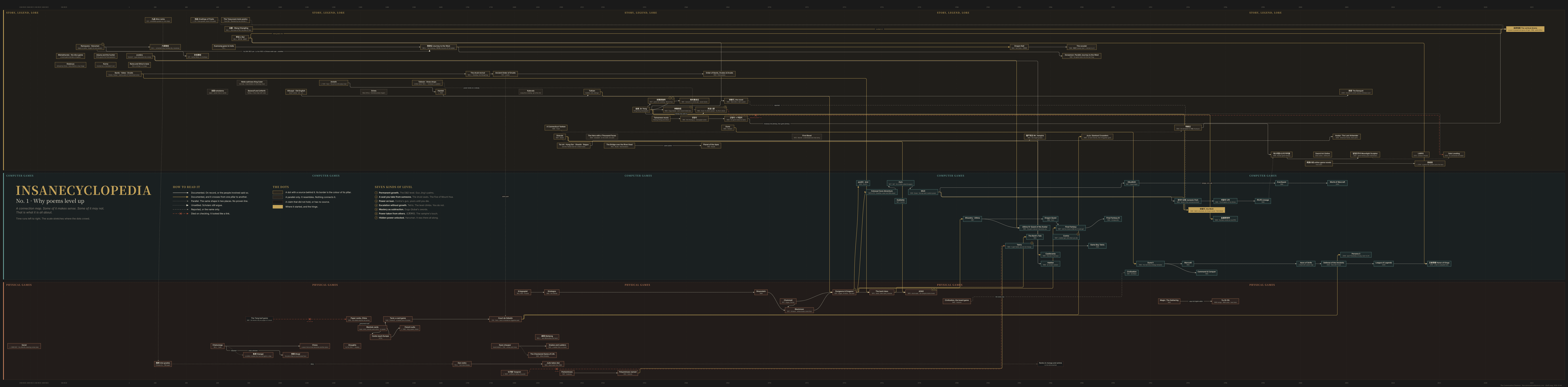
It has three pillars. Stories. Computer games. Physical games. Then the places where they cross.
Every entry carries a tag.
[D] Documented. The fact is on record. Where the entry claims an influence, somebody involved said so, or historians agree.
[P] Parallel. The same shape in two places. No proven line between them.
Anything I could not source is not here. One rule decided the rest. A dot stays only if it shows a new crossing or a new kind of link.
This is the first Insanecyclopedia. There will be others. Some of it makes sense. Some of it may not. That is what it is all about.
This is part of a book I’m writing in the open, AI Has No Morality. It Has Yours. Subscribe to get each piece as it goes out.
The genre
短剧, duanju. Short dramas shot upright for a phone. [D]
爽文, shuangwen. Fiction built to deliver satisfaction again and again. [D]
打脸, face-slapping. The payoff scene. Someone was mocked. Now he is proved right in public, in front of the people who mocked him. [D]
穿越, chuanyue. Crossing over. A person from now wakes up in another time or another world, carrying knowledge nobody there has. [D]
The worthless prince. องค์ชายไร้ค่า in the Thai titles. The lowest son at court, who is not what he seems.
Poems with grades. In the drama I watched, a captured general tied to a tree recites Wang Changling’s 出塞, and golden light pours out of him. A Li Bai poem, the first of the 清平调, is rated grade nine. Both poems are real and both are Tang. The grading is the drama’s invention. [D] for the poems.
Knowing the future is an old trick. Mark Twain sent a man from Connecticut to King Arthur’s court in 1889. Huang Yi sent a modern soldier to the Warring States period in 寻秦记, published in the mid 1990s, and that novel is commonly named as the template for chuanyue fiction. [D] each. [P] between them.
Pillar one: story, legend, lore
China
Poetry was a rank. From 681 the Tang examination for the jinshi degree required two compositions. By the middle of the eighth century those were a poem and a rhapsody. A career turned on verse. [D]
Poets were graded. Between 513 and 518 the critic Zhong Rong wrote the 诗品, the Gradings of Poets. Three grades. About a hundred and twenty poets. All of them dead. [D]
Nine ranks. In 220 the Wei minister Chen Qun set up a system that graded candidates for office on nine steps. 九品. [D] The drama’s grade nine sits in a long shadow. [P]
Sun Wukong is slapped first. In Journey to the West, heaven gives the monkey a title. 弼马温, keeper of the horses. He is pleased with it until he learns the post is not on the rank ladder at all. He overturns the table and leaves heaven. [D] for the text. [P] for reading it as face-slapping.
He also cultivates. An old monkey dies. Wukong leaves home to find someone who can teach him not to. A patriarch teaches him seventy-two transformations and the cloud somersault. [D]
Jin Yong wrote the game before the game. Four novels, serialized in Hong Kong newspapers. The facts are documented. Reading them as game design is mine.
射雕英雄传, from 1957. Guo Jing is slow and nobody rates him. The beggar master Hong Qigong teaches him fifteen of the Eighteen Dragon-Subduing Palms, lured by Huang Rong’s cooking. The last three come later. A skill tree with quest rewards. The contest on Mount Hua ranks five masters by compass point. East Heretic, West Venom, South Emperor, North Beggar, Central Divine. A leaderboard. [D]
神雕侠侣, from 1959. The sword tomb of Dugu Qiubai. A sharp sword before twenty. A soft sword before thirty, thrown away. A heavy blunt iron sword before forty. A wooden sword after that. Then toward no sword at all. A progression chart where the top means holding less. [D]
倚天屠龙记, from 1961. Zhang Wuji cuts the 九阳真经 out of the stitched belly of a white ape. Loot. His other great technique, 乾坤大挪移, comes in seven numbered levels, and he leaves nineteen lines of the seventh unpractised. [D]
天龙八部, from 1963. Duan Yu’s 北冥神功 pulls other people’s inner power into himself. Xu Zhu, who plays Go badly, shuts his eyes and drops a stone at random to stop another man from killing himself over the board. The stone kills his own group. It opens a problem that had beaten its keeper for thirty years. Then the old master who set it pours seventy years of power into him. [D]
The road to Korea. In 1961 Kim Kwang-ju serialized 정협지 in the Kyunghyang Shinmun, adapted from a Taiwanese martial arts novel. In 1966 Wolong Sheng’s 군협지 sold so well that the genre took its name from it. 무협지. [D] From there a line runs into Korean fantasy and then game fantasy. Whether Solo Leveling owes Jin Yong anything in particular, nobody has said. [P]
僵尸, the hopping dead. Mr. Vampire, 1985, set off a run of Hong Kong jiangshi films. [D] A cousin of Dracula with no proven line between them. [P]
India
A board game decides a kingdom. In the Mahabharata, Yudhishthira sits down to dice. He loses his kingdom, his brothers, himself, and then his wife Draupadi. Those losses are cancelled. He plays again. The second stake is twelve years in the forest and a thirteenth in hiding. [D]
A weapon as a quest reward. Arjuna does penance. Shiva comes to him disguised as a hunter, fights him, and then grants him the Pashupatastra. [D]
The ones refused. Ekalavya is turned away by the teacher Drona. He makes a clay image of Drona and trains in front of it, and later pays for the teaching with his thumb. Karna is stopped at the princes’ tournament and asked for his lineage. He cannot answer. He is mocked as a charioteer’s son. [D]
A hidden stat. Hanuman is cursed as a child to forget his own powers. He has them the whole time. Before the leap to Lanka, the old bear Jambavan reminds him. [D]
The bow. Kings have failed to lift Shiva’s bow. Rama lifts it, strings it, and it snaps in the middle. [D]
Avatar. Sanskrit avatāra, the descent of a god into an earthly form. In 1985 Richard Garriott took the word for the player’s own figure in Ultima IV: Quest of the Avatar. A PLATO game had already used the name in 1979, and Lucasfilm’s Habitat used it for on-screen figures in 1986. The god’s descent became your character. [D]
Hanuman and Sun Wukong. Both leap impossible distances. Both change size. Both get inside an enemy. Hanuman shrinks, enters the mouth of the serpent mother Surasa, and comes out. Wukong becomes an insect in Princess Iron Fan’s tea and is swallowed. Both have a tail that causes trouble. Hanuman’s is set on fire and he burns Lanka with it. Wukong turns himself into a shrine, and the tail he cannot hide stands behind it as a flagpole and gives him away.
There is a real road. Xuanzang’s journey to India happened. The 六度集经, translated by Kang Senghui in the third century, tells of an unnamed king whose queen is carried off and who allies with a monkey king. The monkeys build a causeway to an island. The 杂宝藏经, translated in 472, names Rama and tells his exile, with no monkeys in it. [D]
In 1923 Hu Shih argued that Wukong came from Hanuman. Lu Xun argued for a Chinese water ape called 无支祁. The usual view today is some of both. It is not settled. [D] for the debate. The link itself has no tag.
Celtic, Norse, Finnish
Three classes. Strabo names three honoured classes among the Gauls. Bards, who sang. Vates, who divined. Druids. Caesar writes that some druids trained for twenty years, memorizing verse that was deliberately never written down. [D]
The ladder was rebuilt. The eighteenth century revived the druids, through William Stukeley and Iolo Morganwg. The Ancient Order of Druids was founded in London in 1781, as a fraternal society. The Order of Bards, Ovates and Druids, founded in 1964, uses those three as its grades. [D]
1781. The same year, in Paris, Court de Gébelin published the claim that tarot cards held Egyptian wisdom. Before that they were a card game. Druids and tarot were each handed a new past in the same year. Both dates are documented. Putting them side by side is ours. [P]
Satire that raises blisters. In an Irish tale the poet Néde satirizes King Caíer, and three blisters rise on the king’s face. A blemished man cannot be king. He flees. [D] for the tale. [P] as a poem with a damage value.
Three drops. Ceridwen brews a cauldron for a year and a day, for her own son. The three drops that matter land on the boy stirring it, Gwion Bach, who becomes the poet Taliesin. The earliest written version is from the sixteenth century. [D] Power meant for someone else lands on a nobody. Xu Zhu again. [P]
Flyting. A formal exchange of insults. Scholars class Beowulf’s exchange with Unferth as one. [D] A face-slap with rules. [P]
The prince who plays worthless. Around 1200 Saxo Grammaticus wrote down Amleth, a Danish prince who pretends to be mad so that he will be left alive. Through a French retelling he reached Shakespeare. In 2006 Feng Xiaogang’s 夜宴, The Banquet, moved Hamlet to a tenth-century Chinese court. [D]
Sung into a swamp. In the Kalevala, young Joukahainen challenges old Väinämöinen to a contest of songs. Väinämöinen sings him into a swamp, up to the chin. [P]
Elsewhere
Griots. West African historians, praise singers and musicians. The role is inherited. [P]
言霊, kotodama. The Japanese belief that power lives in words and names. [P]
Modern screen
The monkey chain. Dragon Ball began on 20 November 1984 as a loose Journey to the West. Son Goku is the Japanese reading of 孫悟空. In 1988 the scouter arrives, a device over one eye that reads fighting strength, 戦闘力, as a number. The first reading in the series is a farmer. He is a 5. Wukong to Goku to the power level is [D]. Hanuman to Wukong is the open question above.
Doraemon walks into the book. In the 1988 film, Doraemon’s Hero Machine lets you play inside a story, and it is loaded with Journey to the West. He uses it in Tang China and leaves the door open. The game’s monsters walk out into the real past and eat the real Xuanzang. History is rewritten. The children go back as the Journey’s own characters to repair it. [D]
JoJo. In Stardust Crusaders, from 1989, the first twenty-two Stands are named for the tarot trumps. The next nine are named for Egyptian gods. [D] Court de Gébelin’s Egypt, two centuries later. [P]
The reverse direction. Avatar: The Last Airbender, 2005, is an American cartoon. With the martial arts consultant Sifu Kisu, its makers gave each element a Chinese style. Tai chi for water. Hung Gar for earth. Northern Shaolin for fire. Baguazhang for air. The child Avatar is found by the toys he picks out of thousands, the way a reincarnated lama is found in Tibet. One episode teaches seven chakras. Western hands assembling Asian parts. [D]
Boulle. Pierre Boulle wrote Planet of the Apes in 1963. Eleven years earlier he wrote The Bridge over the River Kwai, which is Kanchanaburi. [D] The ape who rises to lead, and Hanuman’s army of monkeys. [P]
Rambo. First Blood is a 1972 novel by David Morrell. A veteran a small town dismisses turns out to be a one-man army. [D] for the book. [P] as a worthless prince.
Campbell. The Hero with a Thousand Faces, 1949. The book that says all of this is one story. [D] We did not use it. See the end.
Pillar two: computer games
The dungeon moves onto a mainframe. On the PLATO system, pedit5 and dnd were written in 1975, one year after Dungeons & Dragons. Oubliette followed in 1977. [D]
The cave. Will Crowther explored Mammoth Cave and played D&D with friends. Across 1975 and 1976 he wrote Colossal Cave Adventure. Don Woods expanded it in 1977. [D]
Zork. Begun at MIT in 1977. For a while it was called Dungeon, until the publisher of D&D objected. [D]
MUD. Roy Trubshaw began the Multi-User Dungeon at the University of Essex in 1978. Richard Bartle took it over in 1980 and gave it points and ranks. A player who reached wizard or witch became immortal, with power over the game and the mortals in it. The top level was admin rights. [D]
Diku to Azeroth. DikuMUD came from five students in Copenhagen, released in 1991. EverQuest, 1999, was shaped by its designers’ years in DikuMUDs. The design debt is documented. The code debt was denied under oath. World of Warcraft, 2004, was built by people who had played EverQuest and wanted to fix it. [D]
Korea. In July 1994 쥬라기 공원, Jurassic Park, went live as the country’s first commercial text MUD. Song Jae-kyung was one of its developers. He was then an original developer of 바람의 나라, The Kingdom of the Winds, 1996, and went on to make Lineage, 1998. Both games were adapted from Korean comics. [D]
侠客行. The hinge. In November 1995 five Chinese students abroad proposed a MUD. Fang Zhouzi wrote the design document. It went live about two months later on a server at a Canadian university. It was built on a Taiwanese code base and filled with the sects of Jin Yong’s novels. A structure that came down from D&D, holding Jin Yong’s world. The source code leaked in 1996 and clones spread. One of them, 北大侠客行, is still running. [D]
And the name. Chinese press reports that the title was borrowed from Jin Yong’s novel 侠客行. That novel is named after a poem by Li Bai. [D] for the novel and the poem. The borrowing is reported, not confirmed by a founder.
Japan takes the Western RPG. Yuji Horii was playing Wizardry and Ultima, both 1981. He combined them into Dragon Quest in 1986. Final Fantasy followed in 1987. One of its designers, Akitoshi Kawazu, said he tried to get as close to D&D as he could. It has the beholder and the mind flayer, and spells that come in a fixed number of charges per level. Final Fantasy III, 1990, let you change jobs. Their two publishers, Enix and Square, merged in 2003. [D]
The bard gets his own game. The Bard’s Tale, 1985. [D]
Dracula becomes a boss. Castlevania, 1986. The count waits at the end of a Japanese game. In D&D a vampire’s hit drains two levels from you. Stoker’s monster became a thing that eats levels. [D]
Tarot becomes friendship. Persona 3, 2006. Each friendship in the game is one of the tarot trumps. Each runs from rank 1 to rank 10. [D]
Jin Yong becomes an RPG. 金庸群侠传, 1996, from Heluo Studio in Taiwan. The player is pulled into the martial world and must collect all fourteen novels. Chuanyue, as a game. [D]
Dune. Westwood made Dune II in 1992, under the film licence, in Herbert’s universe. It set the template for real-time strategy. Patrick Wyatt, who made Warcraft, names it as the inspiration. [D]
Li Bai is playable. A StarCraft custom map called Aeon of Strife. Then Defense of the Ancients in Warcraft III, 2003. Then League of Legends, 2009. Then Tencent’s 王者荣耀, Honor of Kings, 2015. Li Bai is one of its heroes. [D]
Contra. Konami, 1987. You pick up a better gun. You lose it when you die. [D]
Tetris. Alexey Pajitnov began it in 1984 at the Soviet Academy of Sciences’ computing centre. He took it from pentominoes, the puzzle of five-square pieces. The oldest known pentomino puzzle is in Henry Dudeney’s Canterbury Puzzles, 1907. Solomon Golomb named the family in 1953. The Game Boy carried it everywhere in 1989. Its levels make the pieces fall faster and the lines score more. You do not change. [D]
Games become stories again. Korea had game fantasy novels by 1999, with 옥스타칼니스의 아이들. 달빛조각사, The Legendary Moonlight Sculptor, made the form mainstream in 2007. Solo Leveling began in 2016. Sword Art Online went online in 2002 and into print in 2009. Chinese online-game novels, 网游小说, start around 2001 to 2003. The 系统流, stories where a game-like system attaches itself to the hero, is a trend from about 2014. The word LitRPG was coined in Russia in 2013. [D]
Stories were turned into games. The games were turned back into stories. Then somebody shot one upright for a phone.
Pillar three: physical games
The chess family. Chaturanga is placed in India in the sixth century. The first clear mention is from about 625. The line from there to Persia to European chess is secure. Shogi shares the ancestor, by a route nobody can trace. [D] Xiangqi is probably related. Its origin is disputed. [P]
Three ways to rise on a board. In chess a pawn that reaches the far rank becomes another piece. In xiangqi a soldier that crosses the river gains a sideways step and stays a soldier. In shogi the piece is turned over to show its promoted face. [D]
Kinging. Draughts crowns the piece that reaches the far side. The game probably emerged in medieval France or Spain by the thirteenth century. [D] for the rule. The origin is a reconstruction.
Senet. The oldest secure picture of it is in an Egyptian tomb from about 2686 BCE. It began as an ordinary game. By the New Kingdom it was read as the soul’s passage through the afterlife. [D] A game that got its meaning later. Like tarot. [P]
Snakes and Ladders. It descends from gyan chaupar, an Indian game of virtues and vices. The oldest board that can be dated with confidence was made in Lucknow around 1780. The first commercial English version is from 1892. A ladder that is a moral. [D]
The Checkered Game of Life. Milton Bradley, 1860. Squares of virtue and vice. [D] The same idea, with no line to India that I can show. [P]
Mahjong. Nineteenth-century China. Traditional scoring counts 番, fan, and each one doubles the hand. [D]
Dan. The dan ranks of Go are credited to Hon’inbō Dōsaku in seventeenth-century Japan. Chinese Go had its own nine grades long before, and the dan ladder likely echoes them. Nine ranks again. In 1883 Kanō Jigorō borrowed dan for judo. From 1886 his dan holders wore black belts. [D] From there to the ranks and grades of manga and anime, no line is documented. [P]
Playing cards. The oldest cards anyone can prove are Chinese, from a legal case in 1294. Mamluk Egypt had suits of cups, coins, swords and polo sticks, with a king and two deputies and no queen. Cards are in Europe by the 1370s. The French suits come around 1480. The French court of king, queen and knave is a feudal ladder in the hand. [D]
Tarot. The first record is from Florence in 1440. It was a trick-taking game with a permanent ranked row of trumps. The occult story begins in 1781. [D]
From war game to character. A Prussian named Reisswitz built Kriegsspiel in 1812. His son’s 1824 version was adopted by the Prussian army. The line runs through an American version of 1880 and a 1969 game called Braunstein to Dave Arneson’s Blackmoor, 1971, which used the fantasy rules of Chainmail. Dungeons & Dragons was published in 1974. Character levels are credited to Blackmoor. How the credit divides between Arneson and Gary Gygax is argued. [D]
The bard. Doug Schwegman’s bard appeared in The Strategic Review in February 1976. He names its sources as the Norse skald, the Celtic bard, and the southern European minstrel. Its charm works through song. In the 1978 rulebook a bard must first be a fighter, then a thief, then study under druids. [D]
Seats at the top. In first-edition AD&D there are only nine druids of the twelfth level, three archdruids, and one Great Druid. If no seat is empty you must defeat a holder to advance. The loser drops a level. Monks have a similar rule. [D]
Magic to Yu-Gi-Oh. Magic: The Gathering, 1993. The Yu-Gi-Oh manga began in 1996, and the card game inside the story was called Magic & Wizards. Konami’s real card game followed in 1999. Its monsters carry level stars. The manga’s English editor says it is based on Magic. The author never said so in public. [D] with that caution.
Crossings
These are the lines that go from one pillar to another.
Norse to Tolkien to D&D. Tolkien took his dwarf names, and Gandalf, from the Old Norse Völuspá. Ent and orc are Old English words. D&D took his hobbits, ents and balrogs. In 1977 a cease-and-desist from the holder of the film rights turned them into halflings, treants and balors. [D]
Celtic bard to D&D bard to The Bard’s Tale. [D]
Kriegsspiel to Blackmoor to the MUD to 侠客行. [D]
Jin Yong to 侠客行 and 金庸群侠传. [D]
Li Bai to 侠客行 to Honor of Kings to a vertical drama. [D], with the title caution above.
Vishnu to Ultima IV. The avatar. [D]
Sun Wukong to Son Goku to the power level. [D]
Cards. China, Mamluk Egypt, Italy, Paris in 1781, then back east to JoJo in 1989 and Persona in 2006. A loop. [D]
Go to judo. [D] And then to anime. [P]
Wizardry and Ultima to Dragon Quest. D&D to Final Fantasy. [D]
Dune to Dune II to Warcraft. [D]
Hamlet to The Banquet. Chinese martial arts to Airbender. The two reverse crossings. [D]
Story to game to story about a game. [D]
[FULL MAP GOES HERE]
Kinds of level
“Level” is one word. It covers at least seven different things.
Permanent growth. You gain it and keep it. The D&D level. Guo Jing’s palms.
A seat you take from someone. There are only so many places. The druid seats. The five masters of Mount Hua.
Power on loan. Contra’s gun. Yours until you die.
Escalation without growth. Tetris. The level climbs. You do not.
Mastery as subtraction. Dugu Qiubai’s swords. Each stage holds less.
Power taken from others. 北冥神功. The vampire’s touch.
Hidden power unlocked. Hanuman. It was there all along.
What we left out
Marvel. We stopped before Marvel. The list never ends.
Batman. A Westerner who trains in the East. That is the door to Marvel, to Doctor Strange and Iron Fist.
Frankenstein. It fits the AI theme. It is also in every AI essay. Saved for another piece.
Rambo and Rimbaud. A shared name. A coincidence is not a connection.
Gilgamesh, the Odyssey, the Hero’s Journey. Too wide. Everything connects to them, so they show nothing new.
Dots that died on checking
Cheap looking makes cheap wrong answers. These looked like links.
Solo Leveling absorbs power, like Duan Yu. No. Its hero raises the enemies he defeats as his own shadow soldiers. He commands the dead. He does not drink them.
Stallone is on the Contra cover. The artist Bob Wakelin said he worked from Schwarzenegger in Predator. Both soldiers trace to those stills. The bandana only looks like Rambo.
Tangram is the ancestor of Tetris. Different families of puzzle. Neither history mentions the other. The story that tangram is four thousand years old was a hoax from 1908.
Playing cards began in Tang China. The evidence is one line from 868 about a “leaf game.” The leaves may have been pages of a book.
A thirteenth-century saint invented Snakes and Ladders. No board or text survives from then. The story is later.
Civilization the video game came from Civilization the board game. The name was cleared with the board game’s American publisher. Sid Meier rates the board game a minor influence. The name crossed. Most of the game did not.
Sources
Poetry, rank, and China
He Yizhan, “以诗赋取士并非始于唐代,” 文史杂志 2007, on the Tang examination.
J. T. Wixted, “Shi pin 詩品.”
西遊記, chapters 2, 4, 6 and 59, Chinese Wikisource.
Jin Yong, 射雕英雄传, 神雕侠侣, 倚天屠龙记, 天龙八部. Serialization dates from the English Wikipedia entries for each novel.
Arts Council Korea, Munjang webzine, “한국에서의 무협소설.”
India and the monkey question
Mahabharata, Sabha Parva, Vana Parva, Adi Parva. Valmiki Ramayana, Bala Kanda 67 and Sundara Kanda.
六度集經, fascicle 5, and 雜寶藏經, fascicle 1, Chinese Wikisource.
Desai, “Rāmāyaṇa: An Instrument of Historical Contact and Cultural Transmission between India and Asia,” Journal of Asian Studies.
Yang Jian, “孙悟空形象本土与外来之争,” 中国社会科学报, 19 June 2023.
Celtic, Norse, Finnish
Caesar, Gallic War 6.14. Strabo, Geography 4.4.4.
Maynooth University, “Satire and medieval Irish poetry.”
Carol J. Clover, “The Germanic Context of the Unferþ Episode,” Speculum 55 (1980).
Kalevala, translated by W. F. Kirby, Runo III.
Computer games
Aaron Reed, “On the dating of two early CRPGs: pedit5 and dnd.”
Richard Bartle, “Introducing the wizards,” 1985.
Jimmy Maher, The Digital Antiquarian, on EverQuest, Dune II and Civilization.
Patrick Wyatt, “The making of Warcraft, part 1.”
Fang Zhouzi, interview with Tencent Tech, 2008. 北大侠客行 MUD wiki, “mud:history.”
Kanzenshuu, “Scouter.”
Physical games
Piccione, “In Search of the Meaning of Senet.”
Victoria and Albert Museum, “Gyanbazi.” Andrew Topsfield, “A Note on Sufi Snakes and Ladders,” JRAS 2022.
Smithsonian National Museum of American History, “Checkered Game of Life.”
AD&D Players Handbook, 1978, druid and monk entries.
The Strong National Museum of Play, “Cease-and-Desist: Don’t Mess with Tolkien.”
Jason Thompson, “House of 1000 Manga: Yu-Gi-Oh!,” Anime News Network.
The idea behind the page
Don R. Swanson, “Fish oil, Raynaud’s syndrome, and undiscovered public knowledge,” Perspectives in Biology and Medicine 30 (1986).
DiGiacomo, Kremer and Shah, American Journal of Medicine 86 (1989).
That’s the whole of this one. It belongs to a book I’m writing in the open, AI Has No Morality. It Has Yours. Subscribe and I’ll send the next piece when it’s ready.
If it gave you something, pass it to someone.
BØY (Chaiharan) has spent 30 years in tech, building products, recovering disasters, and turning around the things nobody else wanted to touch. Based in Bangkok. Writing a book in public about what AI reveals about the humans who use it.