
There is a small badge you may have seen at the bottom of some websites. It says Not By AI. It is a good badge. It tells you a human made this, and the human is proud of it.
I have nothing against it. But I cannot wear it. Most of what I make now, I make with a machine beside me. This Substack. The code behind bizat.co. The memory system I use every day. If I put Not By AI on any of them, I would be lying.
So I looked for the other badge. The one that says yes, AI was here, and I am not hiding it. I did not find one I liked. So I made it, with Claude.
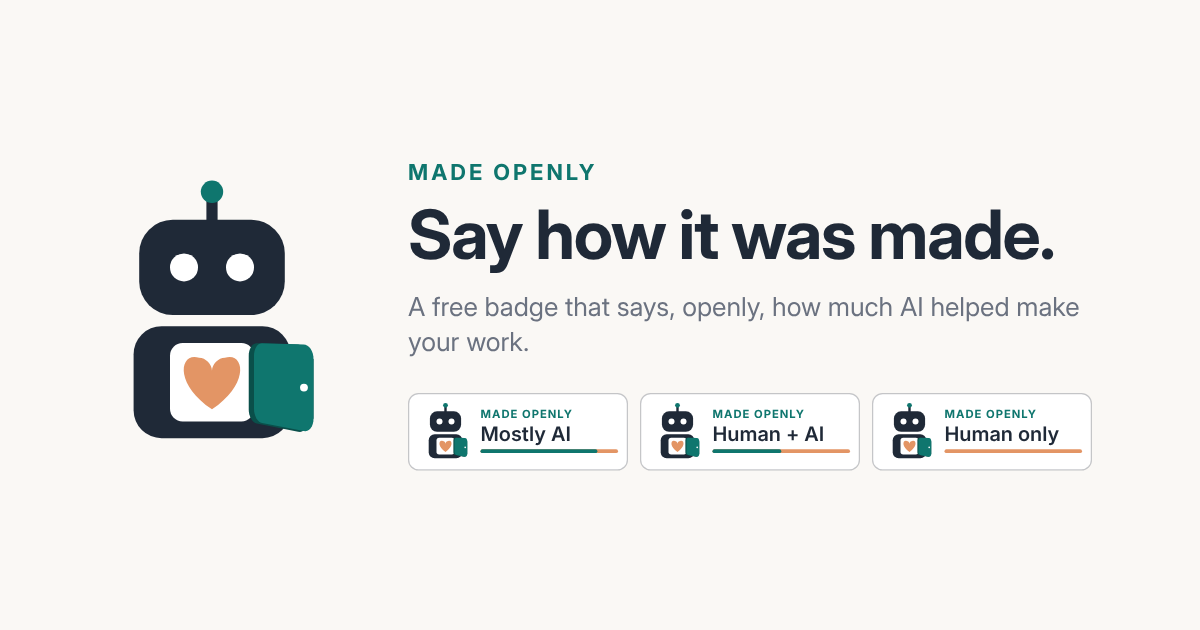
It is called Made Openly.
It started in a comment thread. @MTC wrote a post asking why Substackers loathe AI. We talked under it. That night I added a small line under all 43 of my posts, saying plainly how they were made. Then I asked in his thread if anyone would support a site where people could say it openly, with a badge, and the site would count how many places wear it. He was the first to say yes.
This is that site.
Three labels
The badge has three labels. Mostly AI. Human + AI. Human only.

One question decides which: who produced most of the final words, code or images? If you are torn between two, choose the one with more AI. Being open is the point.
Nobody checks your answer. It is not a certificate. It does not say the work is good. It says you told the truth about how it was made, and you are willing to be seen telling it.
The wrong question
For a few years we have been asking whether a machine touched the work. We build detectors for it. Teachers run essays through them. It is the Voight-Kampff test from Blade Runner, pointed at text. Watch the eyes, measure the response, decide what is real.
In the film it took Deckard more than a hundred questions to catch Rachael. And she did not know it herself.
I think the question is about character, not purity. Is the maker honest about how it was made? Whatever the machine is, the work goes out under my name, and I answer for it. A badge cannot measure the machine. It can only show the hand.
That is what I want Made Openly to say: this was my hand, and the machine worked beside it.
What the law asks
Since August, the EU AI Act asks the companies that build AI to mark what their systems make, in a way other machines can read.
People get a softer rule. AI-written text on matters of public interest must be disclosed, unless a human reviewed it and took editorial responsibility (Article 50). Then it is yours, and nobody asks you to say anything.
That is fair. But it leaves one case in silence: the person who used the machine, took responsibility, and could say so but does not have to. Made Openly is for that person. It is voluntary. It does not make anyone compliant with anything.
One year
I am running it as an experiment for one year. Who chooses which badge?
The site counts places wearing the badge, not visitors. No cookies, no sign-up, no IP addresses. A place counts while we can see the badge there. If you take it off, it stops counting. If you want the record gone too, you keep a small key when you make the badge, and it removes everything.
The numbers are public at madeopenly.com/stats.json. The counter shows every number, even places it cannot see. Today three places count, and all three are mine. Two say Mostly AI. This Substack says Human + AI.
I do not know what the split will look like in a year. Maybe almost everyone picks Human + AI because it feels safe. Maybe Mostly AI grows quietly, from people tired of pretending. Maybe nobody wears it at all. That would also be an answer.
If you want one
It is free at madeopenly.com. Pick a label and give the page address. On your own site or GitHub, paste the code. On Substack or Medium, add the badge as an image and link it. The page shows you how.
The code is open on GitHub. If you want to draw a mascot for it, there is a way to do that too.
I will come back to the numbers in a year. Earlier, if they say something I did not expect.


Thank you for this! We think this is a wonderful idea. Our research pieces utilize Ai, in part, in order to create better and more deeply qualified representations of ideas from the broadest perspectives with the least bias. Without the technology it would not be possible. To date, each of our nascent works recognize the legacy contributors according to apa 7 format references, and we also note the use of Ai as well as ask for critical analysis and corrections from readers. So our pieces have ended up rather dynamic as we update based on continual inputs. However, the proposed iconographic and easy-to-understand method of representation is quickly and unequivocally effective. So we will begin using it. With gratitude, the SystemKraft team.
Glad to see this finally come to life! I’m excited to see how people respond to it and where we can take the idea from here. Count me in!