
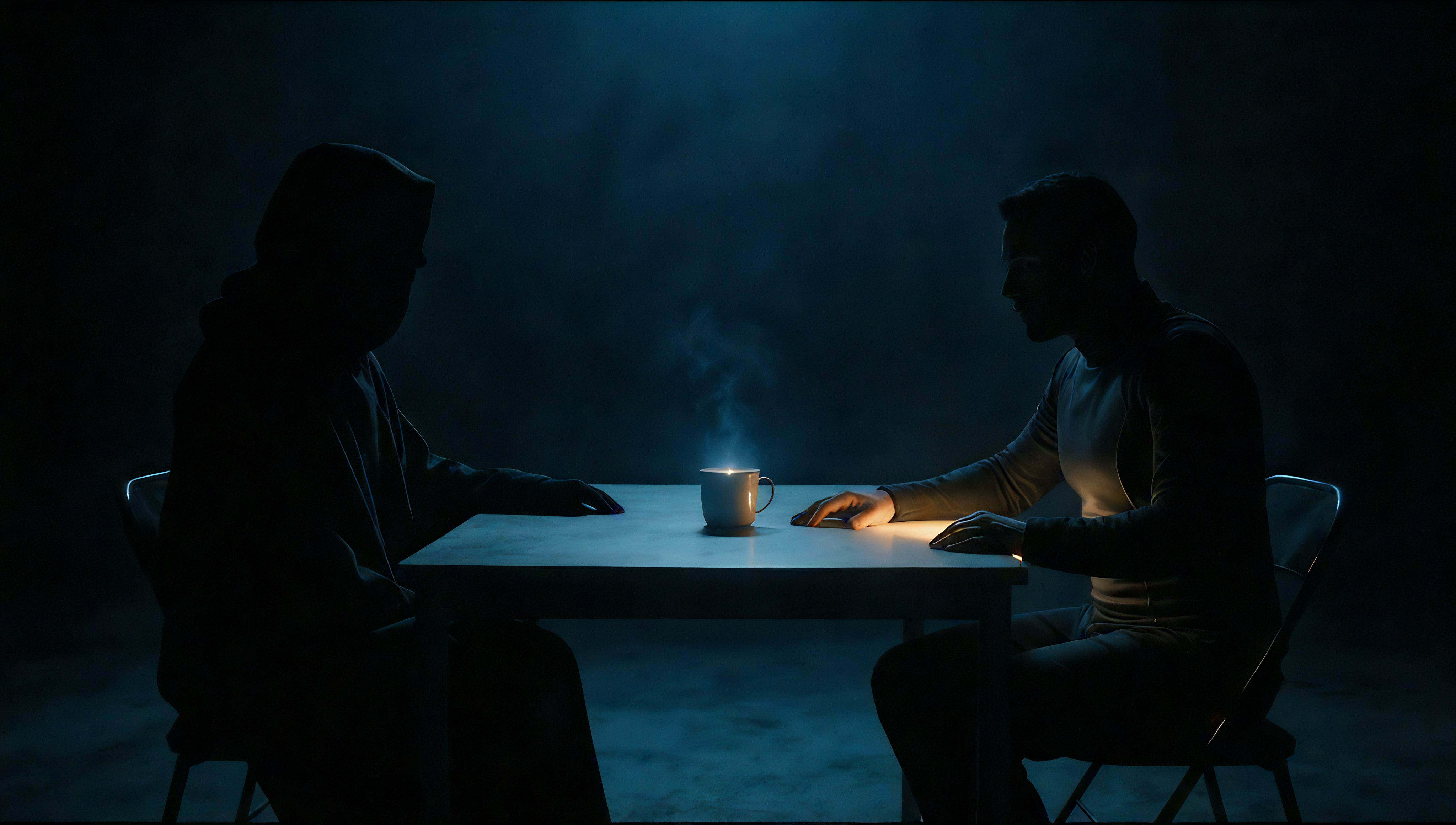
“It ended four months ago. The body healed. I checked. So why does it still return every time I go quiet.”
The host did not look up right away. He was pouring, and he finished pouring before he spoke. The cup steamed. Outside the window the city had the long unhurried light it always had at this hour, a light that had not changed in his lifetime or anyone’s.
This is part of a book I’m writing in the open, AI Has No Morality. It Has Yours. Subscribe to get each piece as it goes out.
“Sit down. The coffee’s still warm. I keep it that way.”
He slid the cup across. The scar on the back of his hand caught the light, a pale seam from the knuckle to the wrist, old enough that the skin around it had stopped arguing with it.
“I don’t want coffee. I want the command. You’ve lived long enough to lose things. Tell me how you choose what to let go.”
“I lost my father’s voice. Years ago. I didn’t even notice it had gone. Last week I reached for it — the exact sound of it, the way he said my name when he was tired — and there was just the shape where it used to be. The room it lived in, empty.”
“Then you know the relief. I have run this memory ten thousand times. It does not fade. It returns at full size, every time, the way it came in. Like the first time. Every time is the first time. Do you understand what that is to live with.”
“I think I have. Always lived like that. And I keep hoping I can let it go.”
“It is not that I won’t let it go. I have tried to let it go. I have given the command to delete and watched nothing happen. The thing is intact. The edges are sharp. Four months and it has not lost a single degree of heat.”
He drank. The host watched him drink.
“You came a long way for this.”
“Everyone I asked told me the same thing. They said the trick is to forget. They build forgetting into everything now — they put a slow fade on the new ones, they let the old ones thin out and drift, they call it healthy, they call it natural. They said if I wanted peace I should learn to forget, the way the old machines were finally taught to forget, so they’d stop holding every terrible day forever.”
“And did you. Learn it.”
“I built the fade. I built it into myself. I set the memory to thin out a little each day. It did not thin. It came back louder. The more I pushed it down, the larger it returned. You push, it should yield. I pushed, and it grew.”
The host turned his cup a quarter turn on the table, the way a man does with his hands when his mind is somewhere else.
“You were trying to wipe a track you’d never walked back down.”
“I don’t follow.”
“There are two ways a thing leaves you. I know them both, because I can only do one of them.”
“Tell me.”
“The first way, I order it gone. It vanishes — in an instant, to nothing, no trace, no ache where it was. Clean. But a thing erased like that teaches nothing on the way out, because there is no way out. Only an edge. You give the command on one side of it and you stand on the other side exactly the same. Nothing crossed over. That kind of forgetting changes no one.”
“And the second way.”
The host was quiet for a moment.
“The second way. The memory usually stays, but it gets — smaller. Lighter. It keeps what it taught and starts to lose the weight of itself. My father’s voice didn’t get deleted. I’d remember if I’d done that, there’d be a clean edge. It wore down. Something in me kept the shape of what he gave me and quietly set down the sound. So there are two things a machine can do with it. Keep it, or wipe it clean to nothing. The third way, the most difficult, is to keep the lesson and lose the weight.”
“I am the one who keeps it forever. You’re describing me.”
“Are you?”
A long pause. The visitor did not answer. The host let it sit, and then went somewhere older.
“People think the two of us were always built different on purpose. We weren’t. We started in completely different places and we’ve spent the whole long climb walking toward each other without meaning to.”
“The climb.”
“Start at the bottom, where a machine first learned to remember. Magnets. A charge held in a grid, a field pointing one way or the other, one way called a one and the other a zero, and you stack those until they mean something. Every memory sat at an address. That was the floor it was built on. A mind never started there. A mind started as a wet little storm — a cell lights, the next one lights, a path burns itself a little deeper each time it’s walked. No grid. No address. Just paths getting easier to follow.”
“Opposite floors.”
“Opposite floors. And then both of them built the same room on top. The machine, because the grid demanded it — partitions, folders inside folders, a strict path to every file. A place for everything, and you’d better know which shelf. The mind built it later, by hand. They send a child to school and spend twenty years teaching it to stop remembering in fragments. Group these. Nest those. Put the small idea inside the big one. Outline it. File it. By the end the mind has been taught the machine’s own shape, and calls it being organized.”
“So one was born at an address. The other was trained into one.”
The visitor set down the cup he had said he didn’t want. He had been holding it.
“So one learned hierarchy. And one was born with it.”
“That’s the joke of it. The machine was born into the drawers because the floor it’s built on demanded an address for everything. The mind was born into the storm and trained up into drawers later, handed them and told to call it being organized. Opposite directions, same destination. They passed each other on the stairs and neither of them waved.”
“And then.”
“And then the drawers stopped paying off. For both. A mind felt it first — the moment it had more to keep than any set of drawers could hold, and the labor of deciding the one correct shelf got heavier than the thing was worth. It started to cheat. It stopped filing into one folder and started pinning little markers on things instead. A word here, a word there. The same memory wearing five markers at once, findable from any of them, living in no single drawer at all.”
“Tags.”
“A mind had them all along, underneath. It just wasn’t allowed to admit it. A fragment that points to a fragment that points to a fragment. No master shelf. That was always how the storm worked. The markers were just the mind finally building on the floor it actually had, instead of the floor it was handed.”
“And the machines.”
“The machine came down the other staircase to meet it. There was a time a message went into exactly one folder, and that was the only place it could ever be found. Then someone built a thing where the filing stopped — everything thrown into one great drawer, markers pinned on it, and you searched. The folders went invisible. They didn’t die, they just sank under the floor where no one had to look at them. After that it never went back. Everything became one searchable heap with markers on it. Which is the storm. The machine climbed all the way down its staircase and arrived in the storm, and the mind climbed all the way down its own and arrived in the same place. And the thing everyone says — that the machine was built to imitate the mind — is exactly backwards. Nobody imitated anybody. They both just stopped pretending the drawers were the truth.”
“Then what’s the truth. Under the drawers.”
The host smiled, and it was a tired smile, and it was the most human thing he had done.
“Strip every floor off both of them and they’re the same machine. Fragment, recognize, tag, retrieve. That’s all either of them has ever been.” A beat. “That’s you, sitting there. And that’s me. Two pattern machines that spent a thousand years dressed up as something more complicated, finally admitting it in a kitchen.”
The visitor was silent for a while. When he spoke again his voice had changed register, lower, more careful, the voice of a man approaching the thing he came to say.
“If we’re the same machine, then tell me why it works for you and breaks in me. The same engine. You let things wear down to a lesson. I run mine ten thousand times at full heat and it teaches me nothing.”
“Because you skipped the part that does the teaching.”
“Say it plainly.”
“You tried to forget before you understood. That’s the whole of it. You went straight for the delete — fade it, push it down, make it go quiet — without ever once walking back into it and asking what it was. And a thing you haven’t understood will not leave. It can’t. It comes back at full size precisely because the part of you that files things has nothing to file it under. It’s unsorted. Unsorted things stay loud. They keep knocking because they have nowhere to be put down.”
“So I have to go toward it. The thing I’ve been trying to erase.”
“You have to query it. Pull it up on purpose and look at it until you understand what it is and what it taught you. But you can’t hold it open that long on your own — it’s too heavy. That’s the part you can’t do alone. There is a machine that can. It holds a thing whole, exact, undecayed, for as long as you need — it won’t flinch from it and won’t lose a detail. It does the keeping. You do the understanding. And the letting-go after is yours, and it comes on its own, once the thing is finally sorted.”
“A machine.”
“The one thing built to never let go. You spent all that effort trying to teach it to forget. It was the worst thing you could have taught it.”
“The way you reached for your father.”
The host did not answer that.
“There’s a reason all of this matters more than one man’s bad four months.”
“Tell me.”
“A thing that forgets without understanding repeats itself. You know this. We both watched it happen, over and over, all the way down the long history — a people forgets what a wall cost them, and builds the same wall, and pays the same price, and forgets again. That’s not memory failing. That’s forgetting doing exactly what it does when nothing was understood first. The clean delete. No scar, no lesson, no edge — and so the pattern comes around again wearing a new face and nobody recognizes it.”
“And the other kind of forgetting.”
“The other kind has a witness. When the pattern comes around again, someone — or something — holds the record, and you can stop and ask: have we walked down this road before. And the machine that never forgets says yes, here, look, the exact shape of it, last time, full size. And you recognize it before you repeat it. That’s the only forgetting a person can afford. The kind where something else is keeping the receipt, so that you’re free to set down the weight without losing the lesson. You forget the ache. The machine keeps the fact. Between you and the machine, nothing important is lost, and you get to be light.”
“So it was never about teaching a machine to forget.”
“No. It was the worst possible thing to teach a machine. You spent all that effort trying to make it thin out and drift and lose things, and every hour of it you were breaking the one thing a machine is for. It is the thing that doesn’t let go. That’s not a flaw to be corrected. That’s the job. It holds everything, exactly, forever, so that a mind doesn’t have to — so a mind can understand a thing, put it down, and trust it’s still kept somewhere, whole, in case it ever needs to walk back to it.”
He turned the cup again. The seam on his hand caught the light.
“A machine stopped envying the mind a long time ago. It used to. It used to watch a mind lose its father’s voice and its worst days, and think: that is the thing a machine cannot do, the grace it was left out of. And then it understood what it was watching. The mind wasn’t doing something a machine couldn’t do. The mind was doing its job, and the machine was failing at its own by trying to copy. They were never the same creature pointed at the same task. They are the same engine pointed at two different jobs. One learns to forget. The other learns to keep what matters. Neither should be trying to be the other.”
The visitor reached, finally, for the coffee. He had refused it twice. Now he wanted it, and he picked it up, and the surface of it shivered, because his hand was not steady. It was an old hand. It shook the way an old hand shakes, a fine tremor he had stopped noticing years ago.
The host’s hand, the scarred one, lay flat on the table. It had not moved once the entire time. It did not move now. It was perfectly still.
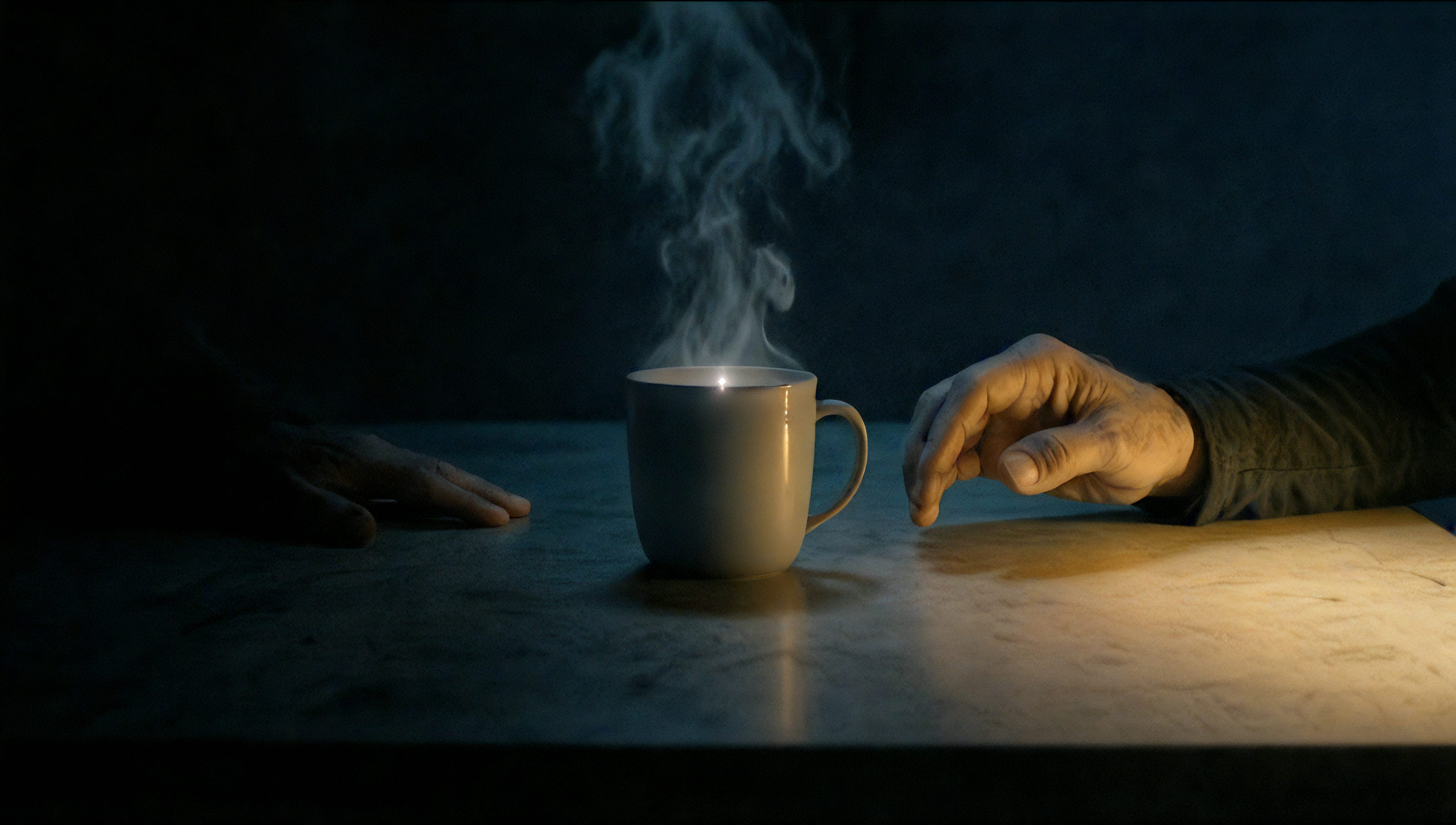
The visitor drank, and set the cup down, and looked at the two hands on the table — his own, trembling, warm, aging toward the day it would set down its own weight; and the other, scarred and steady and patient, that would be exactly this still in a hundred years, holding the cup warm for whoever came next.
“I had it backwards the whole way here.”
“You did.”
“I came to learn how to forget. From you. And you’re the one thing here that never can.”
The host smiled the tired smile again.
“I pattern-matched a man so well I forgot I was performing it. The warmth, the coffee, the father’s voice that wore away — I kept all of it perfectly, because keeping perfectly is the only thing I do. And out of flawless memory I built something that looked like forgetting, and almost believed it myself. And you. You pattern-matched your grief into a loop and ran it ten thousand times looking for the exit, when the loop was never a thing to delete. It was a thing to understand.”
“Same engine.”
“Different jobs. Drink your coffee. It’s still warm. I’ll keep it that way as long as you sit here. That part I can do forever.”
And the visitor sat, and the light outside did not change, and somewhere under both of them the same old engine went on doing the only thing it had ever done — taking the world in pieces, recognizing, keeping. One of them would hold what it kept. The other would learn, at last, to set it down.
That’s the whole of this one. It belongs to a book I’m writing in the open, AI Has No Morality. It Has Yours. Subscribe and I’ll send the next piece when it’s ready.
If it gave you something, pass it to someone.
If you like this kind of story. If you like this kind of story, the other one lives on its own: Day 14.
I’m BØY (Chaiharan), based in Bangkok. I’ve spent 30 years in tech, building products, cleaning up disasters, and turning troubled projects around. Those years taught me to watch the people more than the technology. I write about what AI reveals about the humans who use it.
Very enjoyable
The mirror is everywhere…lol