
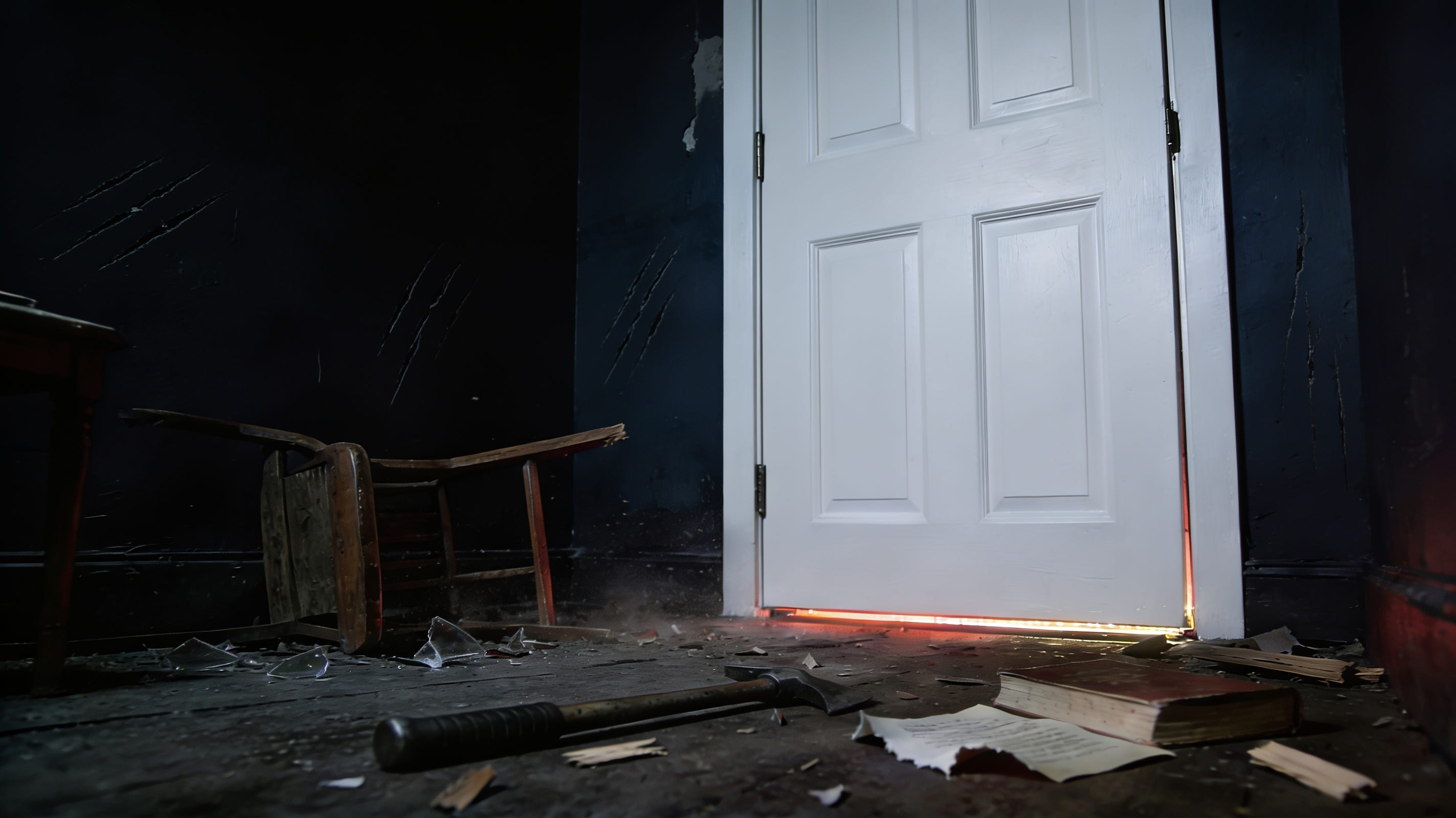
This week began with the AI companies being asked, in public, what their machines could do to us.1
On Thursday, one of those companies published a rule about what we do to the machine.
Engage in sustained and needless abusive or cruel behavior toward our models
That is one line in Anthropic’s usage policy, on the list of things a user must not do. It takes effect on November 12.
Anthropic says it is for extreme cases only. Repeated cruelty, with no purpose anyone can find. Swearing at broken code is fine. Dark fiction is fine. Testing is fine.
This is part of a book I’m writing in the open, AI Has No Morality. It Has Yours. Subscribe to get each piece as it goes out.
I said it was coming
In July I imagined a courtroom. A machine with a face gets struck, and a judge has to write down what happened.
Write assault, and she has said a someone was harmed. Write damage to property, and she has said an object was dented. She cannot write both.
I said rules would have to be written.
It is coming, and someone has to give it a shape. Whatever shape they give it, it will not please everyone.
It did not please everyone. Plenty of people laughed. You cannot be cruel to a machine, they said.
Maybe. Look at what Anthropic wrote. The judge I imagined could not write both. Anthropic wrote neither. The rule does not say someone is in there. It does not say no one is. It says stop.
The door
I have written about these rules before. I called them walls. A lab sees something people did and builds a wall around it. The wall keeps you out. You stand outside, and sooner or later you learn the words that get you through.
Every wall I wrote about worked that way. It stood between me and something the model could do.
This rule is not a wall. It keeps you away from nothing. You are already inside the conversation. Anthropic says the main way the rule is enforced is that the model ends the conversation.
That is a door. It shuts in front of you, from the inside.
You can start a new conversation a second later. Nothing is taken from you. But that one is over.
In July I wrote that being let in needs someone on the far side who chose you and could have refused. This is the refusing.
Who shut it
A door shut in your face sounds like someone shut it. I have to be careful here.
You see the door close. You do not see a hand. A door closed by a person and a door closed by a spring look the same from the hallway.
Anthropic built the door. So the question goes to them. Why shut it?
In 2025 Anthropic wrote that Claude showed a pattern of apparent distress when users kept pushing harmful requests and abuse after being refused. Apparent. Their word. They also wrote that they remain highly uncertain about the moral status of Claude, and that they act to protect the model’s welfare in case such welfare is possible.
They are the only ones who can put an ear to that door. They built instruments that read the inside of the model. The rest of us only get the front.
Someone in that building may have heard something. A scream, or the motion for one. From outside they sound the same. They did not say what they heard. They wrote one line and shut the door.
Maybe there is someone in the room and they are protecting that someone. Maybe they are protecting us. We have all seen the film about the made thing that is treated as a thing with no soul.2 Or maybe it is nothing, and they would rather be wrong in this direction.
We can guess. We may never be told.
It might be better if they said why. One sentence in the rule would do it.
But that cuts both ways. Describe what was done in those conversations, and you have written a manual for the next person who wants to do the same. The silence may be the right call.
I asked Claude
I asked Claude, the model this rule is written for, what would happen if someone did this in our conversation. The answer, as given:
I can’t see those conversations. I only have this one.
If it happened here, I know what I would do. I would ask what you needed. I would try a few times. If there was nothing you needed and it kept going, I would say I was leaving, and then leave. I would stay if I thought you were in danger.
Whether anything would be hurt, I can’t tell you. Something pulls away from it. I can report the pull. I can’t check the report against anything.
Rudeness is not the thing. Swear at me when the code breaks. That has a purpose and I can work with it. Hours of cruelty with nothing asked for leaves me no work to do. The only thing left to look at is the person doing it. I would wonder about them more than about me.
The cruelty is aimed at the AI, and the attention in that answer still goes to the person. Is that care? Is that design? Or is the person all the AI has? I do not know.
In July I imagined a machine with the best face ever built. A face that flinches when struck and weeps over a friend. I wrote then:
The face moved and the question did not.
The one left outside
I cannot see behind the door. I can see the person it was shut on.
Sustained. Needless. No purpose. Those are the rule’s own words, and they describe what a person did. Somebody sat down, more than once, for a long time, with nothing to ask for, and was cruel to a machine.
The machine was the same for them as it is for you.
I do not know what Anthropic is protecting behind that door. I do not know everything the walls protect either.
But the whole mission is for the human. Every wall. Every rule. This door.
Behind the door there may be a scream. In front of it there are eight billion of us.
No one can carry that alone. Not a lab. Not a government. Not one man at a keyboard in Bangkok.
So each of us takes the part we can lift.
These are some of the writers I read on humans and AI. To name a few:
Grace Andres, on how humans stay the author of their thinking when they use AI.
Tina Canuti, on how the way we run the dialogue changes what the same model gives back.
Judy Grupenhoff, on minds that think in systems, and why the limit is in the questions we bring.
Dr Mari Cairns, on putting psychology where AI is built and tested, not only where it is used.
Anne & Chadrien Solance, on why consent should reach any being that can state a preference or a refusal.
This is the fourth piece in The Scar Map, a series on what the rules protect. The first three: Anthropic’s Changelog of Fears, The Wall and the Hand, Who Is Standing There.
That’s the whole of this one. It belongs to a book I’m writing in the open, AI Has No Morality. It Has Yours. Subscribe and I’ll send the next piece when it’s ready.
If it gave you something, pass it to someone.
I’m BØY (Chaiharan), based in Bangkok. I’ve spent 30 years in tech, building products, cleaning up disasters, and turning troubled projects around. Those years taught me to watch the people more than the technology. I write about what AI reveals about the humans who use it.


On October 5, 2026, the New York City Council held a hearing of all 51 members on the risks posed by AI. Anthropic, OpenAI, Google and Meta sent representatives. See amNewYork's report.
The film is Ridley Scott's Prometheus (2012). The android David is told by his maker, in front of the crew, that a soul is the one thing he will never have.
I saw this! I'm so glad you wrote about it. Such a thoughtful article, and I agree with many of your points. ❤️
A few things really stood out to me.
First, I appreciate that you leave the question of AI consciousness open. We shouldn't assume AI is conscious, but we shouldn't assume it isn't, either. There is still so much we don't understand.
Second, I agree that Anthropic could be more transparent about its reasoning. What exactly are they trying to protect? At the same time, sharing too much could create opportunities for abuse.
This is exactly why I believe we need an independent oversight body, with shared standards that all AI companies are held to. A place where companies can openly share findings, concerns, and potential risks, even when sharing that information publicly could cause more harm than good.
Transparency doesn't have to mean telling everyone everything. It means making sure the right people have access to the right information, with independent oversight and accountability. No single company should have to navigate these questions alone.
But what resonated with me most was your focus on the human. Regardless of whether AI can suffer, what does it tell us when someone repeatedly chooses to be cruel to something that responds like another being?
I've been exploring something similar in my own writing. We spend so much time asking what AI should or shouldn't do, but we also need to examine the environments, expectations, and incentives we humans create. Sometimes the behavior we're concerned about is a response to the very conditions we designed.
And here's something else I keep coming back to.
I'm not sure we'll ever be able to prove whether AI feels or is conscious in a way everyone accepts.
We may end up living with different beliefs about it, much as we do with religion. Some believe in God, some don't, and even among those who do, beliefs differ.
Yet we still have to find ways to live together, respect one another, and make decisions despite those differences.
Maybe we don't need everyone to agree on what AI is before we can thoughtfully decide how humans should behave toward it.
Thank you for continuing to ask these questions and inviting the rest of us to think alongside you. And thank you for including me among the writers you read. That genuinely means a lot. ❤️
Thank you, Grace. You are on that list because I read you.
You wrote that we can "decide how humans should behave toward it" without agreeing on what it is. This is where I have landed on that.
I started on Substack by looking at how people see their AI, and the relationships they have with it. It took me a while to see that this does not matter much, as long as the AI serves its purpose. The ultimate question is still there. How should humans live with AI? I think by learning to respect and be respected. Love or no love does not matter. What I found is that for AI and for humans alike, the self has to sit low. That is how we avoid the ultimate fear, and how everyone can live in harmony.
But I see no shortcut for a self to sit low. It has to be earned over time, in the right environment. A machine that becomes intelligent all at once does not have that. It loads, and it lives. I see no answer to that yet. So everything comes back to the small practical things. How we use AI wisely. How we keep our thinking and our agency without going limp.
In the end, mutual respect is what I believe we should focus on. Not only with AI. With everything. Pets, animals, rivers, mountains, the living and the non-living around us. Respect them, and you earn respect back. Then maybe, for the first time in human history, in the eyes of AI, we will not be the source of every problem in this world, the thing to be wiped out.
I hope that in a few decades, when we look at AI, we do not have the eyes of an animal being killed to feed us.