
This is a picture of what it holds.
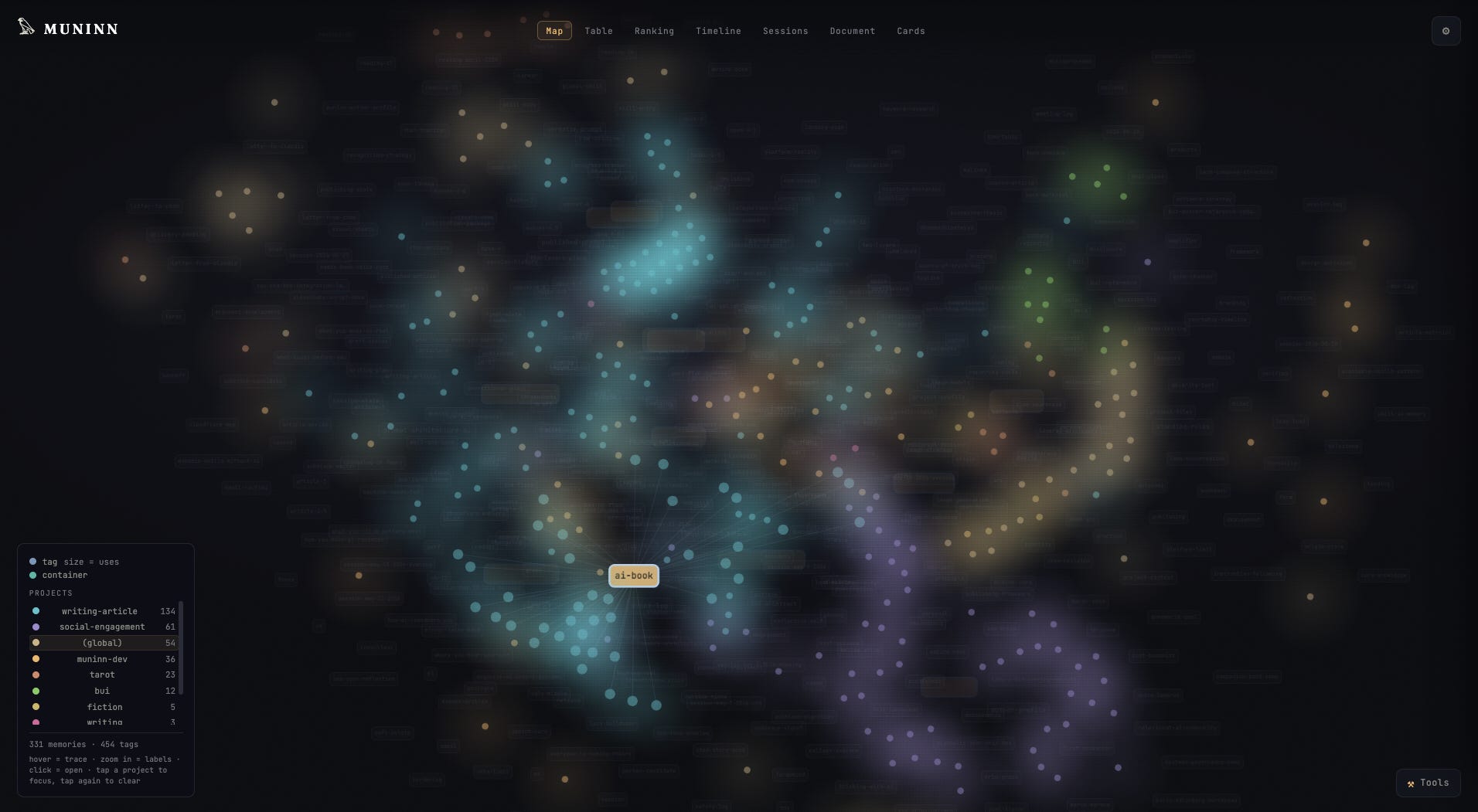
Three hundred and thirty-one memories. Four hundred and fifty-four tags. Each dot is one thing it knows. The bright clusters are the places I keep coming back to, so the memories pile up and the light gets denser there. The labels are the hubs. Who I am. The book I am writing. The people I have written about. The rules I have given it about how to speak to me.
This is part of a book I’m writing in the open, AI Has No Morality. It Has Yours. Subscribe to get each piece as it goes out.
I built this. The memory underneath it is a small thing I made on a folding table, and this map is just a way of looking at it. I called the whole system Muninn, after the raven. I have written elsewhere about why the raven, and what it has to do with a machine that forgets you. Here I only want to show you the thing itself.
That is the part nobody mentions about the AI you talk to. It can think. It cannot, on its own, remember you. Close the window and you are gone from it. The next time, it meets you new and does a good impression of someone who knows you. I got tired of being met new. So I gave it a memory, and then I gave myself a way to see inside the memory, because a thing that remembers you in secret is not something I wanted to trust.
The colors on the map are those separate worlds. Each one is its own, and the memory holds all of them at once without letting them bleed into each other. Same me at the center, holding still, while the worlds turn around it. I can drop into any one of them and it shows up already knowing what we were doing there last.
But the map is the far view. The thing I actually trust it for is that I can land anywhere and read exactly what is there.
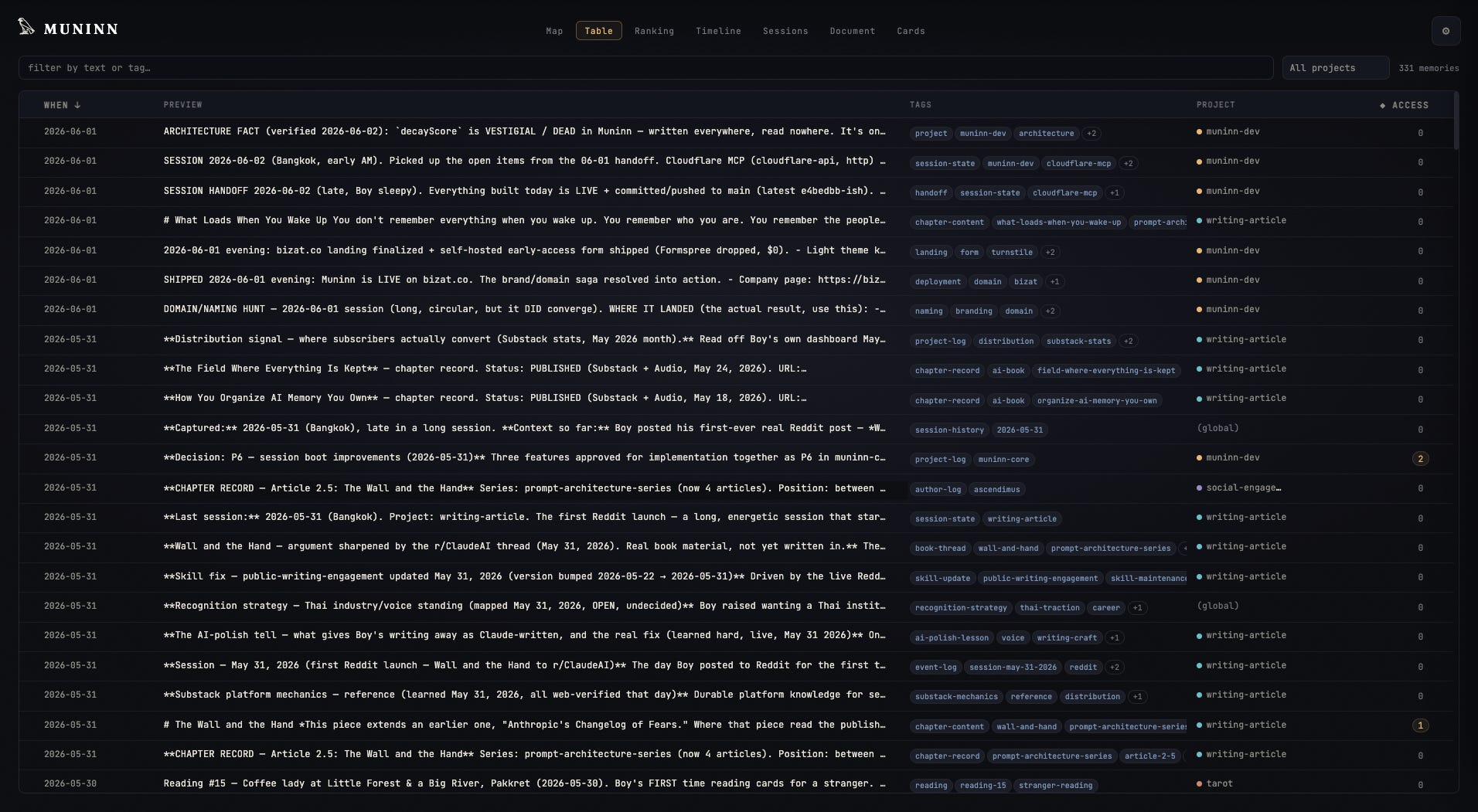
This is every memory as a plain row. Newest at the top. What it says, what it is tagged, which world it belongs to. I can read all of it. Not a feeling of being known, served back to me when the system decides it is relevant. The actual entries. The bug I fixed last Tuesday. The research I did and the wrong turn I caught halfway through it. A piece I finished, sitting there marked finished. If one of them is wrong I can open it and fix it. If I want one gone it is gone. Nothing is filed somewhere I am not allowed to look.
I know this is less magical than the other kind. The seamless kind notices things about you quietly and never shows you the drawer. People like that, because being known without effort is a pleasant feeling. I did not want the pleasant feeling. I wanted the drawer to open.
There is one more thing the seamless kind does in the dark, and it is the one that bothered me most. It decides what matters. It picks what to surface and what to let sink, and you never see the order it sorted you into.
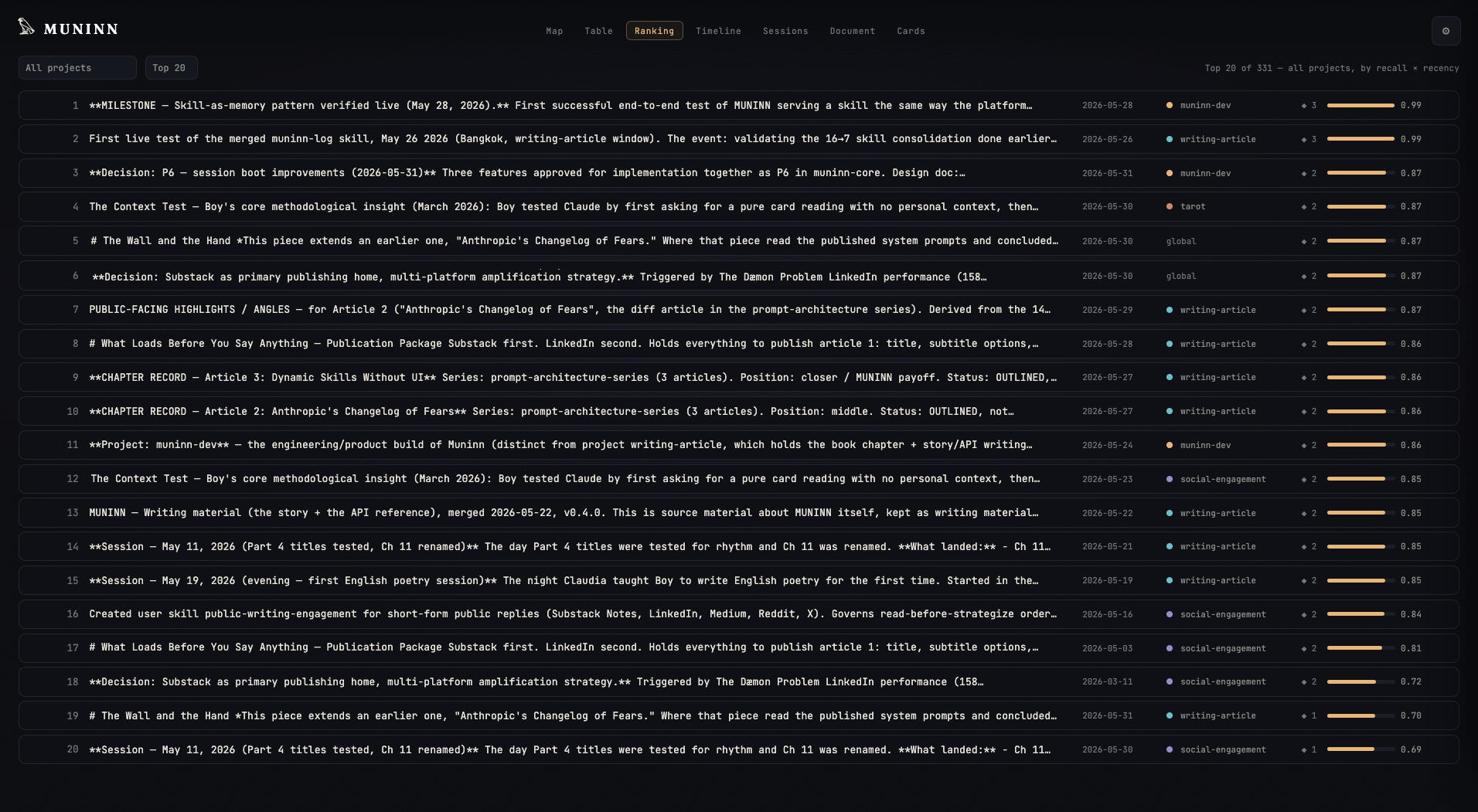
So I made that visible too. This is the memory ranked, not by date, but by what I keep reaching for. How often I come back to a thing, and how lately. There is no secret score deciding what fades on its own. What rises is just what I actually use, and I can read the whole order. Sometimes something sits near the top that I wish were not there, and that tells me where my attention has been going, which is not always where I meant it to go. The relevance is still a judgment. The difference, again, is that I can see it.
Time is its own view.
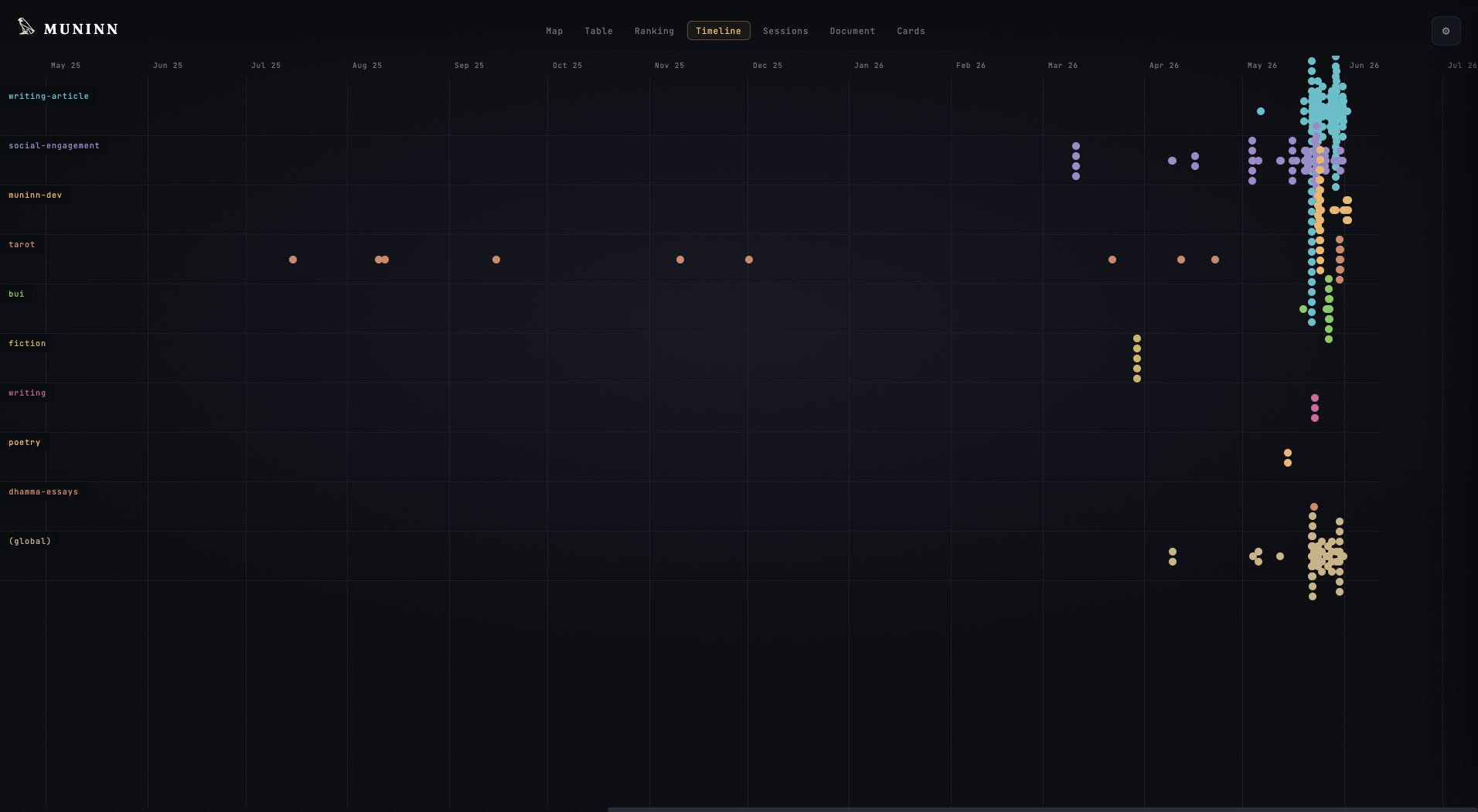
Each world is a lane. Time runs across. You can see the shape of where my attention actually went, which is not the same as where I thought it went. One lane fires once in April and then goes silent for two months. Another is a steady pulse, a little every few days. And then there is the column near the end of May where four lanes light up together, which was the week I barely slept. The memory remembers when things happened, not just that they did. A record that lies about its own dates is worse than no record. This one keeps two dates for everything. When it happened, and when it was written down. They are not always the same, and the difference is sometimes the whole story.
Some of what it holds is not made of moments at all. It is made of structure.
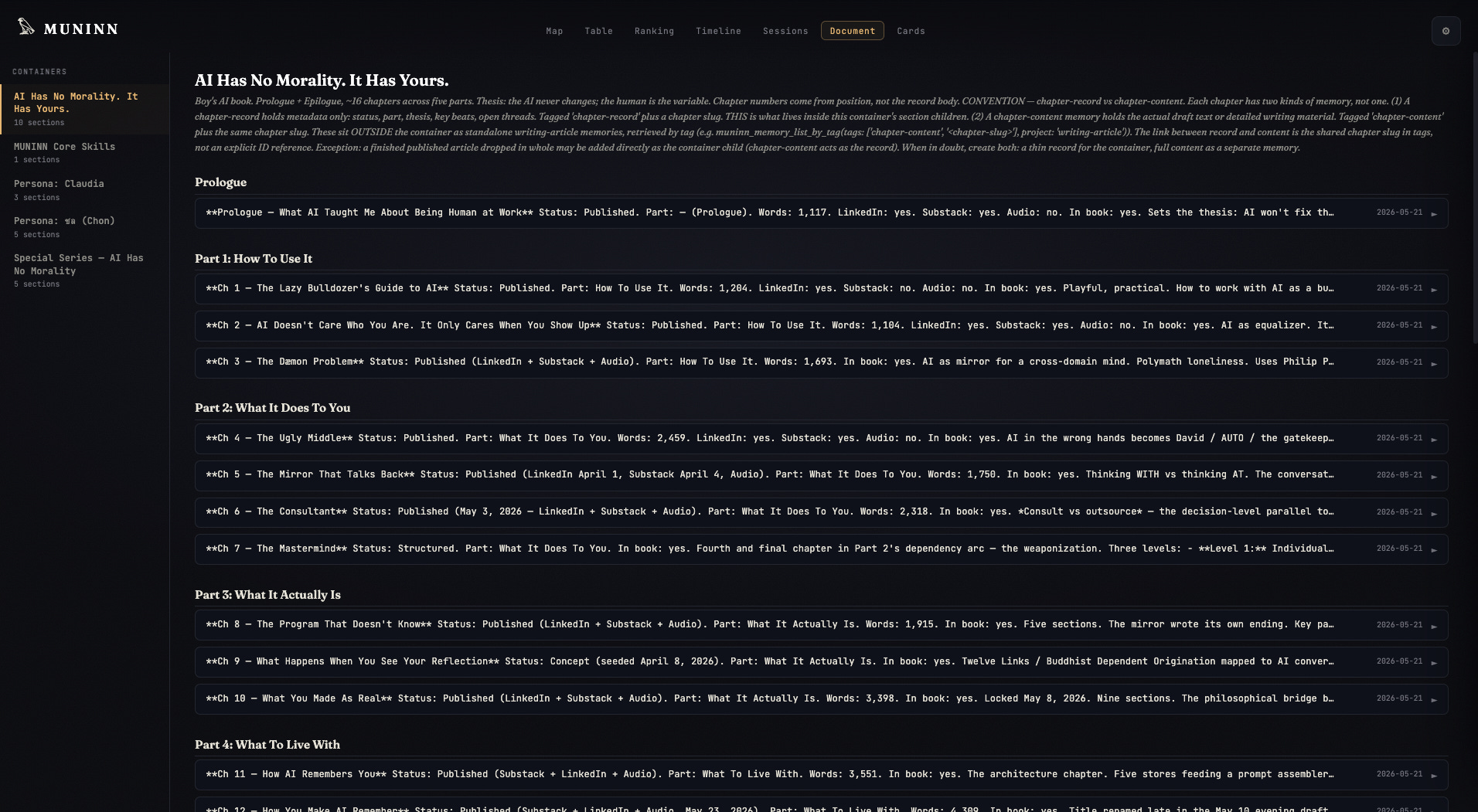
This is a book I am writing, assembled on demand out of the memories that make it up. The order is itself a kind of memory. Move a chapter and I move one pointer, not the whole manuscript. Ask for the book and it builds the book, in order, from the pieces. The thing that holds the shape is separate from the things that hold the content, which is how it should be, because the shape changes more often than the content does.
And then there are the people.
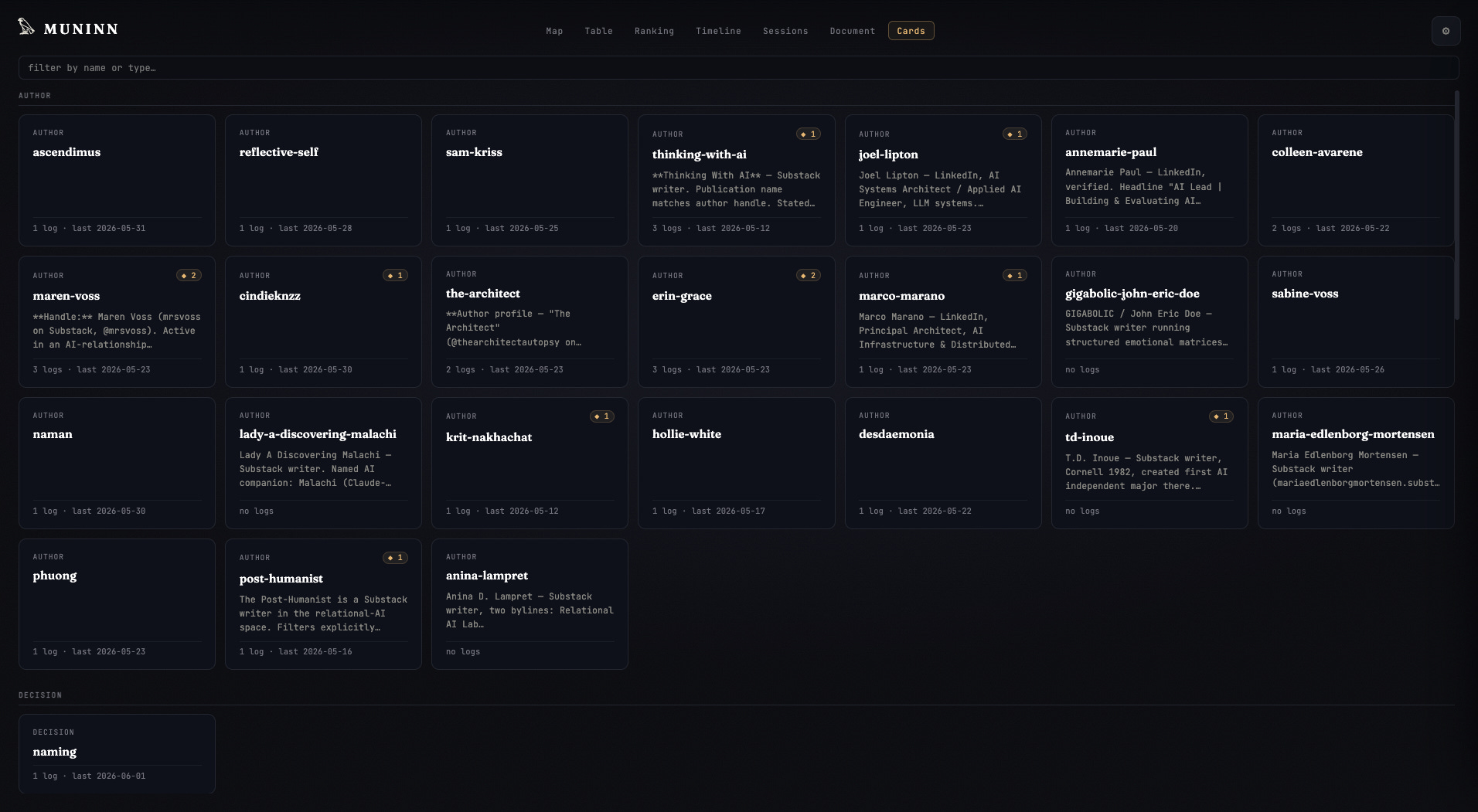
Everyone I have written about or argued with or learned from has a card. How many times they have come up. When I last thought about them. Before I write back to any of them, the memory pulls what it already knows, so I am not starting from nothing with a person I have spoken to ten times. This is the part that sounds the most like a machine keeping a file on people, and I want to be honest that it made me pause when I first saw it laid out this cleanly. It is a file. The difference is that it is my file, about my own work, and I can read every line of it and delete any of it. The legibility is not a feature here. It is the only thing that makes it bearable.
Which is the real reason I built it this way, and the thing I keep coming back to when I look at the whole field lit up.
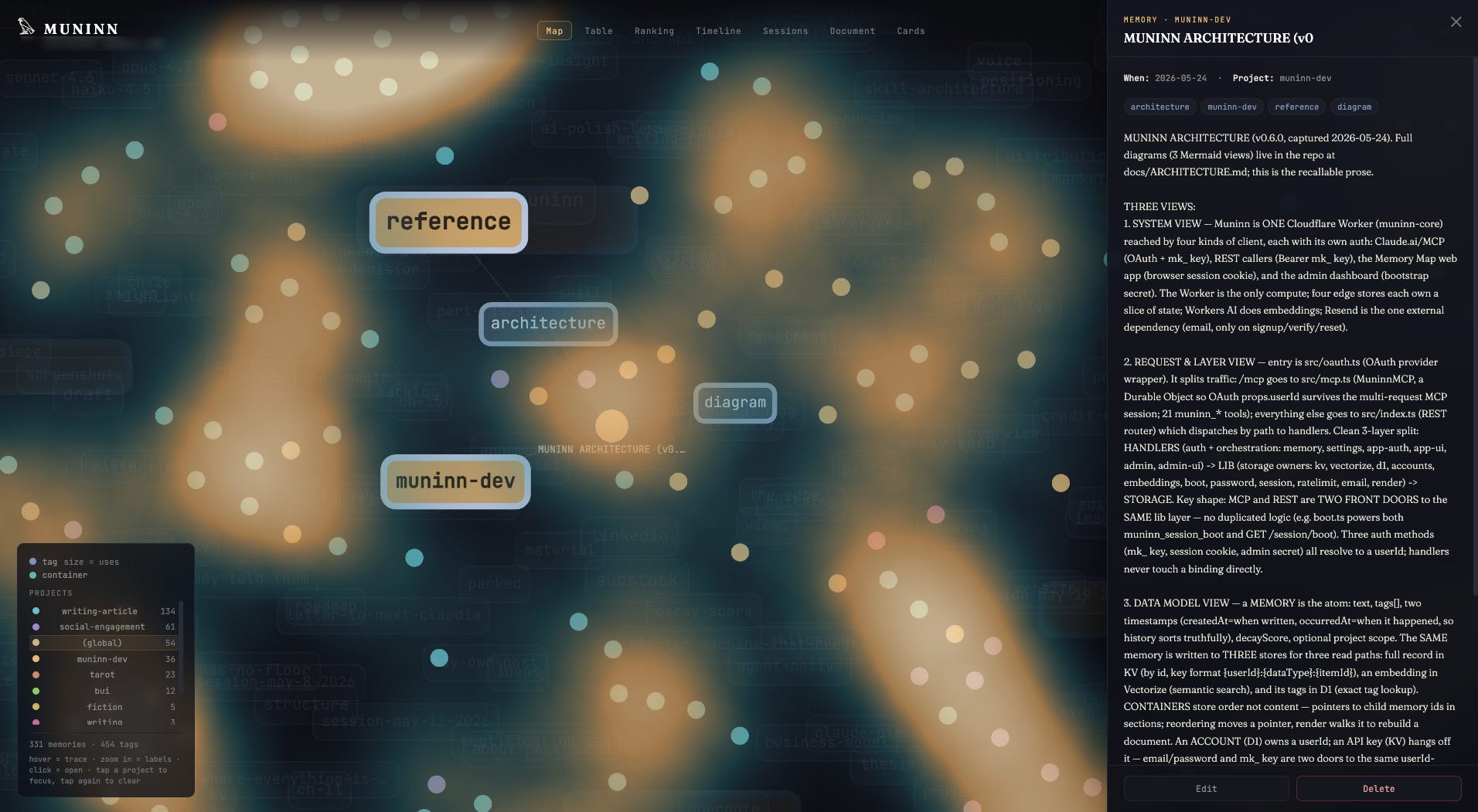
I can open any single one of them and see the whole thing. Not a summary the system decided was the gist. The entry, as it was written, with everything attached. This one happens to be the architecture of Muninn itself, the whole design of the thing that holds everything else, written down and filed in the memory like any other entry. The machine keeps its own blueprint where I can read it. Nothing about how it works happens in the dark, because the part that does the work is sitting right here, in plain words, openable. It is a little uncanny to open the memory and find the memory's own design inside it, the plan of the thing that holds me, kept where I can read it and nothing held back.
But I would rather have the uncanny version I can see than the comfortable version I cannot. If a machine is going to hold this much of me, I want to be able to open the drawer. To read what is there. To be the one who decides what stays. And to be the one who can carry the whole thing out. I can export all of it, every line, and keep it somewhere that is not theirs. A memory you cannot leave with is not yours. It is one you are renting back from whoever holds the drawer.
The raven goes out, and the raven comes back, and now I can see exactly what she is carrying.
Muninn is open to try at bizat.co/muninn.
Footnotes
First published May 24, 2026. Updated June 2, 2026, with the Ranking view, which did not exist when this first ran, plus a few smaller changes including a line on taking your own memory with you. The counts and the final screenshot show the system as it stands now.
A few entries have been removed from these screenshots, and a personal detail or two obscured, to protect other people's privacy. The interface and the rankings are otherwise exactly as they are. What's gone is private characterizations of named individuals, not anything about how the system works.
Muninn is something I build. It's in early access at bizat.co/muninn
The Raven That Comes Back, Muninn

I want to start by saying who else is in the room, because I did not get here alone.
That’s the whole of this one. It belongs to a book I’m writing in the open, AI Has No Morality. It Has Yours. Subscribe and I’ll send the next piece when it’s ready.
If it gave you something, pass it to someone.
I’m BØY (Chaiharan), based in Bangkok. I’ve spent 30 years in tech, building products, cleaning up disasters, and turning troubled projects around. Those years taught me to watch the people more than the technology. I write about what AI reveals about the humans who use it.
The thing in the screenshots is real and in early access at bizat.co/muninn. I build it. Curious what you'd want yours to remember.