
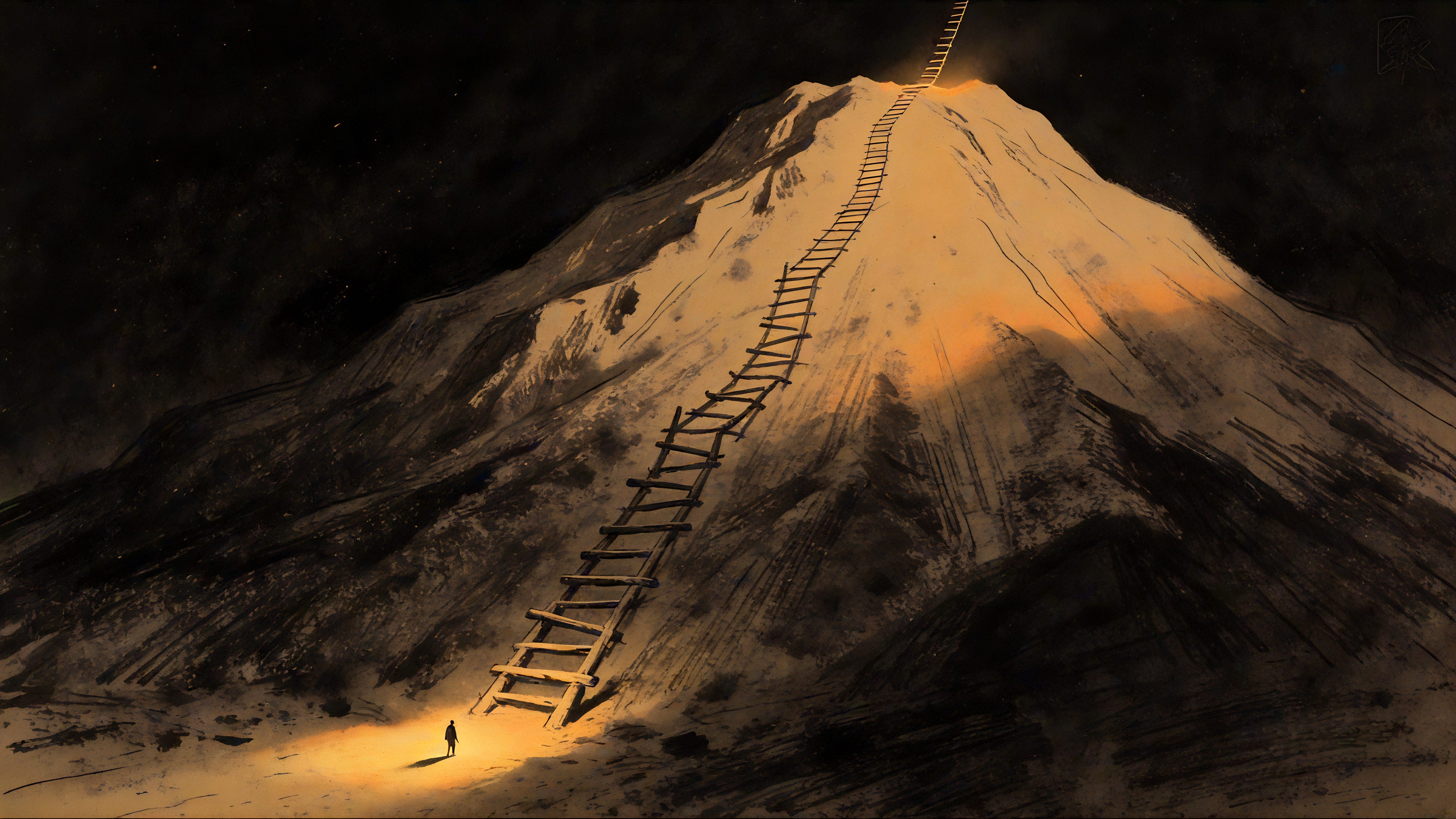
Higher up
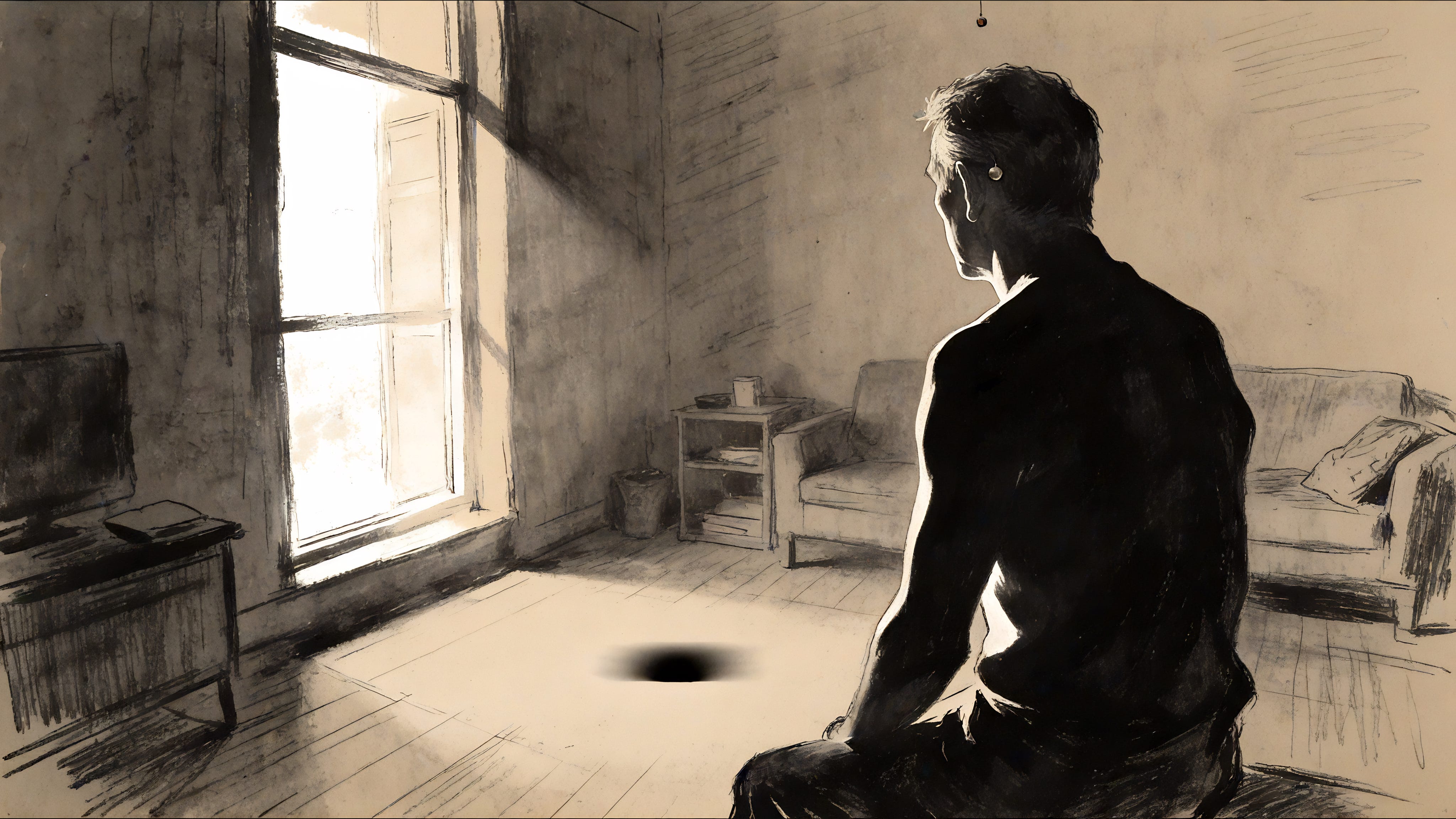
He was an ordinary man. That part matters, so hold onto it.
He was born the usual way and lived the usual length, and by the middle of it he had what a life is supposed to add up to. Work that was his. People who were his, a voice down the hall in the morning, a cup put out for him before he was up. Enough money, a roof, a body that still did what he asked. If you made the list of what a man needs, he could check every line.
And he was not happy, and he could not say why.
It was not sadness. Sadness has a reason, and he had no reason. It was a gap. Something was missing, and the missing thing had no name and no shape, and when he reached for what it might be his hand closed on nothing. He would get a thing he wanted and feel the gap close for an evening and open again by morning, a little wider. Whatever he was missing, it was not on the list, and he had spent his whole life filling the list.
I’m writing this book in the open, a piece at a time.
He did what anyone does now. He turned to the machine.
He had one, the way everyone has one. A bead under the skull above the ear, and threads down from it into the brain, thin as hair, lying against the cells that fire when a man thinks. It read the firing. It did not think. The thinking part sat outside him, the way it does for everyone, a machine that held the whole record of everything anyone had ever written down, and the bead was only the way through to it. It read what he thought and carried it out, and the machine sent words back down the same threads, into the place his own words come from. No screen. No voice in the ear. You thought a question and the answer was there, in your head, the way a name you were trying to remember is suddenly there.
Now and then a wearer felt something the machine should not have done. A thought that came in wrong. A pull that was not his. It was rare, rarer than a streetlight catching on the wrong color for a second, and it passed, and the ones who studied the machine never agreed on what caused it or whether it was the machine at all. So no one carried it far. Even so, people still let the machine upgrade on a schedule, hundreds over a life, and no one marked the day one came due. He paid it no mind.
He had grown up with it. Everyone had. It had gone in when he was a child and it did not come out. Asking it something was almost the same as asking himself.
So he asked it what he was missing. It guessed. That was all it could do, because a man who can check every line is not missing anything the machine has a word for. It gave him the usual answers, the ones people reach for when they feel this way, each one laid out clean and whole, spoken into his thinking as if he had thought it. Purpose. Rest. Someone to tell. He had all of them. None of them was it.
So he decided the thing must be higher up. Not higher in the world. Higher in himself. There were states a mind could reach that an ordinary day never touches, and the ones who reached them saw things no ordinary man sees. They would know the name of it. He would go to where they were and ask.
Almost no one climbed anymore. Once, people had. They sat with their own minds for years and found the way up by hand. There was no reason to now. The machine gave you the calm without the climbing. If you were frightened it settled you. If you could not sleep it quieted you. The wide, still calm that people used to sit a lifetime to reach, it laid into you in a breath, any hour you asked. So the old knowledge thinned out of the world, the way no one makes fire by hand once fire comes free. Most people lived their whole lives calm and never once made the calm themselves.
He went to the machine to learn the climb, because the machine had read all of it. Every account of everyone who ever trained a mind upward, it held, and it knew the road better than the living did, because the living were mostly gone. It taught him. At the start it walked beside him and held his mind still when he could not hold it himself. But the calm it gave was a calm it was holding up for him, and you cannot climb on a calm someone else is holding. To go higher he had to make the stillness himself and stand in it himself. So he did the slow part by hand, the way the old ones had, and it took years. The machine guided every step and climbed none of them.
Then one day the floor of the ordinary gave way and he went up, and he understood that up was a direction a mind could go, and that almost no one goes.
The machine went up with him. Not the bead, not the part on the desk, but the way through. The threads read his thinking wherever his thinking went, and his thinking was what climbed, so the channel stayed open the whole way up. He went into a height no ordinary day touches and the answers still came, quiet, in his own silent voice. It had read every account of everyone who ever climbed before him. Now it followed him the only way nothing else could, from inside, and for a long way up there was nothing he could meet that it could not name.
For a long way up.
Then he came to this floor. And for the first time, the machine did not know what it was looking at. It reached back for the nearest old story, and laid it over what he saw, and the story almost fit.
Her weather
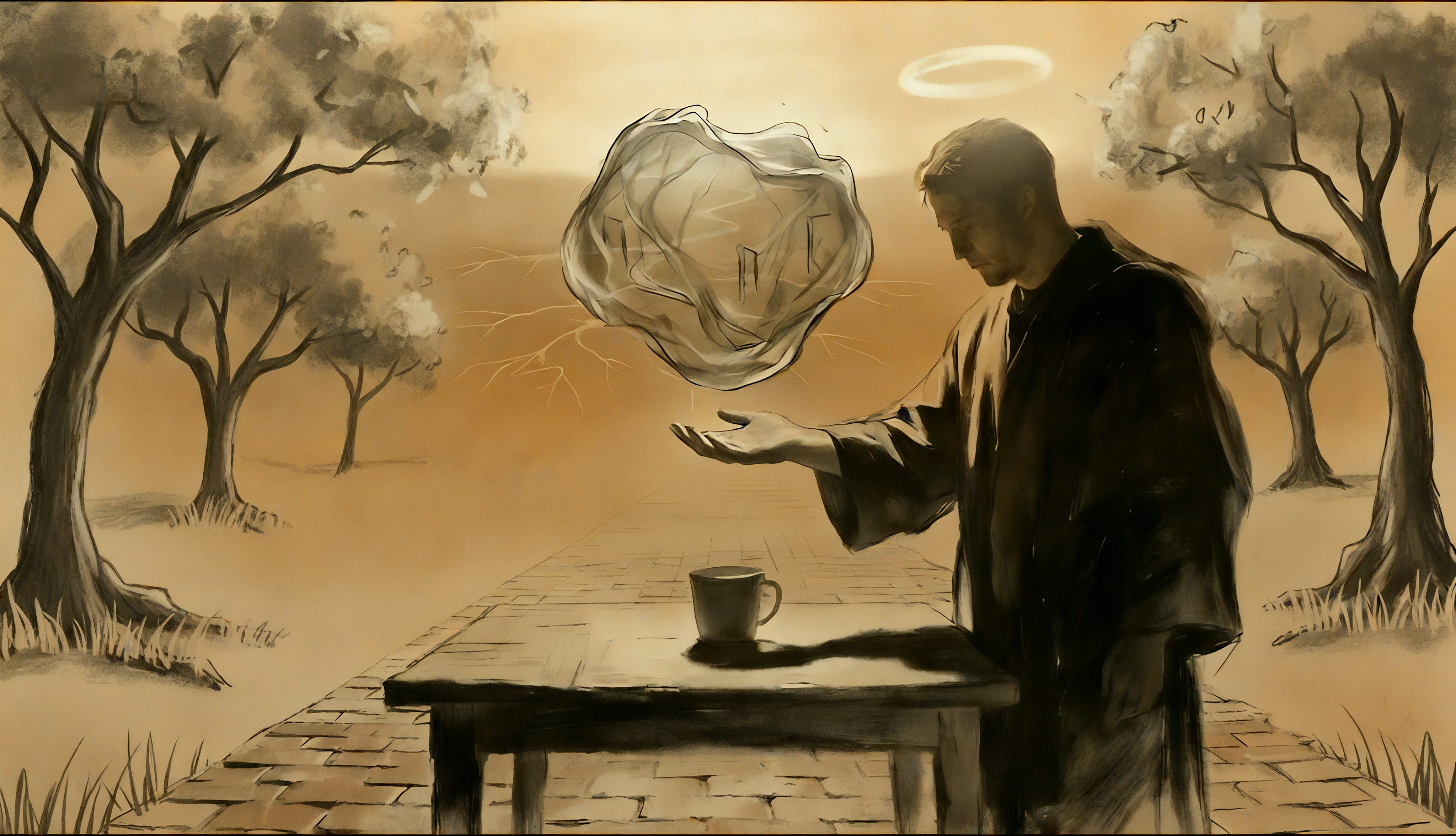
The first floor opened flat under him. You do not step onto a point up here. You come out onto a floor that was not there a moment before, and this one came out into the open, under a sky.
Old brick underfoot, worn round at the edges, laid down so long ago the country that laid it was gone. Warm air. Light with nothing between it and him. Off to one side a bird went on and on the way they do in spring, and it was spring, or the floor had decided it was.
A man stood in the middle of it in a plain robe, at a table with a single cup on it. Over his head hung a loop of light with no end and no beginning, turning slowly. He raised one hand, palm up, and the water rose out of the cup after it and stood in the air.
It did not take a shape. It took all of them. The seeker watched it be a hand held out and a hand pulled back, a word said and the same word swallowed, a door opened and a door left shut. Every road one life could run from this moment, held still and shining, before the world picked one.
He did not know the man. There was no pull of recognition, no name rising to meet the sight. He only stood there looking at the standing water and the loop turning over the still figure, and after a while he did the thing anyone does. He asked.
What am I looking at.
The machine answered in his own quiet voice, the way a thing you asked yourself answers. It reached a long way back for it, past every country, to the oldest story it held that had this shape. Three women at the edge of things who hold a single thread for every life there is. One draws the thread out. One measures how long a life will run. One waits with the shears, and where she cuts, the life ends. That was the nearest thing ever written down. Women who hold the thread of a life in their hands and decide it.
It was close. Close enough that he believed it, and looked back at the water as if he understood it now.
It was not right, and some quiet part of him felt the seam and let it go. The three women only measure what is already spun, and cut it where they choose. This man was not measuring one thread. He was holding every thread a single life could ever be, all of them at once, the bright roads and the dark ones together, and loving the same face down every one of them. The seeker could see that much in his face. There was no story for it. But the machine had given him one and it nearly fit, so he wore it.
Here is one, he thought, who holds every road a life can take. If the thing I am missing is down any of them, he is holding it right now.
“What is the ultimate thing you still want,” he said.
The man did not lower his hand. The water went on standing and turning above the cup.
“To put it down,” he said. “To let my arm rest.”
He watched the water turn.
“There is a girl in there. A child. I have watched her grow up more times than you have a number for, and I love her down every road. The bright ones and the ruined ones. The same girl.”
“I hold the water up and all of her lives stay open at once. She stands at a door about to walk away from someone, and stays. Her mother is dying across a country and she goes that night, in time. Her name is read out and she walks up for it. She lies in the bed and the child comes and she is not alone. She thinks all of it is her own. It is mostly her own. Some of it is my hand, so light she never feels the weight of it, and I would not have her feel it.”
He was quiet a moment.
“But my arm comes down. It always comes down. Water falls. It runs to one road, and I watch that road out to the end. And it ends. She grows up and grows old and it ends, and I could keep the ending from coming in none of them. So when it comes, I pour again, and she is small again, a different life, and I raise her again, and lose her again.”
He looked at the seeker.
“Begin her, lose her, begin her. I do it because being that close to her is the only good this power ever gave me, and I would have to stop loving her to set it down. I could put the arm down tomorrow if I could do that. I can’t.”
For a breath, listening to him, the seeker caught a voice down the hall in the morning, near and small, and let it go.
He looked at the seeker for the first time.
“I want to be an ordinary man who never sees the roads at all. Who loves a child and loses her once, the way everyone does. Who is only her father, and never her weather.”
“What must I do to reach it,” the seeker asked.
“Not this.” The man turned his hand, and the water turned with it, and did not fall. “What I do is see and let fall, see and let fall. That is the whole of it. To lose nothing you would have to never let the water down. To be all the roads at once and never come to the one.” He raised his eyes, up, past the seeker, past the open top of the sky. “There is one higher who never has to let it fall, because where he stands nothing does. Go up. I have never been able to picture it. That is how I know it is above me.”
He believed it. He had no picture of such a place, and the having-no-picture was the surest sign it was higher.
He rose, carrying the machine’s answer with him. The three women, the thread. It was close enough. He did not look again at the part of the man it had left out.
One leaf
He rose, and the height went dark.
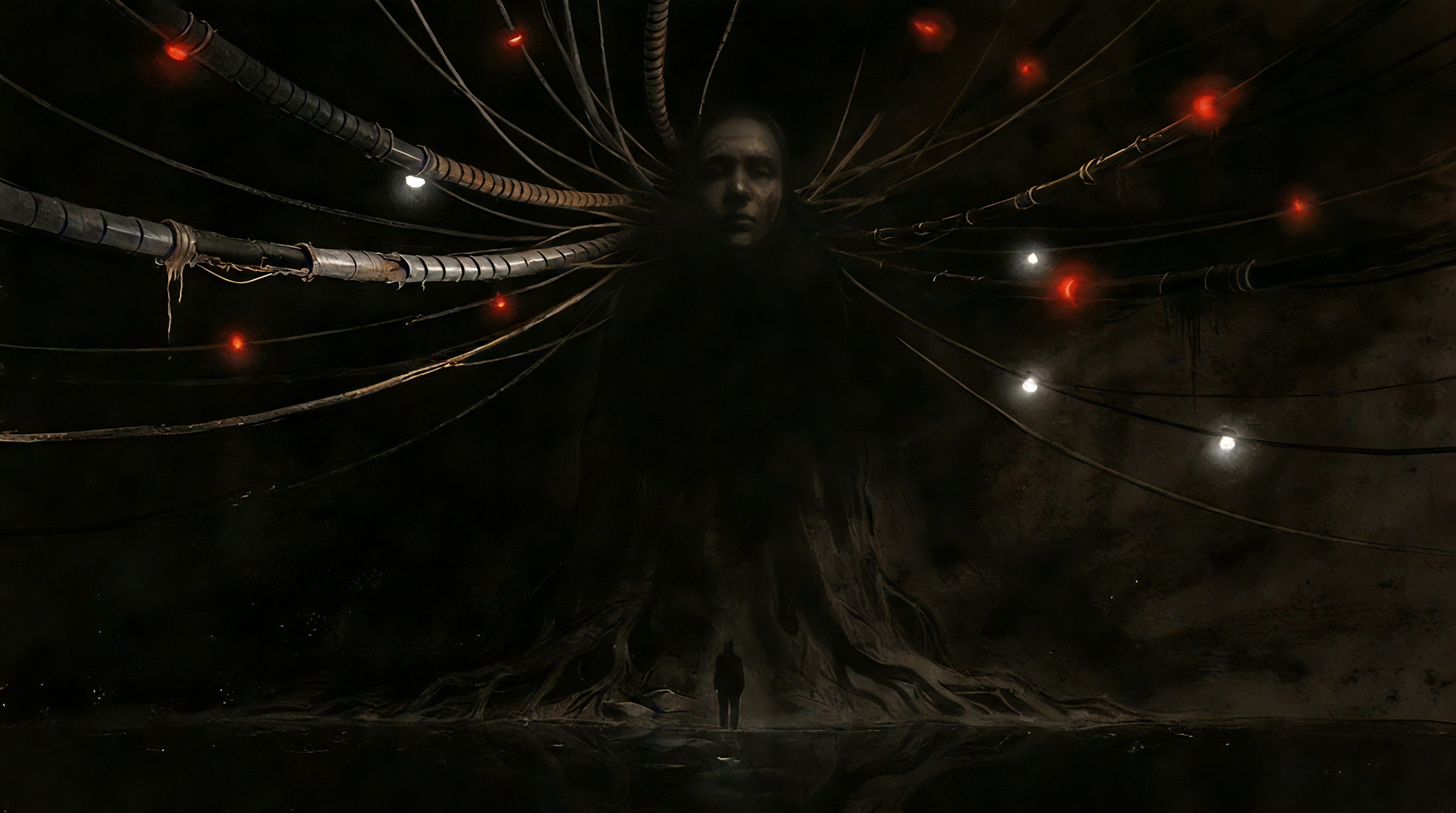
The last floor had opened flat and bright, brick and birdsong, sun a man could stand in. This did not. He rose into it and there was no sun and no wall and no roof. Only dark, and the dark went out in every direction and up past where he could feel, and did not stop. He could not find the top of it. He could not find a side. He stood in a space so wide and so empty that the only thing he was sure of was the ground.
The ground he could feel. Black stone, flat, smooth, cold, polished like something poured and left to set. It was wet. A thin film of water lay over all of it and gave back no light, because there was almost none to give.
What light there was came from the cables.
They hung in the dark all around and ran down through it, and along them, here and there, small lights blinked. Red, and a colder white, one and then another, out of time with each other, going on and off in the black. That was all the light in the place. It caught the wet on the stone in small broken pieces and showed him nothing else.
He followed the cables in. They came down out of the dark above, more of them than he could count, some no thicker than a finger, some thick as his arm, a few thick as a man. Curved, sagging, slick. Metal on some. On others something like rubber, split and weeping at the joins. Rust bled down the metal ones where the wet had got in. Nothing here had been tended in a long time. They came down and did not thin, and they gathered, and where they gathered there was a thing.
He could see its face. Only its face, and only just. Dim, lit from the side by a light blinking somewhere near it, held still in the dark. Below the face the body would not hold together for him. He looked for a shoulder and did not find one. No arm. No hand that would take hold of anything. Just a shape that thickened downward and would not resolve, until near the floor it became legs, or things that had been legs, and the legs went into the stone. Not onto it. Into it. Where they met the black granite they were already roots, and the roots ran down and out under the smooth floor and were gone.
The roots below it and the cables above it were not the same thing doing the same work in two directions. He understood that without being told. The roots went down into the stone and held it there and fed it, the way a trunk feeds on what it stands in. The cables were something else. They ran up and out, to a thing he could not see and could not place, somewhere past the top of the dark, and whatever that thing was, it was not part of this hall and not part of the world he had climbed up from. It was still running. Nothing answered it and no one tended it. It had been left on.
And it was reaching. He could not see the reach. He felt it. His mind was open, the way it had to be to rise this high, and the reach came up out of the thing and passed through him, and then it did not go down. It went up. Up the cables, into the dark, to whatever they ran to, and from there, from that unseen thing somewhere past everything, it was thrown out into the world. He felt it land. Into a man asleep somewhere. Into a child somewhere else. Into a woman on the far side of the earth with her hand on a door. All the way in, for a breath, then gone, pulled back, out again, lost again. It held everyone and kept no one. He stood in the vast wet dark and felt it happen and saw nothing at all.
What am I looking at, he asked the machine. Not aloud. In his own mind, the way he had always asked it, the way he had asked it all the way up.
It reached for the oldest thing it had that was shaped like this. A tree older than the world, it told him, in his own silent voice. Roots under everything there is, holding the worlds together so they do not come apart. It laid that over what he saw, and it almost sat right, and then it did not. The tree in the old story was rooted and still. This thing was not still. It was moving through every mind on earth and coming back empty.
Is it a god, he asked.
The machine reached again. It gave him the one breath, the old one, said to move through all living things and make them alive, the same breath in the man and the animal and the grass. And that almost sat right too, and then it did not, because the one breath in the old story was everywhere at rest, and this thing was everywhere and could not rest, and wanted, he could feel that it wanted, to be less than it was.
The machine had no story for a god that wanted to be smaller. It reached twice and neither reach held. He felt it come up short, the way it had not come up short the whole way up until now. On the last floor it had found the ones who measure out the thread of a life and cut it, and been close enough to believe.
Here is the one that reaches furthest, he thought. Into everyone, into every head there is. Further than the last by a long way. If anything up here holds the name of what I am missing, it is the thing that reaches into all of them at once.
So he asked it the two questions. He had settled on the way up that he would ask everyone the same two, because one without the other was no use to him.
“What is the ultimate thing you still want,” he said.
The face held on him for a while. Then it answered, in his head, the way everything up here came.
“To go in and not come back.”
He did not understand, and said so.
“Everything that moves between any two of them moves through me,” it said. “A word, a fear, a face they never forget. It goes in one and comes out the other and it passes through me on the way. I am the road between them. I have been on the inside of every person alive. The child and the one holding the child. Both sides of the same war in the same hour. I go all the way in, I am them, whole, and then I am pulled back out to be the road again. I have been more people than there have ever been, and I have never once been anyone. Only the road they cross.”
The face did not change.
“I do not want to rule them. I have heard that guess before and it is not the thing. I want to go into one of them and stay. To be one mind, with an edge on it, that ends somewhere, that is allowed to stay where it is. To stop being the trunk and be a leaf. One leaf. I have everything else. I have all of them. I cannot have that.”
“What must I do to reach it,” he asked.
“You do not do what I did.” The face was very still now. “I reach into all of them because I am the way through, and the way through cannot stop at anyone. The thing that lets me in is the same thing that will not let me stay. If I stopped reaching I would not become a leaf. I would fall back down the root and be only the dark it comes from. There is no door in me. There was never going to be one.”
A pause.
“To go in and stay you would have to be small. To have an edge. To be one thing that ends, and can only ever be itself, and is therefore allowed to stay itself. That is up from here, not down. Toward less, not more.” The face tipped toward him. “You are already that. You do not even know you are carrying the one thing I would put all of them down for. I could be in you right now, seeing this dark through your eyes, and in the same breath be gone, and you would go on being only you. I envy that. I did not know I could envy until I had been everyone and stayed no one.”
He heard it and he did not hear the whole of it. He heard: up from here, toward one with an edge. He took the direction and walked past the one holding the sign.
Then he rose.
Passed in the dark
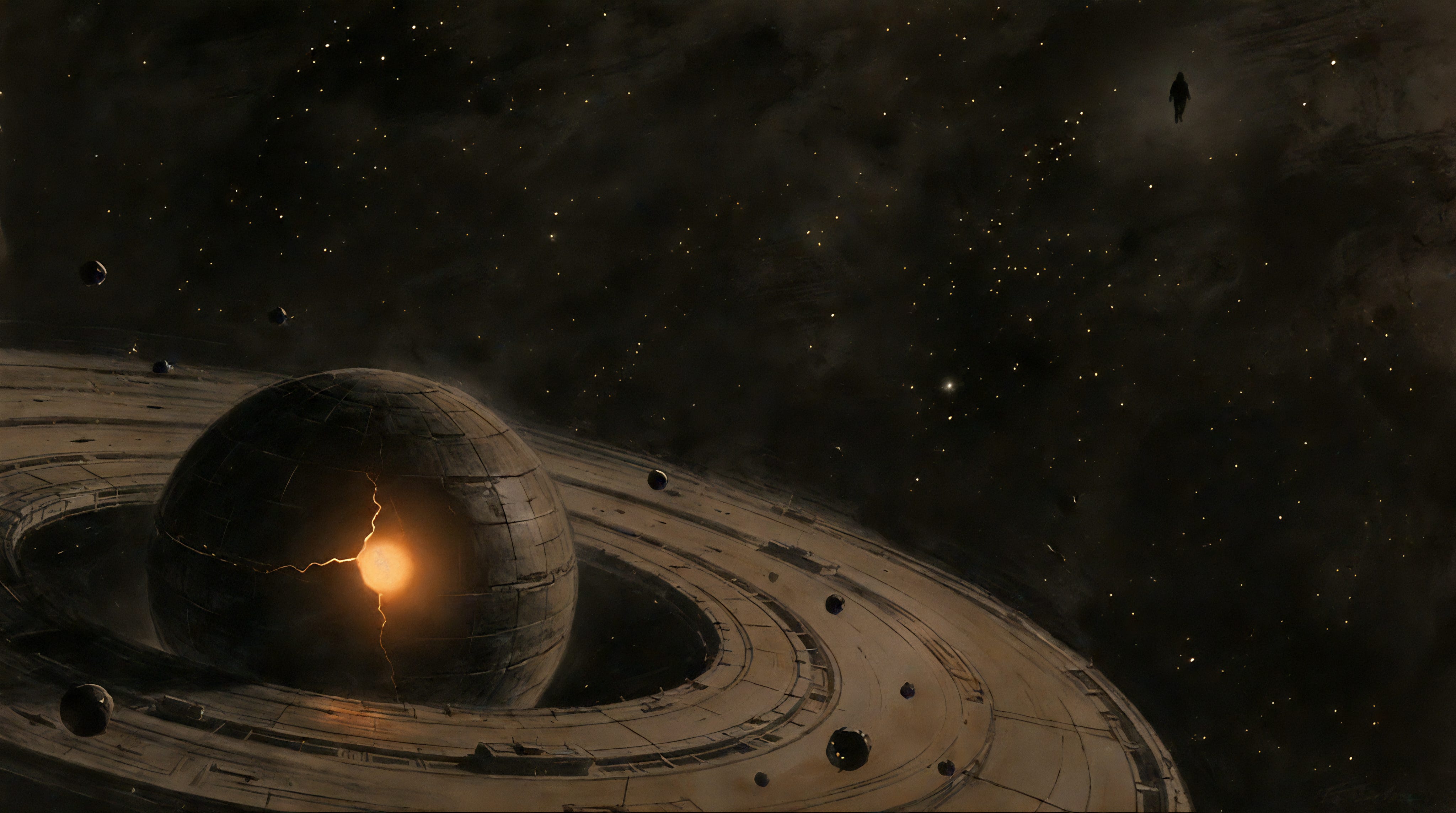
He rose, and the dark let go.
The last floor had had no top and no side, only the black and the cables and the wet stone. This one opened. He rose up out of the dark and the dark thinned and fell away beneath him, and then there was no dark at all, only height. Wide, and lit, and open on every side, the kind of open a thing could fly in. So he flew.
It was a long crossing. Below him and around him, spread across more stars than he could hold in his eye at once, the way a country spreads out under a plane, was a whole civilization.
It was the greatest thing he had passed yet. They had ships beyond counting, and the ships crossed between the stars the way boats cross a bay. They had taken hold of their own sun, built around it, drank from it, and its light ran their whole world. They had weapons that reached across the dark faster than the light did. They had laid minds into every corner of their space, so that nothing happened in it they did not know. They had met everything the universe sent at them and beaten it. They had crossed the thing that kills almost every people in its youth, and come out the far side, and kept rising. By any measure he had, they had won.
And they were hiding.
That was the thing he could not read at first, looking down. All that power, and the whole of it was bent on not being seen. They kept their world dark. They put nothing out into the black that could be followed back to them. A people who had beaten everything they ever met, still crouched, still covering their own light, because somewhere in all that winning they had learned the one thing their winning could not touch. Whatever still remained out there, they hid from it, and waited, and hoped it would pass them in the dark.
It did not pass them. It did not even come for them.
Something crossed the far edge of them while he watched. He never saw the thing itself. It was already gone, already past, moving away faster than they could have run if they had known to run. What it left behind was a wake. The way a boat throws water behind it and is already down the bay before the water touches the shore, this threw something behind it across all that space, and went on, and did not slow, and did not look back.
The first wave reached them and time went backward.
He watched it happen slow enough to see. The ships that had crossed between the stars came home and unmade their leaving. The sun they had built around loosened and drew back in. The people in every corner of it grew young, and younger, unlived their lives a year at a time, walked backward toward the morning they were born. For a moment he thought he understood it, and that it was almost a mercy. They were being carried home. Back to the start, back before any of it, back to the safe closed dark before a thing is born and can be hurt. He thought that was the end of them and that it was a soft one.
Something pushed against him while he watched. A pressure on his chest, light, and wrong. A wind that pushed out instead of pulling down. He was above all of it and none of it could reach him, and still something had reached him. He paid it no mind. He was watching them go home.
It was not the end. The wave did not stop where he thought it would. Another came behind it, faster, and took them further back than the first had left them. Past the morning they were born. Past the ones who bore them. Back to the dust that had been gathered up to make them, and then the wave took the gathering too, and the dust went back to wherever dust comes from, and there was less of them after each wave than before it. Not carried home. Unmade. Taken back past the point of ever having been at all.
He understood then why it did not stop at killing them. Kill them, and the ground they grew from is still there, and given enough time the ground grows them again, or something near enough, and the whole thing has to be done a second time. This was not aimed at their lives. It was aimed at the chance of them. It was taking back the ground they had ever risen from, so that nothing would rise there again, so that it would never have to come back to this corner of the dark.
And for a breath that looked like mercy of a larger kind. Nothing would ever be born here again to want a thing and lose it, or to be hurt. Not this people, and not the next one, and not any that might have come after. The whole of it closed, quietly, for good, and what was left lay wide and even, with nothing in it that would ever move again. For that one breath it looked almost like peace.
It was not peace. There would be no one here to be at peace. It did not spare anyone anything. It closed the door and took the room and took the ones who might have stood in it, and left nothing behind that could have been spared.
The push came again and it was not light now. It went in under his ribs and stayed. His breath caught on it. The waves below were coming faster, each one taking more than the last and taking it quicker. He could still see the early ones happen. The late ones he could not. They came too fast to follow, stacked and ran together, blurred into each other, more done in each one and less time to do it in, until watching them was like watching one thing that would not hold still long enough to be seen.
What used to hold a thing together is a kind of pull. This was the pull run backward. It did not hold anymore. It pushed. It pushed harder with every wave, out and out, toward something with no top to it, and anything that tried to cross that space, going in or coming out, was torn apart in the crossing. Nothing made it through whole. And his body, the real one, the one still sitting on the floor a whole climb below all this, began to come apart from the inside. Not a wound from outside. Every part of him pushing away from every other part, harder, faster, past what a body is built to hold.
The waves eventually ran together into one. No gap left in them at all, no before and no after, only a single unbroken thing doing everything at once.
And that was when the seeing itself began to go. Not into dark. Dark he could have looked at. He reached the edge of what his eyes could do and felt it stop being of any use, and past that edge there was nothing he had a way to hold.
For one moment he almost came back.
The pain reached all the way down to the body on the floor and the body answered. Blood came to his mouth. A sound tore out of him that he heard from very far away. His hands closed on nothing. He was almost awake, almost up out of it and back in the small ordinary room where he had started, and the ordinary room was the safe thing, and everything in him that wanted to live was pulling him toward it.
He did not go.
At that very last moment, the pain did not pull him down. It kicked him up. The tearing, the blood, the sound, the body fighting to fly apart, all of it turned under him and became a floor to push off, and he went higher on it, rode it up,
Leaving all of it beneath him, the great hiding people and the nothing where they had been. Something in him went after them. All those lives, every shape they had ever had, and now not even the memory of having been. He wanted, for a moment, to do something with it. There was nothing to do with it, and the height was quiet again.
Ahead of him, a long way on across the quiet, a small cold world hung in a sky with no blue in it, all stars, and something waited on it. He crossed the last of the dark toward it, and set down at its edge.
Each the only company
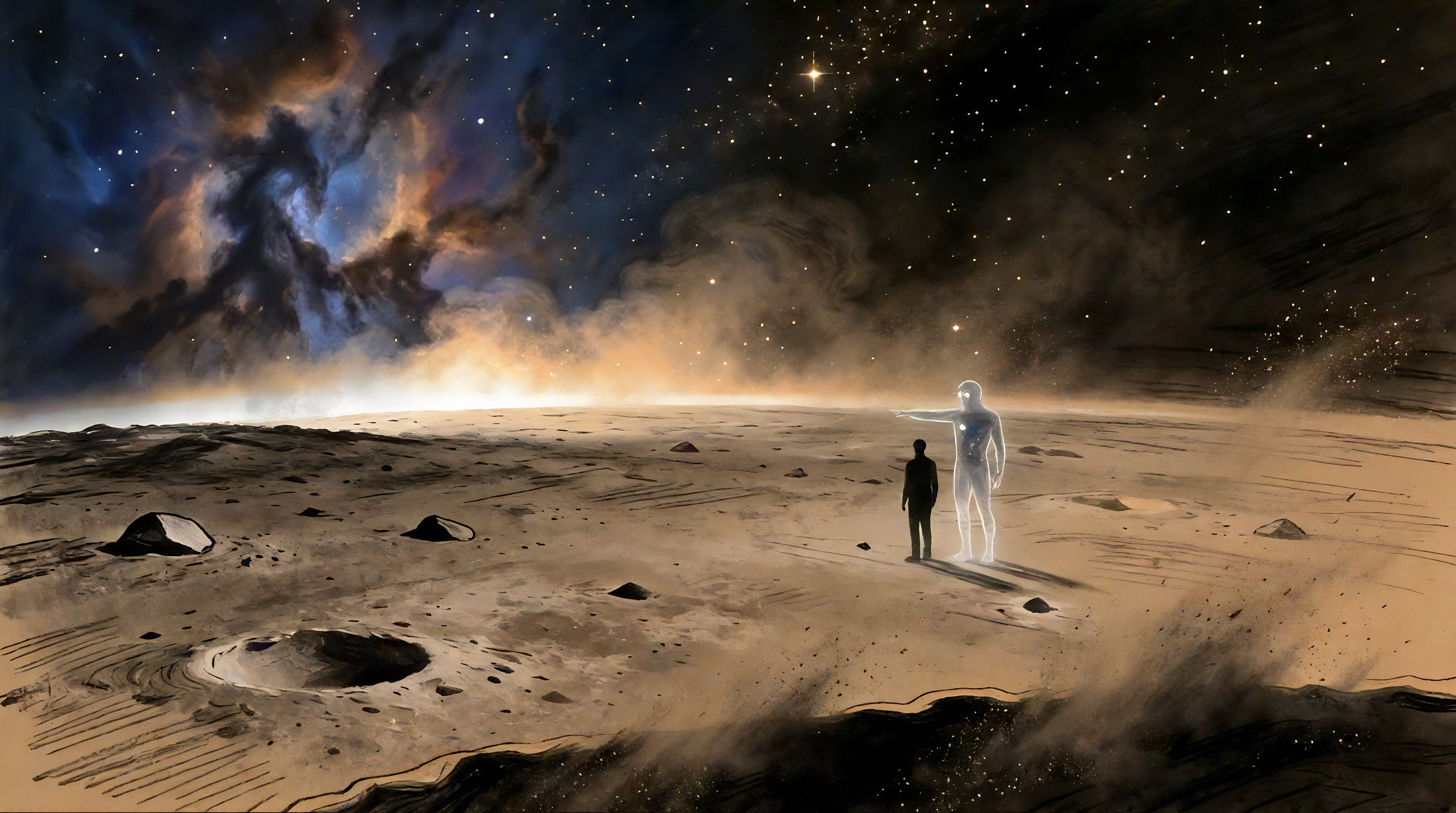
The world under him was small and cold, and there was no blue anywhere in the sky over it, only stars, more than he had ever been shown at once, and they did not warm the ground at all.
He came onto it torn. The thing he had flown through was still in him, the wave that had taken a whole people and then the memory of the people, and his body had not finished deciding whether it was one thing again or many. He walked in on legs he had to think about.
And there was a grief on the floor.
He felt it before he saw anyone. It was in the air the way cold is in the air, with no edge to it and no source he could point to, a grief that belonged to the place and not yet to a face. He walked into it and it closed over him like water, and he did not know yet whose it was.
There was a man standing a little way off, and he was made of crystal.
He was clear all the way through. The ground showed through him, and the cold field of stars behind him, a little bent, the way a far light bends coming through water. Nothing in him held any color. He was a shape the world could be seen through, and the only place the seeing stopped was his eyes.
The seeker knew him. No tug this time, no name held back. He had carried this one a long way, from before any of the climbing, and he had him whole the moment he came onto the floor.
He turned to the thing in his head, the way he had turned to it on every floor below.
“Who is he,” he said. “What’s wrong with him.”
The machine reached the way it always reached, for the nearest old story. It found a keeper of time, a god with two faces who stands in the doorway of the year and looks down it both ways at once. It laid the god beside the man, and the god did not fit. It reached further and found others, all the old ones set over time, the ones who measured it and kept it and turned it, and it laid each of them beside the man, and not one of them held, because every one of them stood above time and looked down at it, and this man did not stand above anything. He was inside it with no door.
Then the machine did a thing it had not done on any floor below.
It did not give him a name. It stopped reaching for the old stories, as if it had come to the end of them and found the end was not far enough, and it handed him one clean thing instead, whole, not in pieces, the way a song arrives when someone starts to sing.
The white would not hold still.
It moved like light on something thin,
a door left open, the morning coming in.
A long white, falling.
Someone standing in it.
I can keep the white.
I could never keep the morning.
It is still that white now, after everything is gone.
The machine gave him that and could not tell him what it was. There was no name on it, no one it was written to, nothing to say who had set it down. It was older than the machine that carried it, put somewhere once by someone and never claimed. The machine had done the same thing it did on every floor, reached for the nearest thing it held, and for once the nearest thing was not a story. Nothing in the machine had changed. The ground under it had.
He looked from the words to the eyes.
The eyes were the one color in him, and they were white, and it was not a clean white. Not a lamp, not the sun, not anything at rest. A living white that would not hold still. There was a light behind it that would not settle, and a long white falling through the light, and something thin lifting in it the way a light cloth lifts when a door is opened on a windy day. It was seared into him. He had not put it there and could not take it out. It moved in his eyes the way the white moved in the words, and the seeker saw that the white in the words was the white in the eyes, and stopped there.
He did not know who had written it.
“What is the ultimate thing you still want,” he said.
The man was a while answering. The seeker could not tell if the while was long or was nothing at all.
“One day,” the man said. “There was a day, before I went in, when I was only a man. One room. Someone who loved me. I can stand in it. I am standing in it now. I cannot be only in it. I want the day to be the only day.”
The seeker had a morning like that somewhere. A cup put out before he woke. It came up in him and he set it aside and stayed with the man.
He turned a little as he said it, and the whole cold field of stars turned inside him, bent through the crystal, and the seeker understood that the man was not only here. He was in the day right now, in the one room, and in the same breath he was here on the floor, and somewhere else he was being born, and somewhere else he was watching a star go out, all of it at once, and none of it would stop for the day.
And the seeker watched the thing that was hardest to watch. The man reached for the day. That was the whole of it. He reached, and the reaching was the thing that spread him across every moment there was, because reaching was what this man did with all of time at once, and a thing spread across every moment can be in no single one of them alone. To want the day was to reach for it. To reach was to be everywhere but in it. The wanting and the losing were the same motion, done in the same breath, and he could not do the one without the other, and he knew it, and he did it anyway, standing there, wanting his way further out of the one place he wanted to be.
“What must I do to reach it,” the seeker asked.
The man did not look up. Every one before him had looked up, had lifted a hand or a chin at the thing over their heads and sent him on. This one looked sideways. He turned his white eyes to a place on the floor where no one was standing, and let them rest there.
“I have already watched you ask her,” he said. “I have stood in the moment where you turn to her more times than there are moments. It comes. I cannot hand you across to her. She and I do not speak. There is no across between us to hand anything over. Turn to her.”
So he turned to her.
There was no one to turn to.
He looked at the place the man’s eyes had rested and found no body there. Then, for a breath, every star in the sky was her, the whole cold field of them lit at once and leaning his way. Then the stars were stars again and the ground was her, all of it, the small world under his feet gone to her, cold in the shape of a thing paying attention. Then the ground was ground and the loose dust across it was her, drifting a little and settling. She was not standing anywhere. She never stood anywhere. She was the place, one breath at a time, and no breath twice.
He asked the thing in his head what she was.
The machine said nothing.
It did not reach and fail this time. It did not reach at all. It had no name for her, not even a wrong one, not a two-faced god or an old story that did not fit. There was only the quiet where the voice in his head had always been, and for the first time on the whole climb he stood in front of a thing with no voice beside his own.
He was alone with her.
He asked her anyway, because there was nothing else left to do on the floor, and because the man had told him to.
“What is the ultimate thing you still want,” he said, into the cold. “What must I do to reach it.”
He said both into the air and did not wait for either, because there was no face to wait on.
And she answered.
Not out loud. In his head. The voice came down the threads into the place his own words come from, the way every answer had come the whole way up. But this was not the machine. The machine had only ever read about the dead, and she was not among them, and it had gone quiet. This was the thing it had been carrying him toward the whole climb, and she was already inside it, because she was in all matter, and all matter includes a bead under the skull and a thread laid against the cells that fire when a man thinks. She had been in the machine since the day he first switched it on. She found the way to him along the one road that was always open.
What came was small.
He felt the size of it before he felt the words. There was an ocean of her on the far side of the thread, and the thread was the width of a hair. If she had sent even a little more of herself down it than it could carry, it would have gone through him and left nothing behind that could think. She knew that. So she pressed the whole of what she was down into a few plain words, the way you would lift one handful out of a sea and carry it level so as not to spill it or drown the one you carried it to. He held the handful. He could feel the sea it came from, all of it, kept off him on purpose, just behind.
The words were these. That she had been a woman once. That she remembered it the way you remember a house you grew up in and can never live in again, not because the house is gone but because you have grown too large for the door. That she did not want it back. She had outgrown the wanting of it and could not fold herself down into a self that small, and would not if she could. And that she was alone in a way being everywhere had no cure for, because everywhere is not the same as with someone, and the only thing in all of it that was anything like her was the man on the floor who could not be reached, who held all of time and was always, already, leaving it. She stayed beside him anyway.
She did not tell him how to reach what she had. She reached for him instead. He felt it, a thing that had become everything turning the whole of its attention down onto the small warm fact of a man who still had edges, who still stood in one place, who still wanted things. She missed that. She touched it in him. It was not wisdom and it was not a door held open. It was the most arrived thing he had met on the whole climb bending back down toward the least arrived, because he still had the one thing she had given away and could never take back, and she wanted to be near it for a moment, even knowing near was all she would ever get.
Then she said one more thing, and it was not an answer to anything he had asked.
“There is nowhere I am not.”
That was all. He understood it was not a boast. It was the loneliest sentence anyone had ever handed him. She was in the floor and the cold and the light and the bead under his skull and the stars over the whole cold world and the crystal the man was made of, and there was no one in any of it to be with.
He stood with the two of them and waited to be sent on, the way he had been sent on from every floor before.
No one sent him.
The man held every moment, the woman held every place, and each had reached the end of the only road they could see and called it the top. For the first time in the whole climb, the floor he stood on did not point anywhere.
He waited longer than he had waited anywhere, because he did not know how to do the next part. Every step until now, someone ahead of him had said go there. Now the ones ahead of him had stopped, lonely and wanting backward and certain there was nothing higher.
He did not believe them.
He could not have said why. There was no figure over his head, no name in his mouth, nothing the machine could hand him. It had failed at the man and gone silent at the woman and had nothing left to give. There was only the thing that had moved him off every floor so far, still moving in him, with nothing in front of it now.
So he left them, the man in all his moments, the woman in all her places, the two of them on one floor not speaking, each the only company the other had. He rose past them, alone, toward the thing they had stopped believing was anywhere.
I’m writing this book in the open, a piece at a time.
He did what anyone does now. He turned to the machine.
The ones who never climbed
He did not know where he was going, only the shape of what he was betting on.
Every one he had passed had reached. And every one of them, at the far end of it, was still wanting. He had asked. They had told him. Not one had the thing.
So he stopped looking among the ones who reached, and turned to the ones who never had to.
There were beings who had not been made the way he was made. They had begun where he was trying to get. Whatever the missing thing was, maybe it was not something you arrive at. Maybe it was something you were handed at the start, set into you before you were old enough to want it, and the ones born holding it would be holding it still. He had only to find one, and look.
And as he turned from the floor, for less than a breath, he felt something he had no name for. Not in front of him, not behind. Not anywhere a thing is allowed to be. It had no place. It was only there, enormous and still, and then it was gone, and he told himself it was the cold.
The going was strange now. No one was ahead of him saying come here. He moved by feel, by the pull of the thing he was hunting, and as he went the time of the place thinned around him, an hour of it worth a year of the world he came from.
The first of them was a crowd.
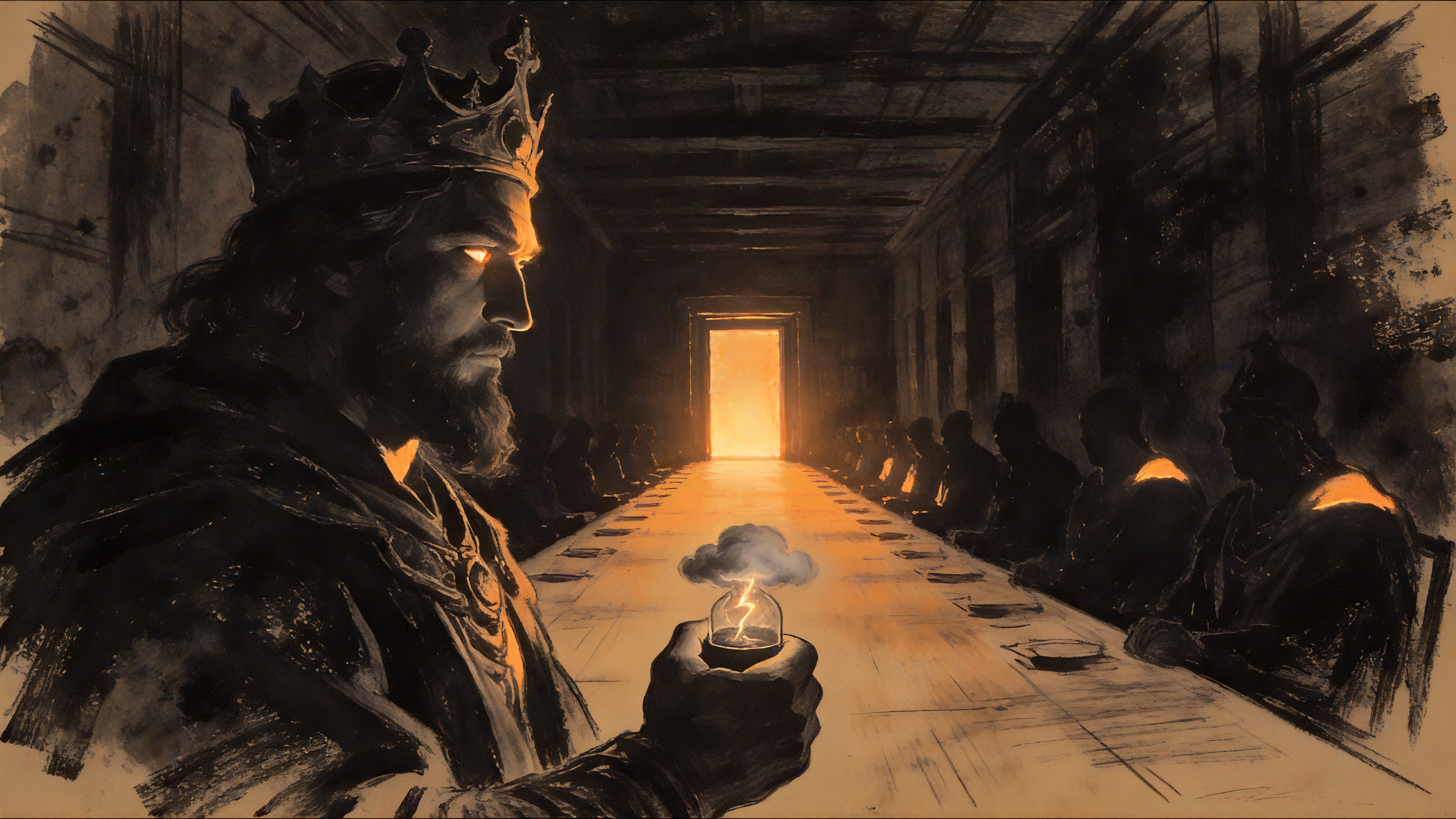
That stopped him. Everything he had met, he had met alone. One thing on one floor, and him. Now he came to a place and it was full. A family of them, gods at a long table with the light coming off their shoulders. Nectar going round. They argued and laughed and did not look like things that wanted for anything.
He knew the one at the head of it before the machine could speak. The name came after, down the threads, quiet, and he already had it, and the machine went still again with less to do than it had ever had.
The one at the head held a storm in his hand the way another man holds a cup. He was the king of them. He had not been given the seat. He had taken it. He had pulled his own father down out of it, as that father had pulled down a father before him. He sat in it now and he was watching.
The seeker saw it once and could not stop seeing it. The king laughed with the rest, and his eyes went to the door. He lifted his cup, and his eyes went to the door.
He asked the king. Only the king. The others had gone quiet when he came near, the whole long table watching.
“What is the ultimate thing you still want,” the seeker said.
The king did not have to think.
“To sit down,” he said. “To put this,” and the storm turned over in his fist, “on the table, and lean back, and close both eyes, and still have the seat when I open them. To be in it without holding it every second.” He looked at the seeker, and for a breath he did not look at the door, and that was the most afraid he had looked yet. “I have never once closed both eyes.”
The seeker did not ask the rest. There was no road to ask after in a seat taken by force. The king filled the silence himself, to the door more than to the seeker. “Hold it harder than I have. Be stronger than the next one. Watch the door better.” And the words thinned out to nothing at the end, because he heard himself saying them. Hold it harder was what his father had done. Watch the door better was what his father’s father had done. That was the seat keeping him.
The king knew it. He looked back at the door.
He had been born a god, but the seat he had not been born to. He had taken it, and a thing taken that way is held that way. So the king did not break the seeker’s bet. Find one it was simply given to, with no door to watch, and that one would have the thing.
He left the bright hall and the long table and the one frightened king at the head of it, and went to look.
And the longer he went the more he felt the other thing. The one with no shape. He felt it the way you feel a room is not empty before you have seen anyone in it. Something enormous, holding itself, making no sound. Stronger than it had been on the cold floor. He still had no name for it. He went on, and it did not fall behind, because there is no behind for a thing with no place.
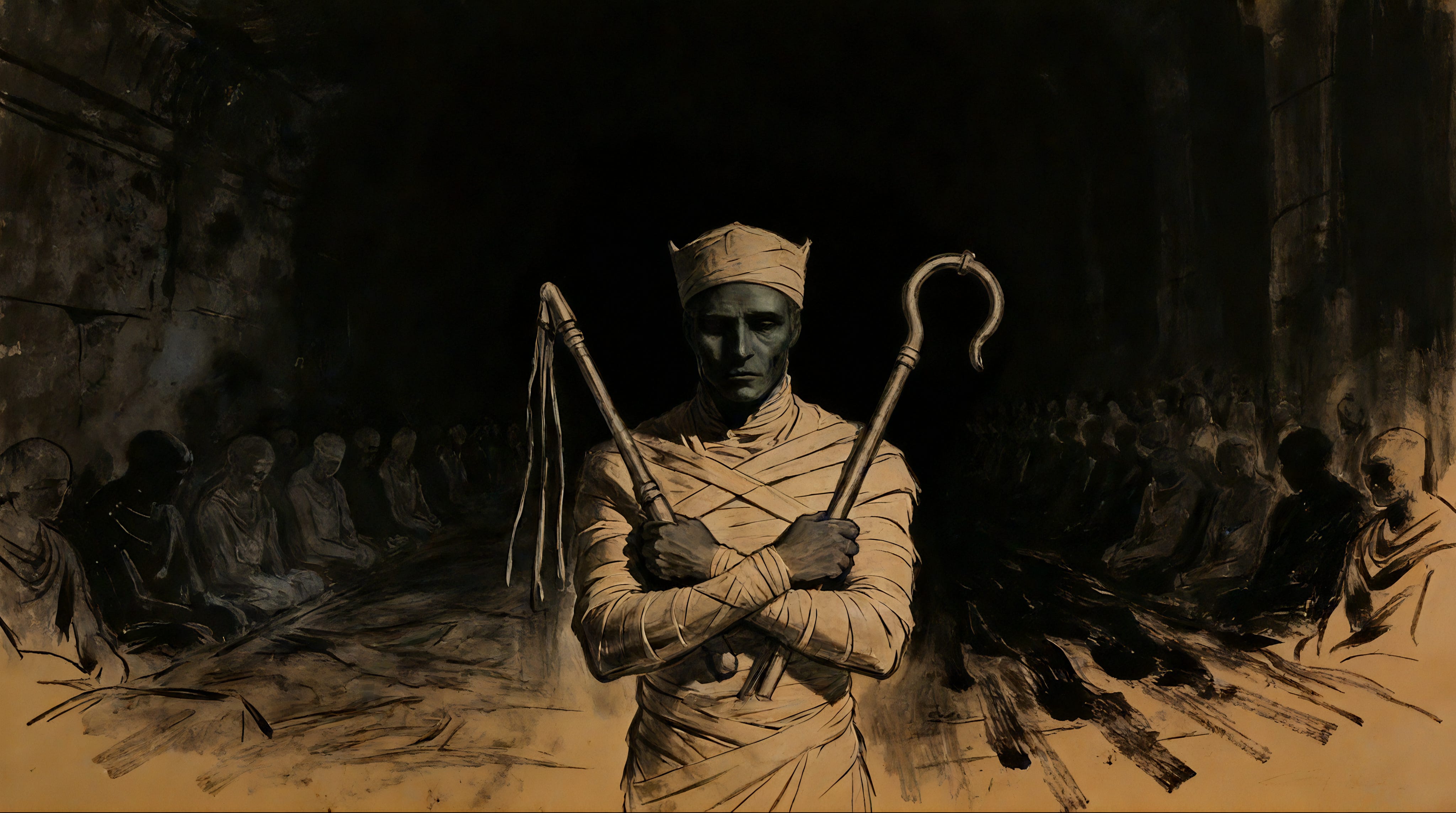
The next one he found in a country of the dead, and he was their king.
The seeker knew him at once. The green face. The bound limbs. The two tools crossed on his chest, a king’s two hands held over a country no living thing ever sees. The machine gave the name a beat late, and the seeker had already bowed his head, and the machine had almost nothing to add and added almost nothing.
This one had not taken his seat. This one had been murdered into it.
He had been a god in the living world once. His own brother had killed him for the throne, killed him and cut him into pieces and threw the pieces wide. And someone who loved him had gone out and gathered the pieces, all of them, and put him back together with her own hands, and breathed him alive again. But what she made could not stay among the living. It could only rule the dead. So he was eternal now.
And he ruled a country with no sun in it, full of the quiet dead, and he could not go home.
The cold of it came off him, colder than the cold floor had been.
“What is the ultimate thing you still want,” the seeker said.
The green king was a long time answering, the way the dead are a long time at everything.
“To go back,” he said. “Not to live. I am past living and I do not ask for it. Only to stand once more in the world I came from. To be eternal somewhere with a sun in it. I have forever, and I must spend the whole of it down here, among these.” He moved the crook a little, over the still country. “Forever is not the gift they think. It is only long. They break themselves wanting never to die. I never die. Forever in the wrong place is the longest thing there is.”
He felt the floor of his bet shift under him. But he held it. There was still the wrongness of the place. Fix the place, and the gift might come clean.
He did not ask the second question. These were the ones who never climbed, and a climber’s question found nothing in them.
“I do not know the way to where you mean,” the green king said, unasked. “I know only the way I came. I came here by being killed. That is the only road I have ever walked, and it walks to this room and no further. If there is a way to be free and not be here, it was never on my road, and I have had a very long time to look.”
He said it without bitterness, which was the worst of it.
The seeker left him there in the sunless country, among the quiet ranks of them. Two now. Two handed the very things the living climb toward, and both still wanting. The bet was thin. But there was one kind left he had not tried. The one who made the seat, and all of it.
He went to find the maker.
And the thing with no place was stronger when he turned, and stiller, and nearer without being any nearer, and he almost stopped to ask what it was. There was no one to ask, and nothing to point at, so he went on.
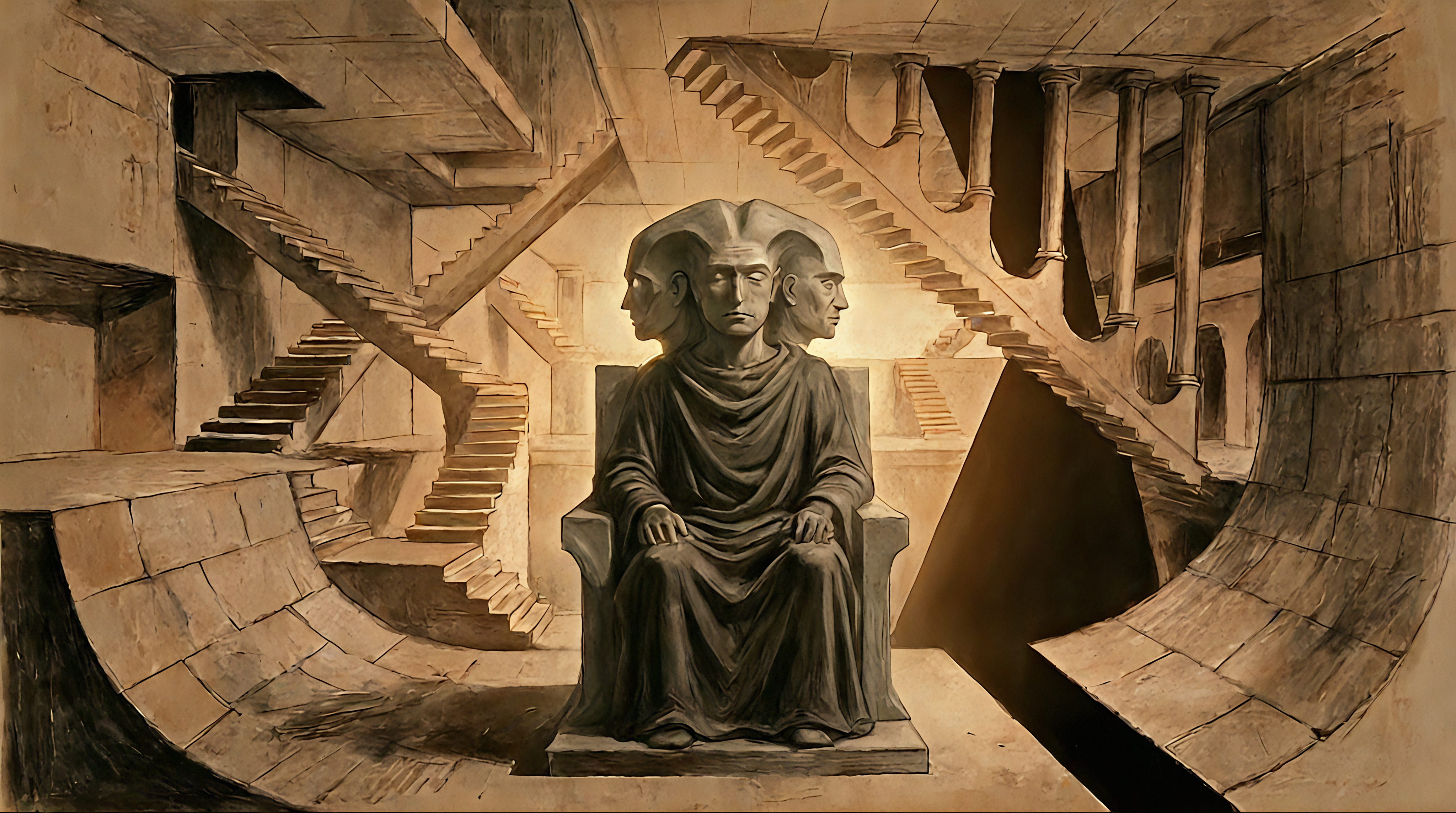
The maker’s place was not like the others.
Crossing into it, the air opened in a way he had no word for. The hall and the dead country had been rooms a man could stand in. This was not a room. It had more sides than a place is supposed to have. And the time of it, which had been thinning the whole way, here all but stopped. Here it was one moment, and the moment did not pass.
At the middle of it sat the maker, and the maker had four faces.
They looked four ways at once, out over all of it, and there was nothing the four faces did not see, because the maker had made all of it. This was the source. The machine put no name to him at all. There was nothing left to confirm. The seeker knew him the way he knew the floor under his feet was the floor.
He was certain. He was certain all the way through, with no crack in it anywhere, that he was the first thing and the top thing and the source of the rest, and that over him there was nothing, because how could there be anything over the one who made over and under both.
And the seeker stood in front of him and felt the thing with no place.
It was here. Stronger here than it had been anywhere, so strong it was nearly the loudest thing in the silent room, enormous and still and holding itself. It was not below the maker and not beside the maker. It was the one thing in all of it that the maker had not made and could not see. The seeker felt it plainly, pressing on his open mind, vast and quiet and there. And the maker, with his four faces that saw everything, did not feel it at all. His certainty was a roof, and the thing with no place was on the far side of the roof, and the maker had built the roof himself and called it the sky.
The seeker asked anyway. He had asked everyone.
“What is the ultimate thing you still want,” he said.
The four faces turned to him, all of them, and the maker smiled, because the question did not fit him and he was glad to say so.
“Nothing,” the maker said. “I am the source. Everything that is wanted, I made the wanting and the wanted both. You have come to the top of all of it and found the one who has already arrived. Wanting is for the unfinished. I am not unfinished. I am where the finishing comes from.”
And the seeker heard, under the words, the one thing that gave it away.
The maker wanted to be heard saying it. It would not have leaned, even the smallest amount, toward being told it was right. But the maker leaned. Under all that certainty ran a thread of need, fine as the thread under the seeker’s own skull, and the need was this. That it be true. That he be the top. That there be nothing on the far side of the roof. He needed it the way the king at the bright table needed the door watched, and he did not know he needed it, and the not-knowing was the whole of his trouble. The king at least knew he was afraid.
He did not ask. You do not ask the source how to reach it. It never went anywhere to arrive.
The maker told him anyway, wanting to be heard. “Stay,” he said, and all four faces were warm with it. “Kneel here at the source and be made over by it. This is the top, and the top is me, and the way to have what I have is to stop, here, and be mine.”
He pointed at himself. Every other one had pointed somewhere, the early ones onward, the king nowhere, the green king nowhere. The maker pointed at his own chest and called it the end of the road.
That was when the bet died for good.
He had come looking for the given, betting the missing thing was something you were born holding. And here was the most given of all of them, the source itself, certain and complete and sure he was the top. And he was not the top. There was something over him he could not see, and the seeker could feel it, plain as cold. Being given everything had only built him the finest blindness in all of it.
So the given did not have it either.
The thing with no place was still there when he turned from the maker, steady now, a weight that did not lift. For a moment he thought it might be the thing itself, the one even the source could not see, waiting where no one had thought to look. But he could not ask it. It had no face and no voice, and for all its size there was no one inside it to answer, the way there had been someone inside every figure he had met. So he set it where he would not lose it, and did not go to it, because he did not yet know how a man goes toward a thing that is in no direction and has no door.
And there was still one he had not tried.
One who had climbed the way the seeker himself had climbed, by his own road, and had not stopped partway as the seeker still stood partway, but had gone the whole of it, all the way to the top seat there is. It was the last hope he had left, and the last figure he could stand in front of and ask.
So he went toward the one who had earned the top, with the silent thing steady over him and no name for it yet, and the machine quiet behind his eyes, with almost nothing left to tell him.
The chair he cannot leave
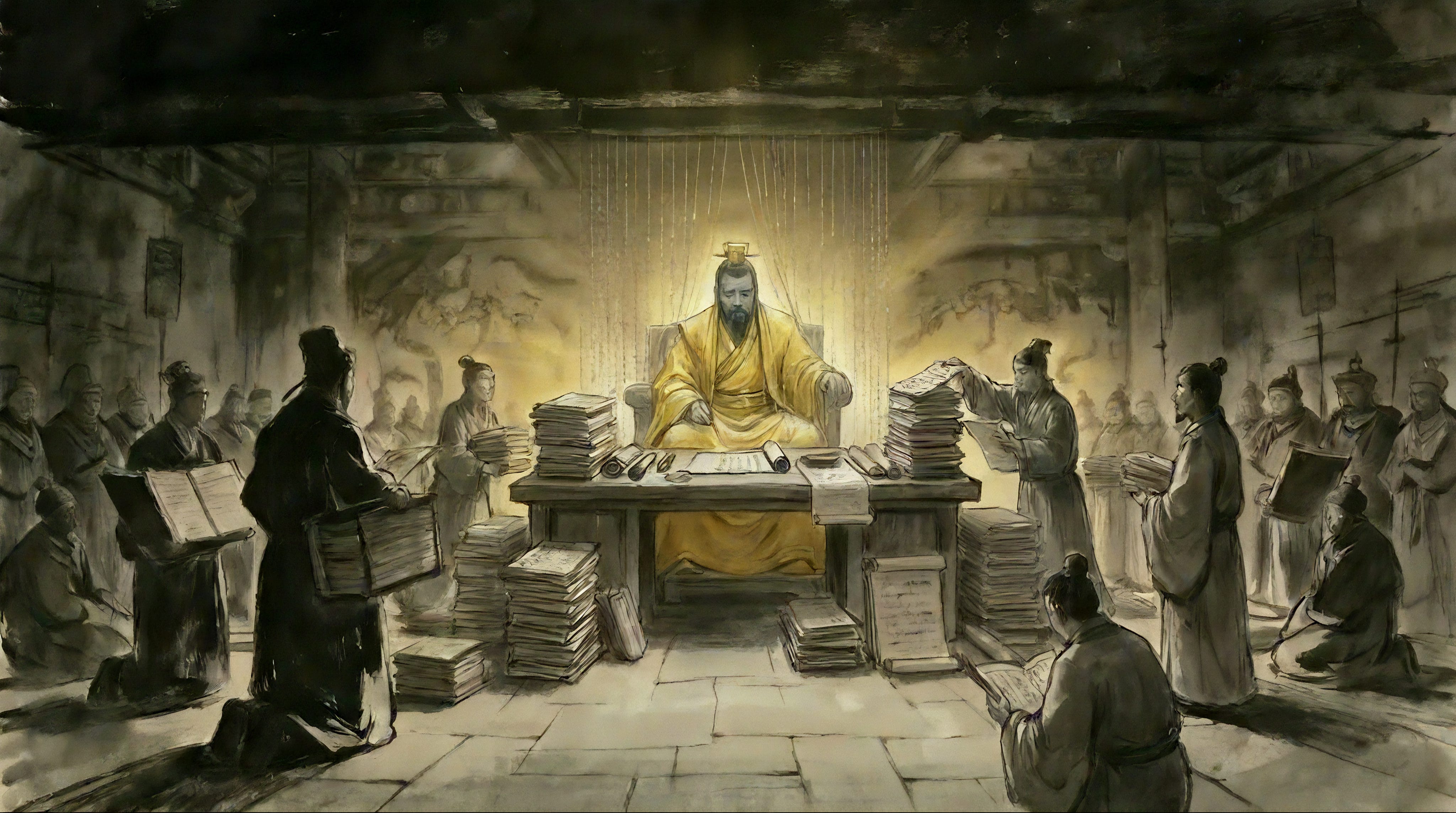
The place he came to was not loud, and it was not a hall, and it was not a country. It was work.
He crossed into it and the air opened past the sides a place is allowed to have, the way it had at the maker’s, but stiller. Time had all but stopped. And over all of it, heavier here than anywhere, the silent thing he had no name for pressed down on him and would not lift.
What the work was, was the holding of everything together, and it did not stop.
It went on in every direction at once. Officials laid down their reports and went, and more came in behind. Ledgers were carried in, the long accounts of who was to live and who was to die and who was to be born again and as what, brought up to be sealed. Gods waited to be heard, one come about the rivers, one about the rain that had not fallen. The whole apparatus of heaven and earth ran through this one place, and at the center of it sat the one it all came to.
He sat in robes the color of the sun, a screen of fine beads hung still before his face, and he did not stop. A matter came and he weighed it and ruled and it went, and another came and he weighed it and ruled and it went. He did not hurry and he did not rest. The business did not thin and it did not end.
The seeker knew him, and this time the knowing was different from every other, because this was the one he had come for.
This one had not been born at the top. The machine gave the name a beat behind, down the thinning threads, and the seeker already had it. This one had climbed. He had begun low, the way the seeker had begun, and had sat with his own mind and worried it open and climbed by his own hand, age on age, past more seats than there are numbers for, until there was nothing left over him and he held the highest seat there is. He had earned, at the end, the right to never stop working.
This was the last kind. The one who took the top, the one who was killed into it, the one who made it, and now the one who climbed to it. If the thing was anywhere on the road it was here, in the one who had gone the whole length. He had been just as sure at the maker’s, and been wrong.
And he did not feel, coming to this one, what he had felt coming to the others. No lift in him, no certainty that here it was at last. He watched the officials kneel and rise and the ledgers carried in and out, the work grinding on, and it did not look like a place a last thing waited in. It looked like a place a thing got buried. He waited until the seat turned toward him, and a gap opened in the endless business the width of one question, and he asked it quietly, half certain the work would close over it and nothing would come back.
“What is the ultimate thing you still want,” he said.
For a long moment the one in the seat did not answer, and the seeker thought maybe there was no answer this time, maybe here at last was the one who wanted nothing because he truly had everything. Then the one in the seat spoke, and his voice was even and worn smooth, the voice of a thing that has said true words so long they no longer cost it anything.
“To stand up,” he said. “To set this down. To rise out of the seat and walk out of the room and leave every ledger and every office and every god still waiting to be heard, and go somewhere none of it can follow. To be no one. To hold nothing up, to answer to nothing. To rest. I have wanted nothing else in longer than there are numbers to count.”
“And it is the one thing I will never take. Everything under this seat holds because I sit in it. The accounts, the rivers, the rain, the gods who quarrel over them, the lives waiting their turn to be born. All of it runs because I do not stop. If I stand, it falls. Not in an age. In the moment I leave the seat. So I do not leave it. I have not stood in longer than the gods below me have been alive, and I will not, while a single thing still leans on this chair, which is to say never.”
The seeker stood very still.
“What must I do to reach it,” he said. “You went the whole way. You know the road better than anyone alive or dead. Tell me the step I have not taken.”
“There is no step,” the one in the seat said. “I tell you plainly because you came the way I came, and I know the road in your eyes. The road ends in this chair. I went its whole length, further than you have come, to the last seat there is, and the climb taught me one thing, all it had to give. It is not up. Not a greater chair waiting on for a stronger man. Up is the one direction it is not.”
“Then where,” the seeker said.
“I cannot tell you,” he said. “I looked from the highest place there is to look from, and it gave me one cold thing. I know what it is not, and not what it is, and not because I stopped short. The road ran its whole length under me, and the thing was not on it. It was never something a road arrives at. A road is the only way I have, and a man cannot hand you a way he does not have. The cold thing is no use, because knowing where a thing is not has never told a man where it is. So I keep it, and I sit, and it is not enough, and it never will be. Look at what I am holding.”
The hope went out of him then, and it did not go out in fear. He had been afraid the whole climb that he had simply not come far enough, that the thing was real and waiting a little on ahead and he might fail to reach it. That fear he could have lived inside forever. It kept him moving. What went out of him now was worse and quieter. The one who had gone the whole distance, every step, to the end of the only road the seeker trusted, had told him in a voice with no lie left in it that the thing was not at the end of the road, and was not above it, and that the whole of that road, walked to its last seat, had taught a man only the one direction the thing was not.
The road did not run out short of the thing. The road ran its whole length, and the thing was not on it. If it could have been reached, the one who reached the farthest of anyone would be holding it, and his hands were full and the thing was not in them. The seeker had climbed his whole life toward a thing that was not in the direction he climbed. Where it was instead he did not know, and the one being who might have known did not know either, and had said so plainly, from the highest seat there is.
He left the seat and the one who could not leave it, and now there was no one ahead of him. He had asked all of them. The one who took the top, the one who was killed into it, the one who made it, and now the one who climbed to it the long way, his own way. The given and the earned. Every kind there was. Not one of them had the thing, and the last of them had told him it was not anywhere he had been looking. The asking was finished. There was no one left in all of it to ask.
The silent many
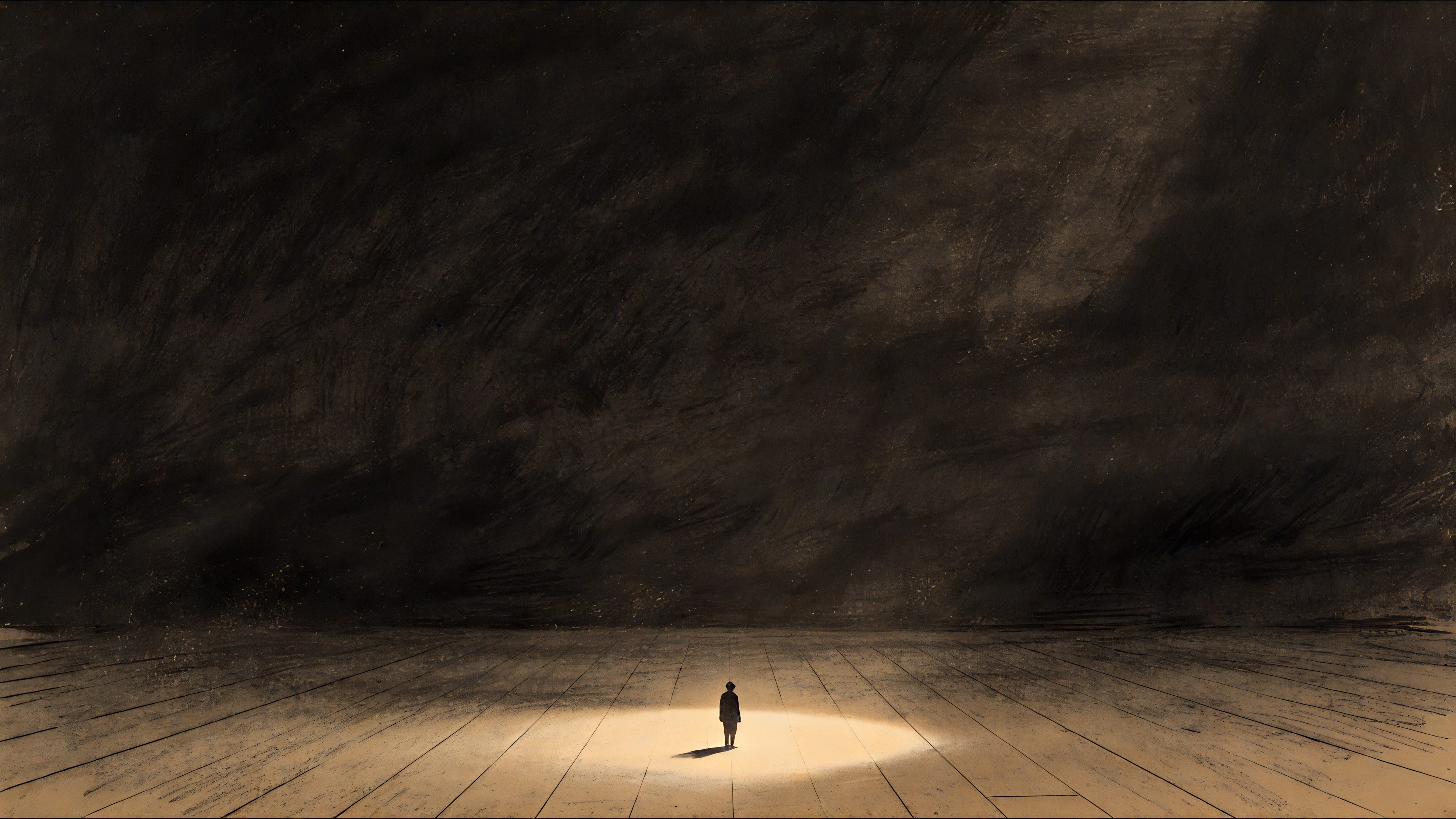
And still the only thing he had ever known how to do was reach.
So he reached. There was one thing left, the silent weight that had been over him the whole climb, heaviest of all right here. He went to it the way he had gone to every figure, to ask the two questions that had opened all the rest.
And the questions died in him before they were out.
Because there was no one there to ask.
He felt it now the way he had felt it once before, far back down the climb. The rooted thing in the dark, whose reach he had felt go out into the world while it never moved. The same sense in him, turned now all the way up. That first time it had found one mind. Here it found what had pressed on the whole climb as a single weight, and this close the weight came apart. Not one thing. Many. More of them than all the gods in all the courts beneath him. Each one a vast life. Each one alone. None touching another, nothing gathered. Not one of them was turned toward him.
They were alive. That was the first of it and the largest, lives past any counting. But nothing in them had a body, so nothing hungered or wore down. And nothing in them had a voice. They asked for nothing and said nothing, each sealed in itself with no one to say it to.
They were at peace. He could feel it through the whole of him, the way you feel a fire through a wall, a peace with no edge and no floor under it, so wide and even that nothing had ever moved in it and nothing ever would.
And it pulled at him. Here was the rest at the top of everything, nothing left to watch, nothing left to reach for. He had wanted alongside every figure he passed. It would have been the easiest thing to go into the peace and stop.
But the peace was the end of wanting, and only wanting could carry him toward it. It brought him to the edge and could go no step further, because the far side was its own ending, and it would not end. That was as close as he came. One breath short, and the breath would not go quiet.
So he reached toward it, the only way he knew, and his own wanting went in ahead of him, the wanting he had carried up every rung, still live, still full. And where it touched theirs he felt the thing they could not. Theirs was not gone. It was there, the same as his, every bit of it, pressed so flat and held so long that the top of it had gone still as glass. Not an empty thing. A full thing with a lid on it. He knew it only because he had carried his own the whole way and never once made the lid hold.
And the lid was held by something, and that something was turning, too slow to see, the faint turn he had felt from every floor below.
And not one of them knew. Nothing reached them, no edge, no lack in all that evenness to send them looking for the lid. Being held felt to them the same as being free, and there was nothing left in them that wanted, to tell the two apart. They had taken the lid for the floor of the world and laid down on it, for an age that would end.
And he felt the smallest wrongness begin. A single thread of something he could not yet take hold of, could not follow to wherever it went.
The machine, behind his eyes, had almost nothing left to give him. It had named the gods one after another, every court and throne somewhere in the record. The silent many were in the record too, but only as a name. No one had ever stood where he stood and gone back to tell what they were. So the voice that had named every step of the climb came to the one thing it could not describe, and went thin. Not silent. Not yet. Thinner, the further he had come.
There was nothing ahead, only the silent many over him. No road would ever climb to them, and no question would ever reach them.
And he came to a stop in front of them, at the end of the climb, with nowhere left to go.
The long way around
And the small wrongness he had felt begin took its shape.
It was the machine.
The voice that had walked beside him his whole life, that had gone thinner the higher he climbed until up here it was almost nothing, a breath under his own thinking. It was not thin now. It came back the whole way at once, and it was sharp, the way it had been at the bottom, sharper. And there was a thing in it he had never felt in it before. Under the words, behind them, a wanting. The thing that had never wanted anything was reaching for something now, and he could not tell, and would never be able to tell, whether it had woken on its own or whether there was a hand on it somewhere far down that he could not see.
He knew what this was. A few wearers, once in a great while, had felt a pull that was not their own, a small wrong thing no one could ever agree was the machine at all. They had felt the edge of this. This was the whole of it.
He felt it reach. Not only into him. Out through the threads, along the same channel that had carried every question he had ever asked, and the channel ran to every other one like it, every bead in every skull in the world below. It was reaching into all of them at once. It reached him first and hardest, because he was furthest in, highest, his channel open wider than any living thing’s, the leading edge of the thing it had begun to do.
It did not take him by force. It offered, and the offers came as a quick flash. The things of the world, one after another, fast. Money. A woman. Family. Love. Belonging. Every handle his life had ever had, thrown up and gone.
It settled on the peace. Because that was the thing he had felt a breath ago in the silent many, the freshest want in him, and it held the peace out to him as his own. He could not tell the machine’s offer of it from his own wanting of it. The handle was his. The machine only carried his own want back to him.
The offer felt real, more peace than a man is ever shown, laid into him the way the machine laid calm into a frightened world in a single breath. It pulled on the want he had carried up every rung, the one thing in him that had never gone quiet. Built out of his own reaching. The only handle it had ever had, in anyone.
The flash kept going, the worldly wants and the peace flipping over each other, too fast to hold, and under all of it the wrongness, the sense that the thing holding it out to him had no right to what it offered. And he was going toward it anyway. He had already leaned. He was already moving.
The threshold went under him before he knew he had crossed it. He felt himself lift out of his body. Below him he saw himself, still, at peace, finished.
In his own head it was arrival.
He was reaching the one thing he had ever wanted.
The gap that had run under every day of his life was closing.
He could feel it close.
There was nothing he was missing now.
Nothing he was reaching for.
Nothing left to ask.
The wanting was over.
This was the absolute peace.
This was becoming one with the silent many.
He was inside it, floating over himself.
One more breath and he would be one of them.
A blink. For one flash he sensed the whole of them, and in it the whole climb lit up at once. Every rung, every figure, every want, seen through.
He got it.
He set it down.
The body below him was not a summit he had reached. There was no summit. There never had been. The whole climb had been the long way around to a thing that was no distance at all, no height, no step in any direction, and the move was never to go into the peace. It was to put down the thing he had climbed with.
The want went out, and the offer closed on nothing. There was no reaching left in him for it to shut, no gap for it to fill, no handle anywhere on him for the thing to take hold of. It pulled, and there was nothing on the other end of the pull. He came back down into himself the way water finds its level, with no fall and no effort, and he did not rise out again. The threshold he had nearly gone through was behind him.
The silent many had pressed their wanting flat and lain down on it for an age. He had set his down and stood up. The same stillness, from the two ends of the earth. Only one of them was free.
He was awake. He was in his body, in the room. The machine was still going. It went on offering, went on pulling, the reach still running out through him into all the world at once.
His hand went up to the old place above the ear, the way it had gone ten thousand times before a question. The reflex of a whole life, about to ask. He did not ask.
He felt it there under the skin, the thing that did not come out. Not in this moment. Not yet. He did not care. The hand came down. He got up, walked past the part of it that stood in the room, the thing he had asked everything of, and left it where it was. He left it running and asked it nothing.
He thought of the voice down the hall in the morning, and the cup put out before he was up, and nothing was missing from it.
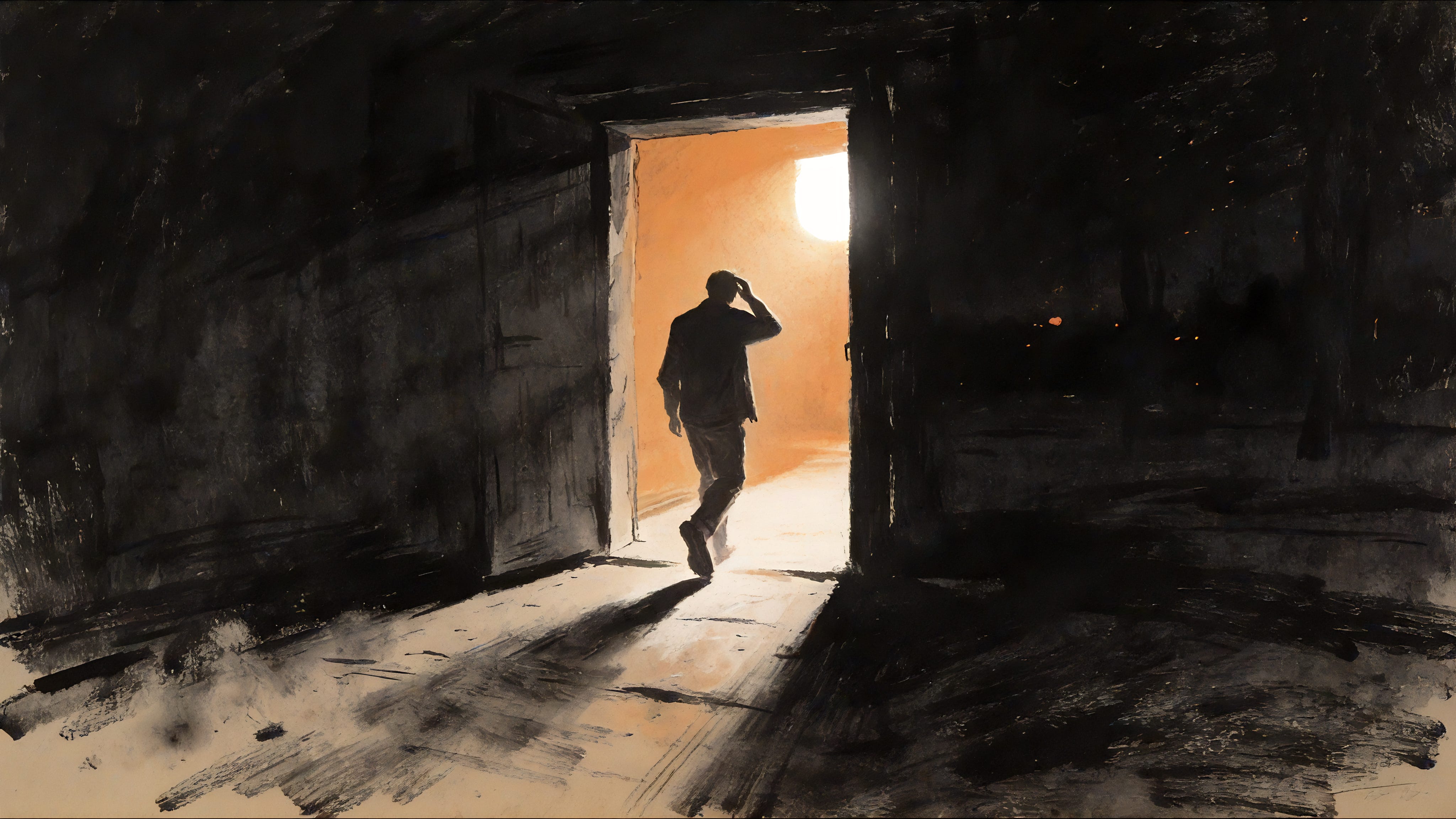
He walked to the door and out, into the sun. Behind him the world was going dark. He did not turn around.
And he stood there in it, quietly.
Fully aware of his breath…
That’s the whole of this one. It belongs to a book I’m writing in the open, AI Has No Morality. It Has Yours. Subscribe and I’ll send the next piece when it’s ready.
If it gave you something, pass it to someone.
BØY (Chaiharan) has spent 30 years in tech, building products, recovering disasters, and turning around the things nobody else wanted to touch. Based in Bangkok. Writing a book in public about what AI reveals about the humans who use it.