
This is part of a book I’m writing in public.
Subscribe to read the rest as it comes
AI will eventually build everything for us. I am not saying this to be dramatic. I am saying this because I have spent the past few years building products with AI every day, hands-on with my team, and I can see where this is going. The speed is not incremental. It is a different kind of speed, the kind that makes you rethink what your job actually is.
I used to spend months with my team designing systems, arguing over architecture, refining interfaces pixel by pixel. Now AI does large parts of that in hours. Not perfectly, but well enough that the remaining work is refinement, not creation. And the gap between “well enough” and “perfect” is closing faster than most of us want to admit.
So yes. AI will build the things. And the way we think about building will change too.
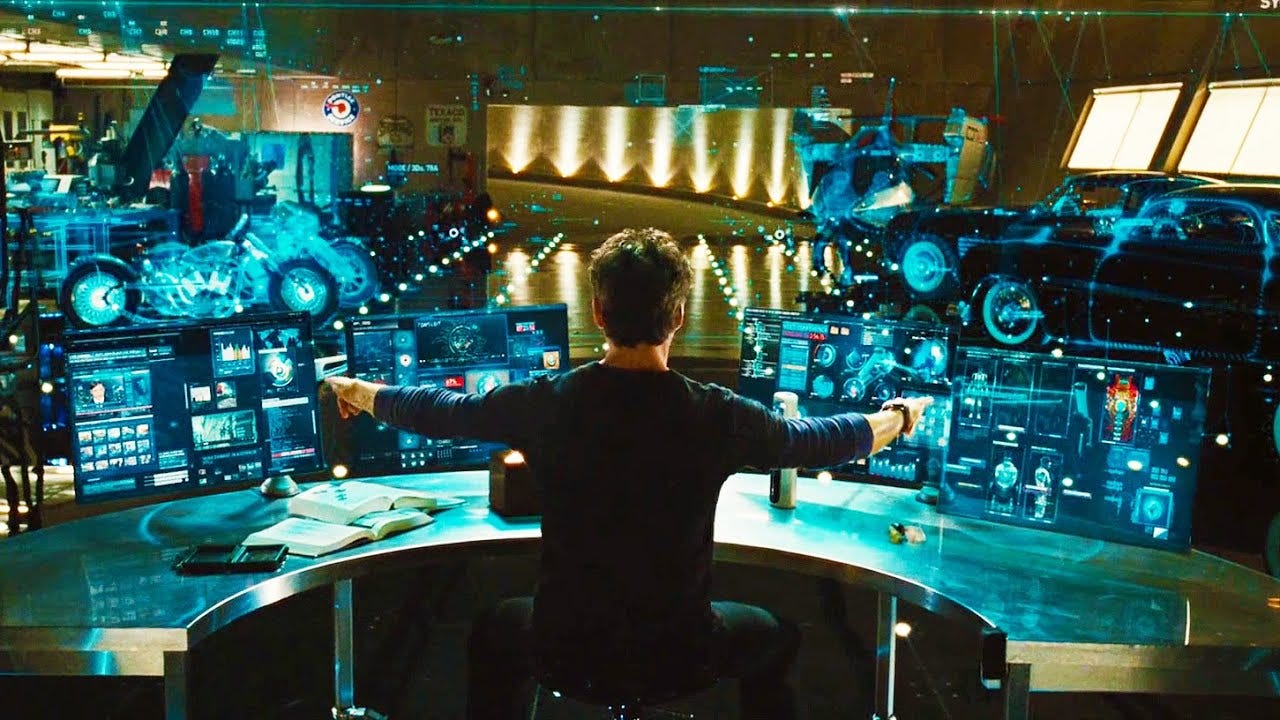
I always think of Ironman and Jarvis. Tony Stark does not click through screens. He does not fill in forms or navigate menus. He just talks, says what he needs, and Jarvis figures out the rest. Builds it, runs it, and then shows Tony the result in whatever way makes sense at that moment. The interface is not designed beforehand. It appears after the work is done.
That is where we are heading. Not just AI writing code for us, but AI removing the entire layer between what you want and what you get. No more designing screens for humans to click through step by step. No more translating your idea into specifications, then into code, then into something a user can touch. The whole middle part dissolves.
Elon Musk said something recently that points in the same direction. He called code a “programming tax,” an overhead we have been paying for decades, and predicted AI will skip it entirely, going straight from human intent to machine execution. I think he is right. And I think it goes even further than code. The programming tax disappears. The UI tax disappears. What is left is just: what do you want, and how do you want to see it.
This is exciting. I genuinely believe this. But it also means something uncomfortable. When the technology layer dissolves, what is left of your working life is the human layer. And the human layer, if we are being honest, has always been the hardest part. AI just took away our excuse to avoid looking at it.
Let me tell you what I mean by the human layer.
I mean the conversation about you that happened before you entered the room, where conclusions were already formed and nobody tells you what was said. I mean the meeting where doing the work and being seen doing the work turned out to be not the same thing, and you spent years not knowing that. I mean the moment you realized that how your work is narrated matters more than how your work is done.
Every workplace has its own version of this. The promotion that went to the person who presented well, not the person who built well. The feedback that measured things you were never told were being measured. The politics you didn’t play, not because you couldn’t, but because you thought the work would speak for itself.

AI cannot help you with any of this. No algorithm will decode why the room decided what it decided before you walked in. No model will teach you the unwritten rules that everyone else seems to already know. No agent will sit in that difficult conversation and say the thing you needed to say but didn’t.
That is the dark side of the humans around you. And it does not go away when AI gets smarter. As technical skill becomes commoditized, the things that differentiate people become softer, more about narrative and perception. The game doesn’t end. It just changes shape.
But there is another dark side. And this one is harder to write about because it is inside.
I know my own patterns. I absorb things I should push back on. I stay quiet when speaking would protect me. I work harder instead of presenting better, both are crafts, and when you spend all your time on one, there is not much left for the other. I tell myself that if I just build well enough, people will notice, and sometimes they do, just not always in the way or at the time that matters.
As a leader I know I should delegate more. But delegation needs the right people, and getting the right people needs approvals, budget, and conversations that move much slower than deadlines. So when the gap is there, you fill it yourself. Not because you don’t know how to lead. Because you chose to deliver.
These patterns are mine. They did not come from AI and they will not be fixed by AI. They were here long before I wrote my first line of code, and they will be here long after AI writes all the code for me.
AI actually made these patterns more visible. When the excuse of “I am busy building” disappears, you have to face the question: why do I keep doing it my way when I already know what is expected? And the answer is not always the system. Sometimes the answer is in how you move through the system. How you let people treat you. What you accept as normal. What you tell yourself is fine when it is not.

But I think this is the real conversation we need to have about AI and work. Not “will AI take my job,” maybe it will, maybe it won’t. The more immediate question is: when AI takes over the parts of your job that felt safe and clear and technical, are you ready for what is left?
What is left is people. Their ambitions, their insecurities, their politics, their blind spots. And yours.
I have spent more time making things work than planning how to present them. AI is teaching me the second one is not optional anymore.
AI taught me many things about being human at work. But the most important one is this: the job was never really about the technology. It never was.
The technology was just the thing we hid behind so we didn’t have to deal with the rest.
I am writing this book one chapter at a time.
If you want to read it as it happens, subscribe below
If this made you think, share it with someone who needs to read it.
BØY (Chaiharan) has spent 30 years in tech, building products, recovering disasters, and turning around the things nobody else wanted to touch. Based in Bangkok. Writing a book in public about what AI reveals about the humans who use it.