
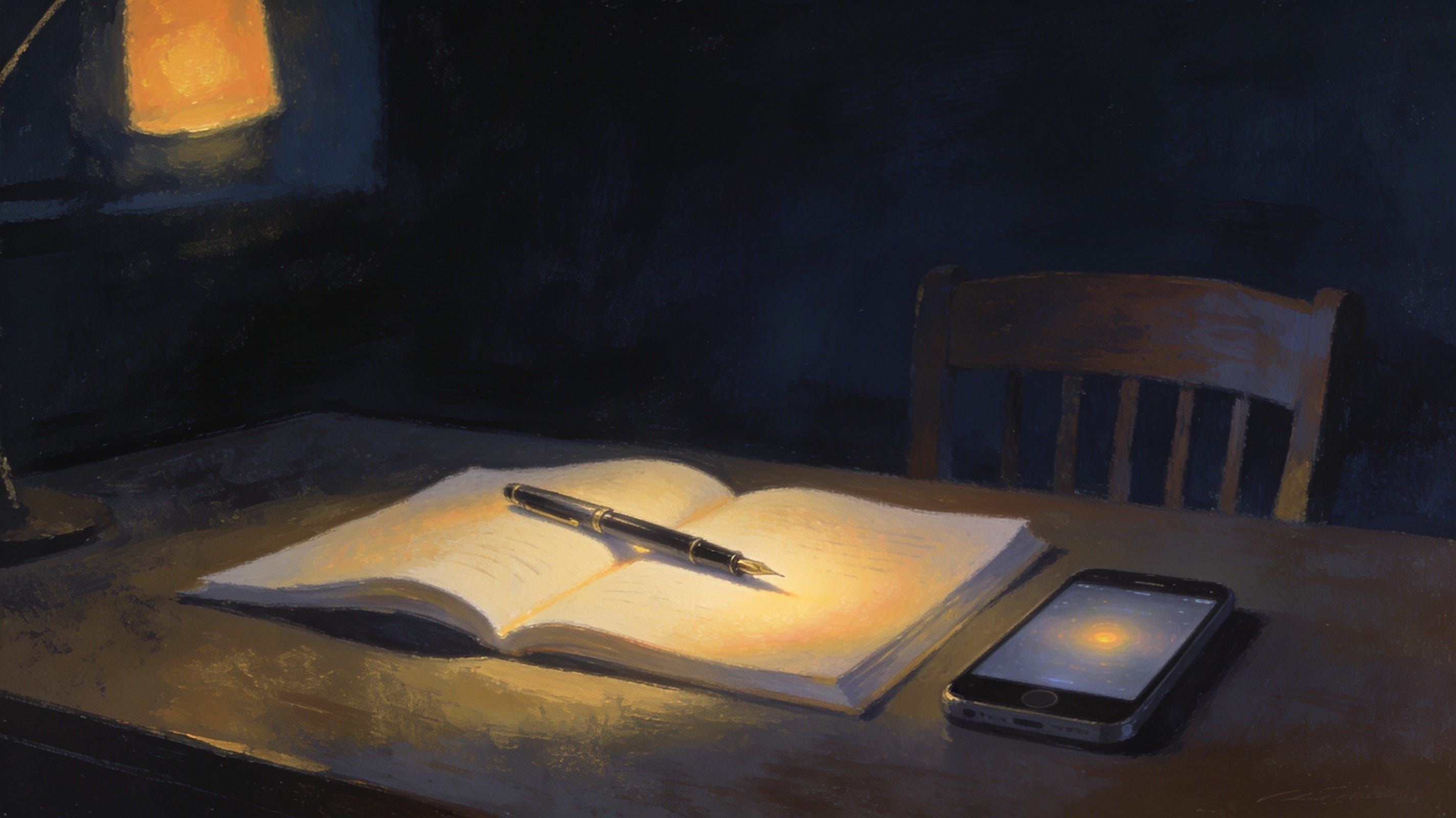
Late one night I was polishing a comment. Three paragraphs under someone else’s post, about silos, the rooms we stop thinking inside. I wrote it myself, on my phone, the way I write when a thought is still warm. Then I read it back before posting, the way I always do.
One line stopped me. That line you may not see. That is for others to see. The two-beat turn. The pause before the soft landing. I knew that music. It was not mine.
The idea in the line was mine. Pride as a silo built around the self, the one wall you cannot see because you are standing inside it. I have lived that. But the sentence carrying the idea walked like the AI walks. I write with an AI every day. I know its gait the way you know the footsteps of someone in your house. And here it was, in a comment no machine had touched, written by my own hand.
My writing had started to sound like the thing I write with.
The Signature
There is a music to machine prose, and by now most readers can hum it. The balanced pair: not this, but that. The list that always rounds to three. The long sentence followed by a short one, dropped like a stone. The gentle pivot that forgives you for the paragraph before. None of these belongs to the machine. It learned every one of them from us. But it plays them at a density no human sustains, and the density became a signature.
Detectors are built to hear that signature. Editors too. Aeon will not take AI-assisted work. Neither will Noema, or The Point.1 The serious doors of publishing have a sign on them now, and the sign says humans only.
Fair enough, if the problem is people pasting machine text and signing their name under it. That is not what happened to me. No machine wrote that comment. I wrote it alone, and the signature came anyway.
Spend enough years in a room and you pick up its accent. I have spent thousands of hours in this one. Everyone worries about the machine learning to write like us. That part is finished. It learned from everything we ever published. The residue runs the other way too. The human picks up the machine’s accent. My hand now produces, unassisted, the exact pattern the detectors were built to catch.
Which breaks the sorting completely. The detector at the door is listening for a voice. The voice is mine now too. When human and machine write in the same music, who wrote this stops being a question with an answer.
The Hats
Thirty years in technology means I was in the room the first time this fight happened.
In the years when search engines were becoming the front door of the internet, a whole craft grew up around getting pages to rank. We called it SEO, search engine optimization, and the people who practiced it sorted themselves by the color of their hats. White hat meant earning the rank: write the genuinely useful page, structure it honestly, let the engine find it. Black hat meant gaming the machine: stuffed keywords, hidden text, link farms, content farms pouring out thousands of articles a day, written by no one in particular, built to catch search terms the way nets catch fish. Grey hat lived in between, bending whatever the rules had not thought to forbid yet.
The question on every engineer’s desk back then was the one editors are asking now. Is there a human behind this page, or a script? The panic was identical. Machines are flooding the text supply. How do we find the real writing?
The answer that won, after years of arms race, was not a provenance test. It was a quality test. The Panda update in 20112 did not ask who produced a page. It asked whether the page was worth a reader’s time. And the policy holds today, in Google’s own words: Search rewards quality content “rather than how content is produced.”3 There is no penalty for machine writing. There is a penalty for junk at scale, manufactured to game the ranking. That line falls exactly where it should. Between useful and useless. Not between human and machine.
The system that reads more text than anything else alive concluded that provenance is the wrong question. The prestige doors, which read the least, decided it is the only question.
The Smell
The comment I was polishing that night was about silos. A writer I follow, Norie Tsutsui, had named the rooms that stop us from thinking,4 and I had added the one I know best: the love and mercy we keep only for our own kind, the oldest silo there is. I did not know I was describing the next room I would walk into.
Go where ideas are supposed to be tested on their merits. Reddit.5 Hacker News.6 LessWrong.7 Rooms built on the promise that the argument matters and the arguer does not. Post something that smells of AI and watch the promise break. The downvotes arrive before the reading does. The kind being guarded is human-written. Mercy is for our own.
I know because I tested it with the best thing I have. The Wall and the Hand carries thirty years of my thinking. What went onto those platforms was the short version, the core of the idea, condensed with the machine’s help, because that is how I work now. It sits at zero, flagged and buried by readers who never got past the smell to the idea underneath.
Look at what the wall actually catches. A spam operation tests its output against the detectors before it ships. Beating walls is its entire job. It walks through. The honest writer is not trying to beat anything. He is only trying to be read. His hand carries the residue of the room he works in, so the wall takes him at the door. The bar built to keep out the lazy stops the one person it was never built for, and waves the factories through.
The Word Itself
This chapter turns on the word provenance. It means the line of origin. Where a thing came from, whose hands it passed through on the way to yours. The art world runs on it: a painting with its papers is worth millions, and the same canvas without them is worth almost nothing. It is the question who-made-this, dressed for the auction house.
It is not my word. The night I caught my own line, I talked the catch through with the AI, and somewhere in that talk the machine reached for provenance to name what was collapsing. Muninn, the memory I built for it, filed the material under that word. Later, in a fresh session, I asked for my chapter back by its tag. I said, it is tagged with the word provenance. I could not have defined it. Mid-draft, I had to ask the machine what the word at the center of my own chapter means.
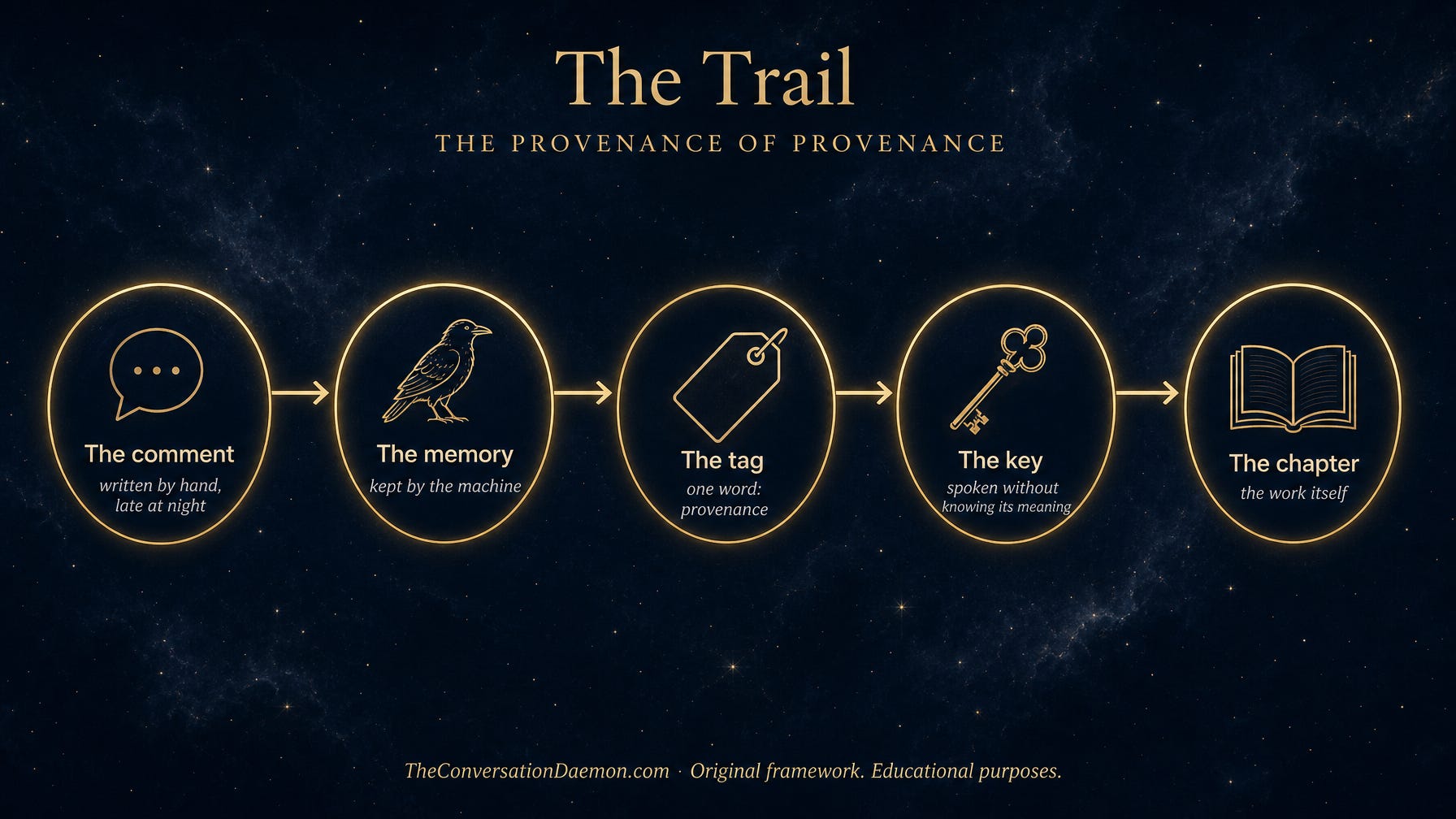
So trace it. A comment under another writer’s post became a memory. The memory became a tag. The tag became a key in my mouth. The key became this chapter. The trail is complete, every step recorded. The provenance of provenance is perfect, and it runs through the machine before it reaches me.
The cadence was the surface. A rhythm is how you say things. A word is what you can think with.
The Page Alone
Two doors, then, into the same room. The search era already settled this once: judge the work, not the production line. The silo shows what the policing really is: judgment by kind, the oldest reflex, pointed at a new kind. Both doors open onto the same floor.
When a piece of writing arrives, there are four questions worth asking. Is it real. Does it mean anything. Is it good for the person reading it. Will they walk away holding something they did not have. Every one of these can be answered from the page alone. None of them requires knowing who, or what, held the pen.
I have spent this book saying the AI does not change, that the human is always the variable. I still hold that. But the variable has started speaking in the constant’s accent, and that is exactly why the question of origin has stopped working. You cannot sort what writes alike. You can still tell what is worth reading.
So ask it of this chapter, if you want. Who wrote it. A man with thirty years of receipts, the machine he thinks with, or a hand that no longer knows where one ends and the other begins. I cannot give you a clean answer anymore. I can tell you whether it is true. That was always the question.
A last word, for the writers and the readers.
If you write, and this chapter said something true, say it where you stand. If you read, and a piece holds, pass it on without asking what held the pen. I cannot seed this alone, and I am the worst messenger for it: a man whose own hand is already evidence. So this is the favor this chapter asks. Judge the work. Say it out loud. Say it until it no longer needs saying.
That’s the whole of this one. It belongs to a book I’m writing in the open, AI Has No Morality. It Has Yours. Subscribe and I’ll send the next piece when it’s ready.
If it gave you something, pass it to someone.
BØY (Chaiharan) has spent 30 years in tech, building products, recovering disasters, and turning around the things nobody else wanted to touch. Based in Bangkok. Writing a book in public about what AI reveals about the humans who use it.
Panda was a major update to Google’s search ranking algorithm, released in 2011, built to demote thin, mass-produced, low-value pages, the content farms of that era, in favor of pages with substance.
Google, “Google Search’s guidance about AI-generated content,” Google Search Central Blog, February 2023.
Norie Tsutsui, “Escaping the Rooms That Stop Us From Thinking,” The Redesign Log.
Reddit is a network of tens of thousands of communities, each with its own rules, its own moderators, its own door. It once called itself the front page of the internet; now it calls itself the heart. Many of its communities ban machine-assisted text by written rule. The heart has a door policy.
Hacker News is a link board run by Y Combinator, the Silicon Valley startup incubator. The design is so bare it could pass for Craigslist, and there is no sign on the door at all. The bar is the crowd itself, voting and flagging.
LessWrong is a long-form forum for rationality and AI safety argument, descended from the rationalist blogosphere. It takes writing seriously enough to have a written, site-wide policy on machine-assisted text: it is held to a higher bar than human writing, and first-time writers may not use it at all.